
“The physics of news, rumors, and opinions”
The boundaries between physical and social networks have narrowed with the advent of the Internet and its pervasive platforms. This has given rise to a complex adaptive information ecosystem where individuals and machines compete for attention, leading to emergent collective phenomena. The flow of information in this ecosystem is often non-trivial and involves complex user strategies—from the forging or strategic amplification of manipulative content to large-scale coordinated behavior—that trigger misinformation cascades, echo-chamber reinforcement, and opinion polarization. We argue that statistical physics provides a suitable and necessary framework for analyzing the unfolding of these complex dynamics on socio-technological systems. This review systematically covers the foundational and applied aspects of this framework. The review is structured to first establish the theoretical foundation for analyzing these complex systems, examining both structural models of complex networks and physical models of social dynamics (e.g., epidemic and spin models). We then ground these concepts by describing the modern media ecosystem where these dynamics currently unfold, including a comparative analysis of platforms and the challenge of information disorders. The central sections proceed to apply this framework to two central phenomena: first, by analyzing the collective dynamics of information spreading, with a dedicated focus on the models, the main empirical insights, and the unique traits characterizing misinformation; and second, by reviewing current models of opinion dynamics, spanning discrete, continuous, and coevolutionary approaches. In summary, we review both empirical findings based on massive data analytics and theoretical advances, highlighting the valuable insights obtained from physics-based efforts to investigate these phenomena of high societal impact
The study of social systems has long been approached by the definition of frameworks from economics, psychology, and sociology, which often focus on individual decision-making or qualitative interactions. However, many large-scale social phenomena such as opinion dynamics, crowd behavior, market fluctuations, and migration patterns exhibit emergent properties that bear striking resemblance to the collective behavior of complex physical systems. This suggests a deeper analogy: some feature in the behavior of human populations may be modeled as many-body systems governed by statistical mechanics, where macroscopic social patterns arise from microscopic interactions between individuals (often not represented by an ordered lattice structure, but rather by complex graphs), much like how temperature and pressure emerge from molecular collisions. In this sense, the boundaries between physical and social networks have narrowed since the advent of the Internet, with platforms such as social media and portable devices allowing real-time access to news everywhere on Earth.
In the last decades, the massive use of information and communication technologies (ICT) is producing a continuous large flow of traceable data that can be used to describe and understand the changes in our society, from an individual level to collectives. The complexity of this analysis calls for an approach that, on the example of statistical physics, can lead to a properly defined physics of society, describing society through its interacting individuals. In this respect, the quantities of interest come from sociometric and behavioral data, covering several aspects of human dynamics, from mobility to communication. Nevertheless, it is unlikely that such quantities can be statistically described using the same approaches adopted for large sets of particles—like in a box filled with gas—to obtain the equivalent of a Maxwell–Boltzmann distribution. This is because individuals are more similar to active matter than gas particles and that groups of individuals—with their interactions—are best described by fat-tail distributions and out-of-equilibrium dynamics. On this rugged landscape, we must, therefore, stick to the few observational regularities—such as scaling laws—that we can uncover on this extremely heterogeneous structure given by individuals and their social networks.
Statistical physics provides a natural toolkit for understanding such systems. By treating individuals as interacting particles subject to social forces (e.g., peer influence, cultural norms, or economic incentives), we can apply concepts like phase transitions, entropy, and stochastic dynamics to explain phenomena such as polarization, consensus formation, or sudden shifts in public opinion. For instance:
- Phase transitions may describe abrupt societal changes (e.g., revolutions or market crashes) as critical points where small perturbations trigger system-wide transformations.
- Diffusion processes can model the spread of information or behaviors through social networks, analogous to heat propagation in materials.
- Entropic forces might quantify the role of randomness in decision-making, where a suitable definition of “social temperature” reflects the variability of individual choices.
Since information does not spread on a homogeneous substrate, any plausible model of online information diffusion must be able to explain, or at least accommodate, mesoscale empirical regularities such as discursive communities, mediation structures, and homophilic clusters that selectively expose users to some contents while insulating them from others. In the analysis of online social networks, the term discursive community is used to identify groups of individuals contributing to the formation of a common discourse, sharing implicit rules and following a common goal. Originally proposed in social science, the term has been extended to the context of online social media, although there is no complete agreement on a perfect translation of the original phenomenon into this novel framework.
Using the definition above, a standard “network theory” community structure differs from a discursive community. The former, regardless of the community detection method employed, captures the excess of links inside a group of nodes, while the latter focuses on identifying groups of users gathering around a common set of concepts and ideas. Nevertheless, tools from network theory can be useful to detect discursive communities when appropriately adapted.
To detect discursive communities on Twitter, an effective method proposed in the literature revolves around verified accounts. Before its change in ownership in 2022, on Twitter, the identity of the owners of accounts relevant for the public debate was certified autonomously by the platform. While the introduction of ‘verified’ users was perceived by some as the introduction of a VIP class of accounts, it was intended to avoid unauthorized impersonations of famous persons on the platform. The verification of an account is graphically depicted as a blue checkmark close to the username. […]
Such a framework was applied in multiple cases, providing good results: in political online debates on Twitter, discursive communities align with political coalitions. Furthermore, it was recently observed that verified users are much more efficient as seed for the detection of discursive communities than other class of users based exclusively on the activity: in a sense, it seems that the prestige provided by the verification of an account is particularly relevant in the public debate. Such an observation generates numerous concerns about the opportunity of providing verification checkmarks upon payment.
A notable aspect of this line of work is methodological. Here, statistical-mechanics tools do not primarily enter through a diffusion model, but through the use of maximum-entropy benchmarks and statistically validated projections that separate genuine mesoscale organization from patterns that could arise solely from heterogeneous activity. This makes it possible to identify which structures are informative for diffusion and which are compatible with constrained randomness alone.
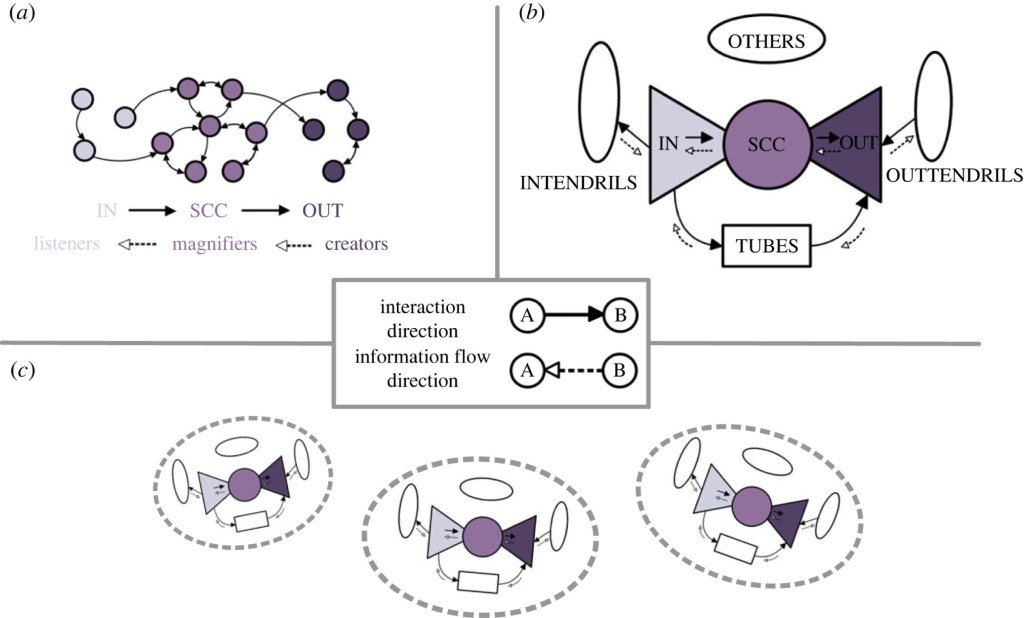
Building on this perspective, a recent stream of research has identified a recurring mesoscale pattern in user interactions, known as the bow tie structure. Broder et al. [Graph structure in the web, ”Comput. Netw.” (2000), 10.1016/S1389-1286(00)00083-9] originally introduced the bow tie decomposition to characterize the World Wide Web’s architecture. Specifically, one first identifies the Largest Strongly Connected Component (LSCC); nodes that can access to (but not part of) the LSCC are labeled IN, while those reachable from (but not part of) the LSCC are labeled OUT. Yang and colleagues later refined this classification, introducing other blocks in the decomposition. The bow-tie structure is displayed pictorially in the figure below.
In their depiction of the Web, nodes represented websites and edges represented hyperlinks: the LSCC contained most websites, the IN segment was dominated by search engines, and the OUT segment comprised authoritative sources such as Wikipedia. This framework has since been applied to various systems, including the Tor network, the control networks of transnational corporations, and more recently, online social platforms.
The advent of the Internet and social media has fundamentally reshaped the information landscape, blurring the boundaries between physical and social networks and creating a dynamic, complex adaptive information ecosystem. This landscape, where news, rumors, and opinions spread at unprecedented speed and scale, is rife with unreliable and competing content, making rigorous scientific analysis essential. The inherent complexity of these socio-technological systems—characterized by disordered connectivity patterns, nonlinear dynamics, and active, adaptive agents—poses significant challenges for traditional analytical approaches. This review has argued that statistical physics and network science provide a valuable quantitative framework for clarifying many of the mechanisms governing these systems, complementing descriptive and data-driven approaches.
The study of collective social dynamics necessitates first characterizing the medium. We have shown how the analysis of social media platforms (particularly X, Facebook, and Reddit) reveals distinct topological and algorithmic features that shape information diffusion. Network models, including random graphs, preferential attachment frameworks, and fitness-based approaches, have proven essential in quantifying how information disorders emerge from platform architectures. Maximum entropy null models, in particular, provide a robust baseline for distinguishing organic information flow from artificially amplified campaigns. At the mesoscopic scale, structural features like echo chambers and polarized communities arise naturally from homophilic interactions and algorithmic reinforcement. At the macroscopic level, abrupt changes in visibility, reach, or collective attention can in some cases be usefully interpreted through the lens of threshold phenomena and phase-transition-like behavior, although the empirical evidence for sharp critical behavior remains context dependent. The properties of these networks—being directed, weighted, and signed—encode how information flows and provide critical insights into the macroscopic spread and microscopic user dynamics.
The core of the review addressed how and how fast news, rumors, and opinions spread, showing that the dynamics of propagation are governed by both simple and complex contagion processes. While some false narratives spread through viral, broadcast-like mechanisms (simple contagion), others require repeated exposure or social reinforcement (complex contagion), particularly in ideologically insulated communities. Threshold models and bounded-confidence opinion dynamics help clarify how reinforcement, selective exposure, and network coevolution can sustain polarization and make certain beliefs—including false or misleading ones—more resilient over time. The temporal dimension adds further complexity, including phenomena such as burstiness, memory effects, and non-Markovian interactions. This requires temporally resolved models that capture the non-stationary dynamics of these ecosystems, reinforcing the need to investigate the principles at the basis of spreading patterns in disordered structures, as well as measuring the pervasiveness of different narratives in online media.
 Surtil :