
“FROM RISK TO FLOURISHING: SEEDS FOR RESPONDING TO A
COMPLEX WORLD”
Flourishing is the actualization of all beings toward their good–not only individually but collectively, answering the question of ‘how do we live well with and for each other?’. In science as in society, the tendency to reduce, segregate, specialize, and settle has precluded embracing the concept of flourishing as a guiding principle. The aim of this perspective is to identify an approach to risk science research that promotes the flourishing of socio-ecological-technological systems (SETS).
We discuss the normative role of an orientation toward flourishing for the field of risk science. We explore the possibility that (risk) science could be done in a way that is capable of pointing society toward a different future, one more resilient and more capable of flourishing. Our exploration mirrors the conversational nature of flourishing itself: examine ideologies traditionally believed to be rigidly in opposition and consider what emerges in the space(s) and conversation between them. We call this a dialectical approach.
Within this dialectical paradigm grounded in conversation, pluralism, and pragmatism, we revisit three longstanding tensions in risk science: physical|social, determinism|uncertainty, and contextuality|generality.
Although these tensions are not new, revisiting them together through the lens of complexity science, and with explicit attention to the normative commitments that shape risk research, reveals underexplored possibilities for the field. Examining them as a joint set, each in conversation with the other, allows us to explore the provisional seeds for what might be termed complex risk science: interdependence, responsivity, participation, pluralism, openness, and ongoingness.
Enacting the dialectical paradigm towards a risk science for a flourishing world will depend on creating collectives toward complex risk science, supporting them with skillfully governed commons, and centering care in our research and evaluation.
Our destiny is fated not only by great powers
David Whyte [2015]
beyond our beckoning horizon but by the very
way we shape and hold the everyday
conversations of a familiar life.
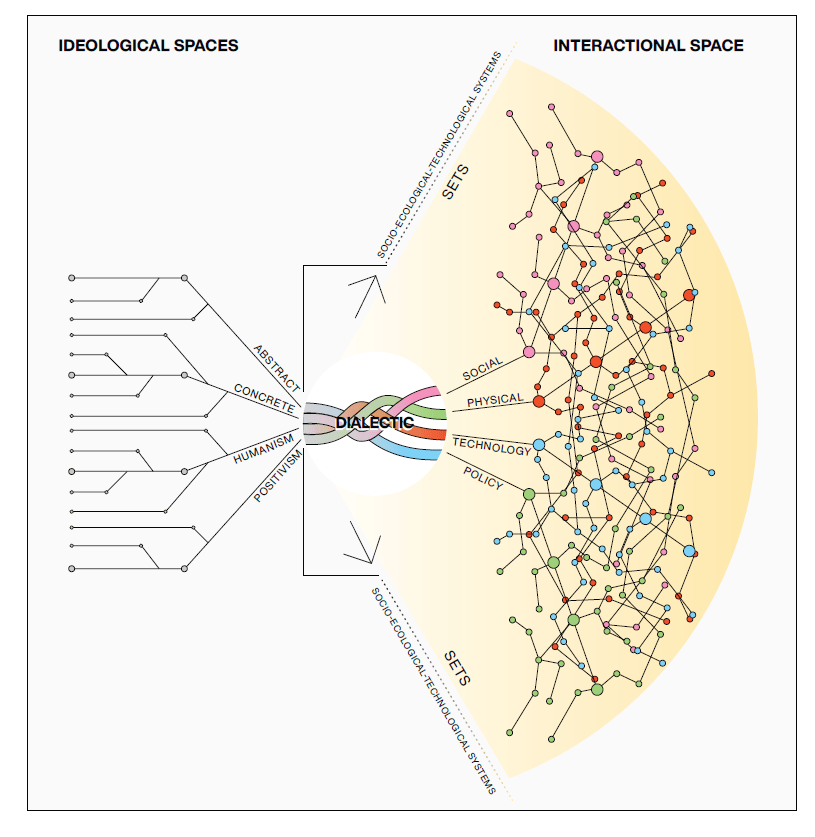
(Left, ideological spaces) Root ideologies of science–abstract, concrete, humanist, and positivist–represent distinct worldviews that artificially separate theory, material systems, values, and biophysical phenomena. These separate poles fragment understanding, creating tension and limiting engagement with the complexity of real-world systems.
(Right, interactional space) SETS exist in a messy, entangled space where social, physical, technology, and policy dimensions are not new ideological positions but are emergent networks of ideas, practices, and structures from each of the perspectives on the left. Dialectic is the way in which we apprehend this interactional space, enabling dialogue, weaving diverse knowledges, and supporting pragmatic approaches that contribute to the flourishing of the scientific community as well as the human and more-than-human world.
This framing recognizes that each dialectic is an indivisible duality, for which there can be no unambiguous resolution
on either side of the binary, but instead create the conditions for new insights, possibilities, and collective action within
the complex realities of SETS.
The paper uses a conversational method called a dialectical approach. Instead of treating opposing ideas as enemies, it looks at the space between them. By doing this, it revisits three old tensions in risk science:
- Physical | Social: How natural and human systems interact.
- Determinism | Uncertainty: The balance between predictable laws and the unknown.
- Contextuality | Generality: Local specificities versus broad, global rules
In time, those Unconscionable Maps no longer satisfied, and the Cartographers Guilds struck a Map of the Empire whose size was that of the Empire, and which coincided point for point with it. The following Generations, who were not so fond of the Study of Cartography as their Forebears had been, saw that that vast map was Useless, and not without some Pitilessness was it, that they delivered it up to the Inclemencies of Sun and Winters.
Jorge Luis Borge [1972]
On exactitude in science.
A Universal History of Infamy, page 141
Looking at these tensions through complexity science reveals six core principles, or “seeds,” for a better way to study risk:
- Interdependence: Recognizing that everything is connected.
- Responsivity: Being able to adapt as situations change.
- Participation: Involving diverse voices and communities.
- Pluralism: Accepting multiple valid perspectives and types of knowledge.
- Openness: Remaining flexible rather than rigid.
- Ongoingness: Treating risk management as a continuous, evolving process.
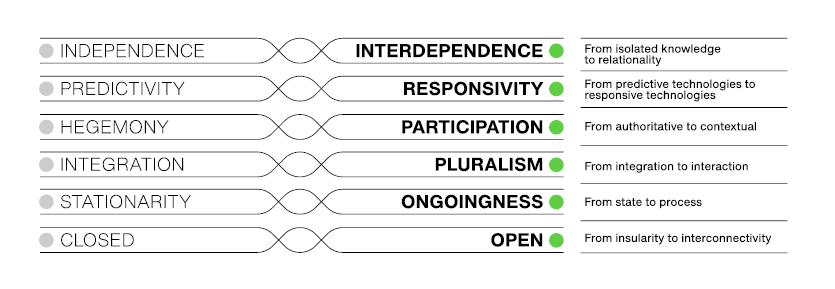
Together they suggest six seeds, each a disposition of inquiry and daily activity that can enact the paradigm in risk science research and practice.
To turn this vision into reality, the authors suggest three practical steps:
Create collectives: Build groups dedicated to practicing complex risk science together.
- Support commons: Use shared resources governed by skilled, fair rules.
- Center care: Put empathy and care at the heart of research and evaluation.
Policy-makers and funders must affect the incentives that generate the kind of science that is practiced. These incentives may involve support for shifting focus from the individual to the collective, a process which has always begun with a kind of epistemic humility, a self-emptying that makes space for others’ knowing. It is perhaps through a recognition of the importance of self-emptying by which a vision of collective flourishing becomes active and actionable.
Scientists occupy a position of trust in a society where trust is fraying. That trust is a form of social capital, and social capital is for using. In a world with changing extremes, growing vulnerabilities, and undeniable interdependence, how will we put our science (of social, ecological, technological, complex systems) in the world and for what purpose?
Perhaps this is the great lesson from The Risk Society: that the literacies and practices of reflexivity are paramount. A civilizational call indeed: to become more individually, collectively, fractally reflexive. Scientists
must become more adept at attending to subjective experience.
Subjectivity is not opposed to science but essential to it, especially in complex risk settings. We lack robust methods for apprehending experience, yet this is precisely the need for gaining a better understanding of contextuality and meaningfully including communities in scientific work. Scientists’ reflection on their own work as well as the reflection of ‘lay’ people are both tremendous and mostly untapped potentials. Areas within cognitive science such as micro-phenomenology are making progress to make sense of experience for scientific use and could be translated into SETS research in myriad ways.
To respond to complex risk is not only to manage hazards, but to mature our ways of knowing and being together. The science that meets this moment will not separate the physical from the social, the deterministic from uncertain, the contextual from the general, but weaves them into a new form of collective intelligence, one capable of holding both the world’s fragility and its generative possibility.

