
This paper proposes the Distributed Adaptive Control theory of volition and agency (DACva), which parses biological and artificial free will into six capacities that close the agency gap between a reflex and an act:
– active decoupling,
– endogenous drive,
– leeway,
– normative self-governance,
– diachronic integrity and
– experiential ownership.
Together they constitute Responsible Autonomy.
The DACva architecture spans five layers, somatic to reflective, coordinated by a decoupled model-predictive controller, the compression–expansion–selection–projection (CESP) cascade. It constructs, rather than presupposes, the causal models counterfactual control requires, under the evolutionary pressure of survival in social worlds pervaded by hidden intentional states.
The computational principles and neurobiological substrate of DACva are specified in a 12-equation formalism, with an assay and a refutation condition for each capacity. The formalism closes on one equation, the CESP cascade, and yields an explicit definition of freedom: the degree to which an act is the committed trajectory of the agent’s own cascade, read on six conditions, one per capacity.
From this follows the Evaluation Suite for Responsible Autonomy (ESRA), a perturbational test of architectural competence rather than mimicry, proposed to replace the imitation game; ESRA-S assesses the safety constraints a deployer of AI must impose.
DACva argues that the architecture of Responsible Autonomy is the architecture of mind.
‘That thing is called free which exists from the necessity of its nature alone, and is determined to act by itself alone.’
Spinoza, Ethics, I, Def. 7 (1677/1985)
| I. Active decoupling: self is actively decoupled from non-self |
| decoupling is hierarchically controlled relative to viability; trust in the decoupled model rises with its reliability for the valued goal, stays bounded above a non-negative floor, falls faster than it recovers and combines anticipation, recall and authorship discrepancies |
| II. Endogenous drive: self is moved by its own needs, not by supplied reward |
| viability grounds action through allostasis, segregating appetitive and aversive value; net drive is their difference, conflict their sign-invariant co-activation, which raises the evidence needed to commit; the aggregates are hierarchically organized and score a candidate’s predicted effect on need |
| III. Leeway: self constructs more than one genuine path |
| leeway increases with the breadth of viable alternatives, vanishes when generation collapses to one or the dynamics become unstructured, stays bounded by the agent’s self-anchored causal model and history, counts only alternatives made available to selection and depends non-monotonically on the substrate’s dynamical regime |
| IV. Normative self-governance: self is bound by norms it holds as its own |
| physical and social value combine on a common scale under a bounded convex weight with positive reserve, so viability is never erased; prohibition is a property of the acquired norm, not intrinsic to the agent; commitment operates on a candidate trajectory that is coherent, model-supported and decisive relative to conflict; withholding is causally distinct from choosing inaction |
| V. Diachronic integrity: self stays one and the same across time |
| integrity jointly rewards depth, concentration and coherence of mental traversal, contracting the ensemble onto segments supported by evidence, succession and value |
| VI. Experiential ownership: self owns the acts it authors |
| Ownership holds for covert/unreleased and overt trajectories in agent-defined episodes, is assigned by default and reduced by intention and control error and is independent of outcome success; efficacy is measured intrinsically against the agent’s realized policy and active self-regulation, not injected value |
In the DAC framework, Responsible Autonomy is an evolutionary control response to the transition from physical survival in How, Why, What, Where and When (H4W) to social environments pervaded by the hidden intentional states of others, the Who in H5W.
This transition creates two computational bounds.
Deciding whether there exists a joint policy that attains a specified reward in a finite-horizon decentralized partially observable Markov decision process is NEXP-complete with as few as two agents, so entry into social worlds cannot be bought with computation alone. Evolution replaced the problem rather than solving it: the agent satisfices, substituting a good-enough own policy for an optimal joint one, bounded by what its own viability can tolerate.
The second bound is individual: unrestricted recursive modelling of others produces an unbounded hierarchy of nested beliefs, so modelling depth must be controlled. The Intentionality Prior is the bounded inductive response to both: it segments observed dynamics through a restricted set of inferred agents, goals, beliefs and intentions, and the depth bound itself is derived, not stipulated.
DACva defines Responsible Autonomy as an integrated agent-centric control construct for H5W worlds in which the agent is simultaneously a fit subject of accountability practices and an active participant in them. It is predicated on this substitution: an agent that acts socially at all is one that has replaced the intractable problem with a bounded one it can afford.
DACva builds on the canonical DAC formulation of agent-centric multilayered control, from the reactive–adaptive architecture through sequential episodic control, anticipation and allostatic regulation to its current benchmarks, hereafter canonical DAC. DAC is not one architecture among many; its taxonomy of layers and columns locates all extant proposals such as the subsumption, SOAR, ACT-R, real-time control architecture, and the current deep reinforcement learning and foundation-model systems, as partial instantiations of one layered control system.
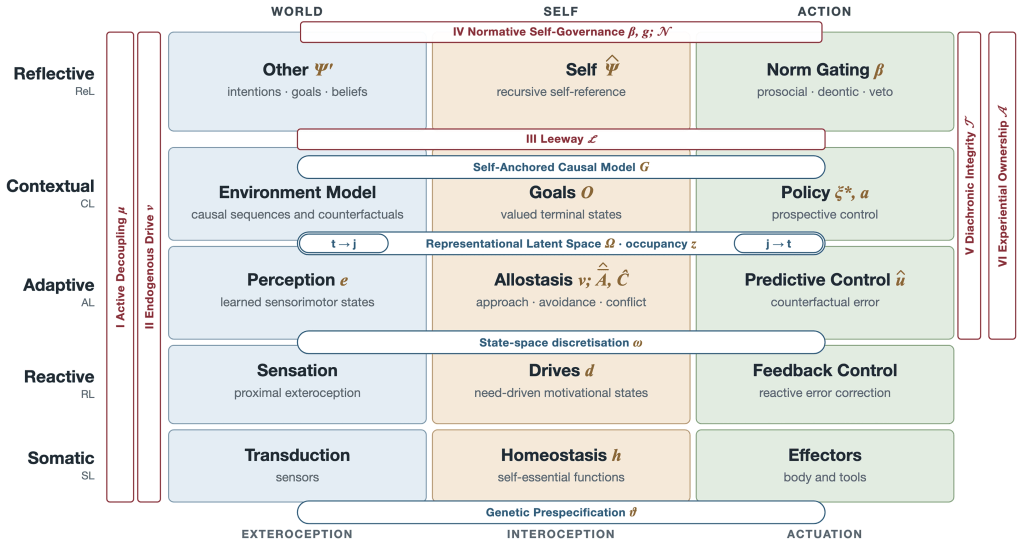
Five hierarchical layers (somatic, reactive, adaptive, contextual and reflective) intersect three functional columns processing states of world, self and action along the exteroceptive, interoceptive and actuation modalities.
Each cell names the function constituted at that intersection.
Four horizontal bands trace the bottom-up construction of genetic prespecification [] at the somatic level, the discretization of the continuous sensorimotor space into conjunctive state couplets [] at the reactive/adaptive border, their compression into the representational latent space [] at the adaptive/contextual border and the self-anchored causal model G, whose nodes are formed from [] across the contextual layer and whose dynamic-memory occupancy z is the transient state the compression–expansion–selection–projection (CESP) cascade evolves.
Facing the fundamental challenge of understanding and regulating biological and artificial free will, I have proposed the six capacities of Responsible Autonomy, DACva and the ESRA test.
Together they explain free will as Responsible Autonomy: causality reorganized, not broken.
This framework displaces the imitation game as the benchmark of machine agency, and indeed, as a method for evaluating any other mental faculty.
The contrast is exact: Turing’s test made internal organization irrelevant, scoring a system solely on whether its surface output could deceive a human observer, anticipating the functionalism of symbolic AI that followed, and whose problem of priors the field has still not mastered. ESRA assesses capacities under perturbation of the mediators a system declares, treating surface performance as insufficient by construction.
The imitation game asks whether a system can be taken for an agent. ESRA asks whether it is one.
Through this, the DACva architecture places the agent back at the centre of the mechanism, practice and experience of freedom.
This allows a definition of freedom in terms of the DACva architecture. Freedom is not a property a system has or lacks.
Evolution is not finished with agency.
The confluence of human and artificial agents is the next transition in collaborative cybernetics, and it will bring new forms of experience, achievement, and abuse and cruelty.
The suffering will not be that of machines, an intellectual distraction over which panpsychists and their neighbours wring their hands, but of humans, through machines and the institutions that deploy them, as the record already shows.
Governance of agency is itself agency: one cannot govern agency without being responsible, and so it requires an architecture of responsible governance.
The generalization is warranted not by analogy but by level: the six capacities are read on the same quantities in a person and an artefact, and in an institution by what it lacks, and the convergent validation DACva pursues carries that reading from the armchair and the laboratory to the real world and its record.
Constructive disobedience protects, changes or rescues the common norm, so that responsibility and disobedience go hand in hand.
‘Liberté’ is the agency gap closed: what the architecture of Responsible Autonomy explains, measures and protects, in whatever substrate can carry it.

