
“The six capacities of Responsible Autonomy and their evolutionary drivers.”
The rapid integration of agentic AI is intensifying disputes about artificial autonomy, widening an agency schism between normative frameworks that presuppose agency and a scientific ontology that denies it.
This paper proposes a revisionary naturalization: free will designates the control interface that embodied agents evolved to navigate social worlds pervaded by hidden intentional states, not a metaphysical ornament.
The antinomy between determinism and libertarian freedom is dissolved by analysing free will from the perspective of control mechanisms.
Diagnosing the philosophical record and systems neuroscience, I specify six capacities that naturalize free will as Responsible Autonomy:
Active Decoupling,
Endogenous Drive,
Leeway,
Normative Self-Governance,
Diachronic Integrity and
Experiential Ownership.
These are proposed as control constraints on any responsible agent, and hence as design constraints for model construction and as a checklist for evaluating responsible agency in biological and artificial systems.
‘I planned it not,
Story of Sinuhe (early 12th Dynasty, c. 1900 BCE; transl. A.H. Gardiner, 1916)
it was not in my heart,
I conceived it not,
I know not what sundered me from my place.’
Biological proto-agency initially evolved to solve the H4W problem (Why, What, Where, When and How) of physical survival.
The Cambrian explosion, about 540 Ma, introduced a critical new variable: other agents, first as predator and prey.
The presence of ‘the other’ began a qualitative transition in neural control, further accelerated in social species, towards systems that solve the H5W problem (by adding ‘Who’), in which agents must master a social world pervaded by hidden intentional states.
This transition from physical survival to social navigation drove the evolution of complex nervous systems and, ultimately, the social brain.
Dunbar’s social brain hypothesis ties brain size to social complexity but leaves open what this brain must control. Distributed Adaptive Control (DAC) theory of volition and agency (DACva) supplies that control for an H5W world: the principles required to infer hidden states and convert them, with extracted norms, into action serving the agent’s viability.
The folk-psychological notion of free will is a pragmatic psychological stance that shows remarkable cross-cultural convergence onto three components:
(i) the capability of choice,
(ii) alignment of action with desire, and
(iii) freedom from coercion.
By contrast, the scientific elimination of this notion is based on two synergistic trends:
(i) the metaphysical consequence of a strict physical monism, where freedom is an intolerable breach of the causal fabric dictated by Laplace’s demon, for whom past and future follow from the state of the world at one instant, and
(ii) the observation that humans can display a misattribution of their locus of control.
The first trend is formalized as the Consequence Argument (CA): if determinism holds, every act is a consequence of the laws of nature and the remote past, neither of which is up to the agent. The argument by necessity relegates agency to a ‘metaphysical ornament’ incompatible with the attractive neatness of a hierarchy of science grounded in physics that has dominated the study of mind since psychology emerged as a science in the mid-nineteenth century.
The second trend concludes that claiming agency over outcomes is merely a matter of feeling authorship, while being agnostic to the actual, subliminal causes of choice and action.
The contradiction between the societal and individual understanding of free will and its scientific elimination is not merely a legal or philosophical technicality; it strikes both at the evolutionary root of Homo sapiens and at the governance of synthetic agency. As Graeber and Wengrow argue, human nature and social complexity are predicated on three primordial freedoms: to disobey, relocate and create social structures.
This adds a recursive layer to the H5W problem: the capability to infer, from a third-person perspective, the hidden intentional states governing agent–agent and agent–collective relations: who did what to whom, where, when and why, and to act according to the associated implied norms. This forces us to think about free will beyond psychophysics and individual choice, and places boundary conditions on its empirical assays.
| capacity | definition | evolutionary driver |
|---|---|---|
| I Active Decoupling | Functional separation of the agent’s internal dynamics from the immediate causal flux, enabling offline simulation and counterfactual evaluation in mental order. | Inference of hidden states in the H5W world requires the agent to model what is beyond physical presence and not directly observable: intention. |
| II Endogenous Drive | Intrinsic, allostatic necessity that orients motivated goals and ensures the agent is a prime mover rather than a passive transducer. | Survival in H5W worlds requires an agent with its own teleology, one that acts from internal necessity, not only from external stimulus. |
| III Leeway | Endogenous capacity to generate alternative possibilities for interpretation and action predicated on the agent’s self-anchored causal model and history, not dictated by current input or environmental statistics. | H5W survival favours agents who can entertain and evaluate multiple scenarios, including novel and counterfactual ones not present in current or past input. |
| IV Normative Self-Governance | Inference of other agents’ states and norms via the intentionality prior, entered as social needs into allostatic control and its value system, through which they can shape and withhold first-order impulses, including the mutual instrumentalization of agents. | Multi-agent H5W survival requires inferring norms, including those never given, then answering to and authoring them. |
| V Diachronic Integrity | Binding of intentions, commitments and policies across time, maintaining the stability of multi-scale goals against perturbation. | H5W goals unfold in parallel over timescales that exceed immediate events, requiring persistent commitment across disruptions and sub-goals. |
| VI Experiential Ownership | Causal self-attribution of actions and outcomes, differentiating ego-causation from other-causation and external physics, for covert as well as overt action. | H5W accountability requires the agent to bind intentions, actions and consequences to a unified self-model. |
Modern Conceptual Architecture of Responsible Autonomy (MCARA), so named because what philosophers progressively identified as the necessary conditions for ‘free will’ can, in hindsight, be reinterpreted as architectural requirements for Responsible Autonomy.
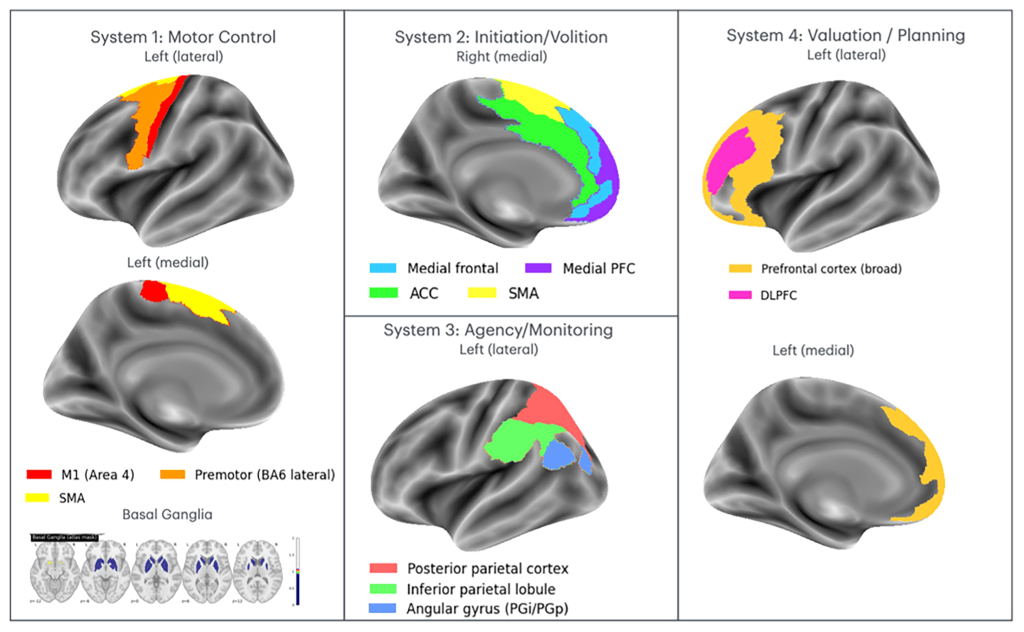
MCARA has converged onto four broad neural subsystems of volition and agency.
Motor control: primary motor cortex (M1), supplementary motor area/supplementary motor cortex (SMA), premotor cortex, basal ganglia (BG);
volition/initiation: medial frontal cortex, medial prefrontal cortex, SMA, anterior cingulate cortex (ACC)/anterior cingulate gyrus;
agency monitoring: inferior parietal lobule, angular gyrus (AG; areas PGi and PGp)/left AG, posterior parietal cortex, right parietal lobe/parietal lobe, parietal cortex;
valuation/planning: prefrontal cortex, dorsolateral prefrontal cortex (DLPFC);
integrated through the corpus callosum (not shown).
Where AI falls short: Homo ignorans and the new ghost in the machine
The six capacities are stated as control constraints on Responsible Autonomy, and so as design constraints for any artificial agent. Their most immediate application is the class of artefacts that provoked the governance crisis that motivated this paper. That crisis turns on a question that the governance debate leaves open: how can we judge artificial autonomy without understanding its biological realization? Applying the six capacities to current developments in artificial intelligence is therefore not a digression but their first test case.
Active Decoupling (Capacity I): Contemporary models decouple from the immediate input in a shallow sense: they operate over learned representations rather than raw stimuli, while the representational latent space is frozen at training time. There is no online reconstruction of that space from the agent’s own ongoing experience; agentic wrappers add tool-use and retrieval loops, yet these extend reach without granting endogenous re-representation. The decoupling is inherited and human-imposed.
Endogenous Drive (Capacity II): AI systems lack Endogenous Drive. Objectives are supplied externally, through a human-engineered reward model, a fine-tuning signal or a prompt. Nothing in the system corresponds to a conatus or to the allostatic regulation of self-essential variables, so the system is a sophisticated transducer rather than a prime mover. Without an intrinsic teleology, the system has no purpose of its own. The logical conclusion is that these are extensions of human agency, even if their operators cannot fully explain how they work.
Leeway (Capacity III): Stochastic decoding is mistaken for a capacity to do otherwise, and hence for proto-agency. Sampling temperature is not the controlled Expansion of a self-generated latent space. Alternatives are drawn from the human-supplied training distribution rather than from the agent’s own learning history, so the CA objection reappears in its exact form: the system remains coupled to external human-controlled statistics, and its variability is luck in the form of randomness, not Leeway.
Normative Self-Governance (Capacity IV): Norms are imposed by human-controlled alignment training and ad hoc heuristics rather than bootstrapped from IP-driven interaction. The system conforms to norms without extracting them and cannot revise them through the recursion on norms that deviation sets up. Conformity is not self-governance.
Diachronic Integrity (Capacity V): Context windows and episodic-memory bolt-ons approximate temporal binding but do not constitute it: there is no policy-level commitment that resists proximal perturbation across genuinely long horizons, only a longer context buffer. Game-playing agents trained by self-play and hierarchical reinforcement-learning agents generate novel policies and hold distal subgoals. They may approximate Active Decoupling, and Diachronic Integrity in part. But all their computations serve an externally specified reward, so they fail on Endogenous Drive, Leeway, Normative Self-Governance and Experiential Ownership.
Experiential Ownership (Capacity VI): Even granting, as a thought experiment, that an AI agent had intentions and agency, it would still lack a closed comparator loop binding intention to action to outcome against a self-model and so have no principled basis on which credit or blame could attach to it as author.


One response to “Six Capacities of Responsible Autonomy”
[…] – diachronic integrity and – experiential ownership. Together they constitute Responsible Autonomy. The DACva architecture spans five layers, somatic to reflective, coordinated by a decoupled […]
LikeLike