“THE DEAD SALMONS OF AI INTERPRETABILITY”
THE DEAD SALMONS OF AI INTERPRETABILITY”
In a striking neuroscience study, the authors placed a dead salmon in an MRI scanner and showed it images of humans in social situations. Astonishingly, standard analyses of the time reported brain regions predictive of social emotions.
The explanation, of course, was not supernatural cognition but a cautionary tale about misapplied statistical inference.
In AI interpretability, reports of similar “dead salmon” artifacts abound: feature attribution, probing, sparse auto-encoding, and even causal analyses can produce plausible-looking explanations for randomly initialized neural networks.
Upon inspection of this phenomenon our position is to argue for a pragmatic statistical-causal reframing: explanations of computational systems should be treated as parameters of a (statistical) model, inferred from computational traces.
This perspective goes beyond simply measuring statistical variability of explanations due to finite sampling of input data; interpretability methods become statistical estimators, and findings should be tested against explicit and meaningful alternative computational hypotheses, with uncertainty quantified with respect to the postulated statistical model.
It also highlights important theoretical issues, such as the identifiability of common interpretability queries, which we argue is critical to understand the field’s susceptibility to false discoveries, poor generalizability, and high variance.
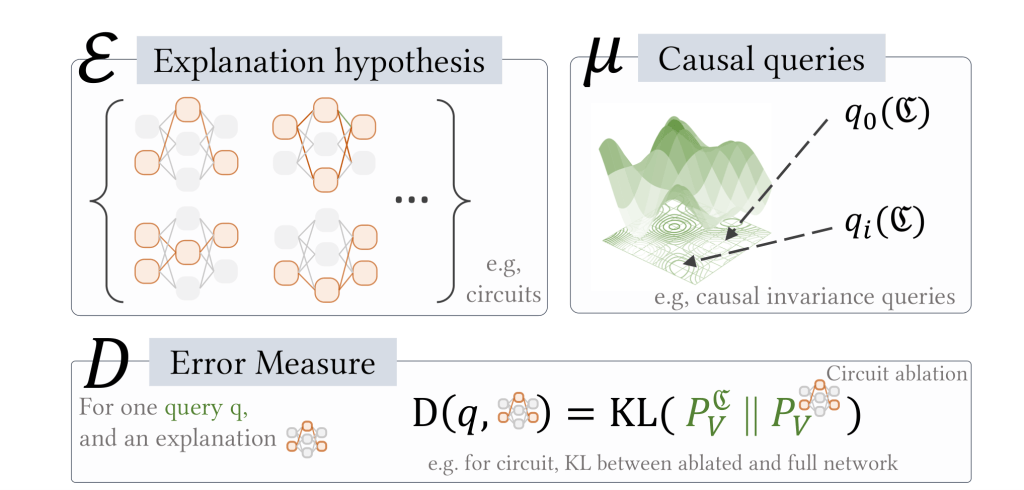
The authors of the paper propose a pragmatic statistical-causal reframing, advocating for explanations of computational systems to be treated as parameters of a statistical model. Under this perspective, interpretability methods would function as statistical estimators, requiring rigorous testing against explicit alternative computational hypotheses and quantified uncertainty. This approach also underscores theoretical challenges, particularly concerning the identifiability of common interpretability queries, which explains the field’s susceptibility to unreliable findings. By integrating interpretability within standard statistical inference, the paper aims to establish methodological guardrails, similar to those adopted in neuroscience, psychology, and econometrics.
Ultimately, this reframing seeks to transform AI interpretability into a rigorous and pragmatic science, demanding a clearer understanding of what it truly means to “explain” a neural network.
To move from anecdotal discovery to cumulative science, interpretability research should make explicit what is being explained, under which assumptions, and with what uncertainty.
Drawing on the philosophy of science and recent calls for a pragmatic approach to interpretability, the framework proposed above naturally distinguishes the explanandum (what is to be explained, encoded in ) from the explanans (what does the explaining, encoded in ). Researchers and practitioners have substantial freedom in choosing both. There is no single “correct” explanation of a neural network. The appropriate type of description depends on one’s purposes. Descriptive understanding corresponds to queries about observational distributions; predictive goals involve queries requiring surrogates to generalize to new input distributions; control and intervention require queries about counterfactual or interventional distributions.
However, once the explanatory project is specified, i.e., once are fixed, the explanation becomes an objective inference problem.
The best surrogate is the one minimizing , and is a property of the system itself and the interpretability task. If the task is identifiable, this explanation is unique (up to permissible symmetries, e.g., rotation invariance in representation space). This reconciles pluralism about explanatory goals with rigor about explanatory claims.
Perhaps most critically, the statistical framing demands that interpretability methods report not just point estimates but confidence sets or posterior distributions over explanations (in case of Bayesian framing).
Just as we would not trust a clinical trial reporting effect sizes without confidence intervals, we may not trust interpretability claims without uncertainty quantification.