
“Modularisation and the management of IT architecture complexity”
Managing IT architecture complexity is crucial for organisations striving for efficiency, flexibility, and agility.
This paper examines modularisation as a strategy to address IT architecture complexity through a case study at a European bank. We explore three key design choices in modularisation: level of granularity, standardisation of interfaces, and unification of data, and their impacts on structural, dynamic, and subjective complexity.
Our findings reveal that these design choices involve trade-offs, where optimising one dimension may exacerbate another. Our findings lead to a conceptualisation of the relationship between modularisation and complexity as one in which design choices set in motion patterns of shifts within, and interactions between, different forms of complexity.
Thus, this study provides a nuanced understanding of how modularisation influences IT architecture complexity, offering valuable insights for organisations seeking to manage complexity effectively.
By unpacking the shifts and interactions shaping complexity, we contribute to the literature on IT architecture complexity and modularisation, highlighting the importance of a multi-level perspective in understanding the consequences of modularisation design choices.
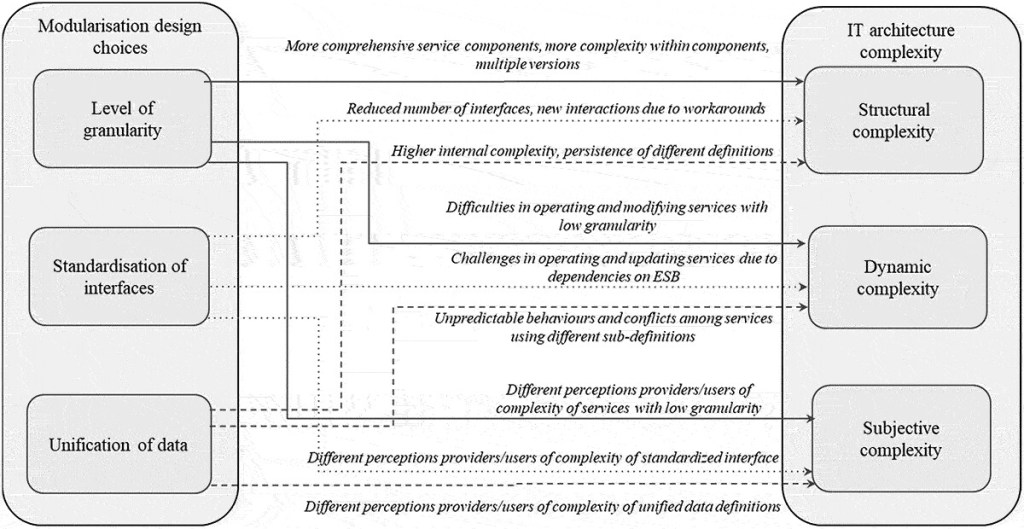
In this figure, different arrows indicate the influence of different design choices: granularity (solid arrows), standardisation of interfaces (dotted arrows), and unification of data (dashed arrows). The text accompanying each arrow indicates how each modularisation design choice affected each form of complexity.
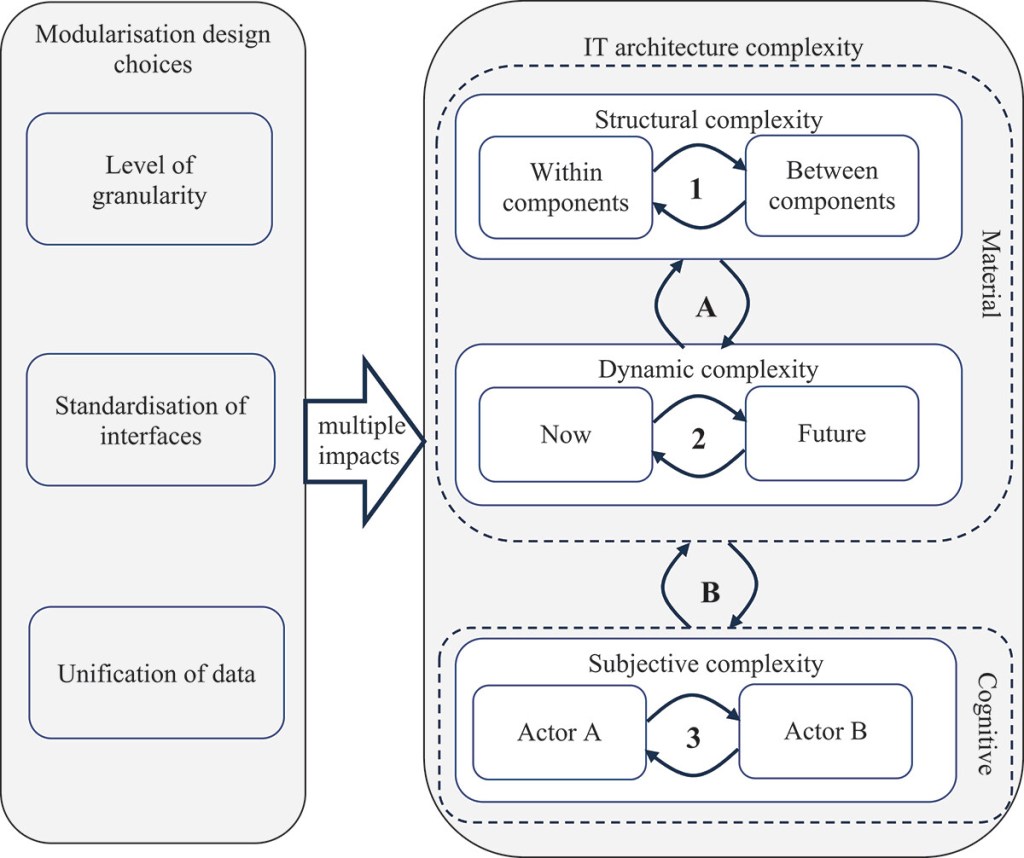
We identified three shifts in complexity as well as two interactions between forms of complexity that together shape how IT architecture complexity dynamically evolves. The three shifts are
(1) a shift in structural complexity from within to between components and vice versa,
(2) a shift in dynamic complexity between now and the future, and
(3) a shift in subjective complexity between different stakeholders.
The two interactions we identified are
(A) between structural and dynamic complexity and
(B) between the material and the cognitive realm of complexity.
Managing complexity is about understanding where and why complexity is part of the architecture, and being able to benefit from complexity where possible, at the same time avoiding negative effects on efficiency, flexibility, and organisational agility.
Being able to fulfil these aims, our study indicates, requires a constant monitoring of, and responding to, shifts and interactions with regard to complexity.
Managers should be aware of such requirements and not regard interventions (such as modularisation) as one-time events, but as the start of an ongoing process that will in due course require new and possibly different interventions.
This also requires anticipating future developments. It is important to devise concrete scenarios (based on extrapolations of current developments and predictions of future ones) and extensively assess these. Furthermore, proactively disrupting the IT architecture in line with these scenarios is also a way of moving complexity “from the future to the present”, as these interventions will give concrete insights into what the effects of these scenarios will be.
Finally, practitioners involved in the design of modular IT architectures should consider the full range of design choices and complexity conceptions in their design decisions. It is important to be aware that choices in terms of, for instance, level of granularity of modules have implications that go beyond the internal complexity of those modules, since other design choices (for instance, in terms of unification of data definitions) also affect this internal complexity.
Finally, it is crucial to realise that such choices are part of a dynamic process of complex interactions between different components of the architecture, as well as between different conceptions of and perspectives on what is complex about that architecture.

