
“Nonergodicity and Simpson’s paradox in neurocognitive dynamics of cognitive control”
Nonergodicity and Simpson’s paradox present significant, yet underappreciated challenges in cognitive neuroscience. Leveraging brain imaging and behavioral data from over 4000 individuals and a Bayesian computational model of cognitive dynamics, we investigated brain-behavior relationships underlying cognitive control at both between-subjects and within-subjects levels. Strikingly, brain-behavior associations reversed across levels of analysis, revealing pervasive nonergodicity. Within-subjects analysis uncovered dissociated neural representations of reactive and proactive control and revealed that individuals who adaptively versus maladaptively regulated cognitive control exhibited distinct brain-behavior associations.
Our findings demonstrate that between-subjects analyses can fundamentally mischaracterize within-individuals mechanisms, as group-level patterns not only disagreed with individual-level patterns but often reversed them.
This work highlights the necessity of distinguishing between-subjects and within-subjects inferences in neuroscience, with implications for understanding cognitive mechanisms and designing personalized interventions.
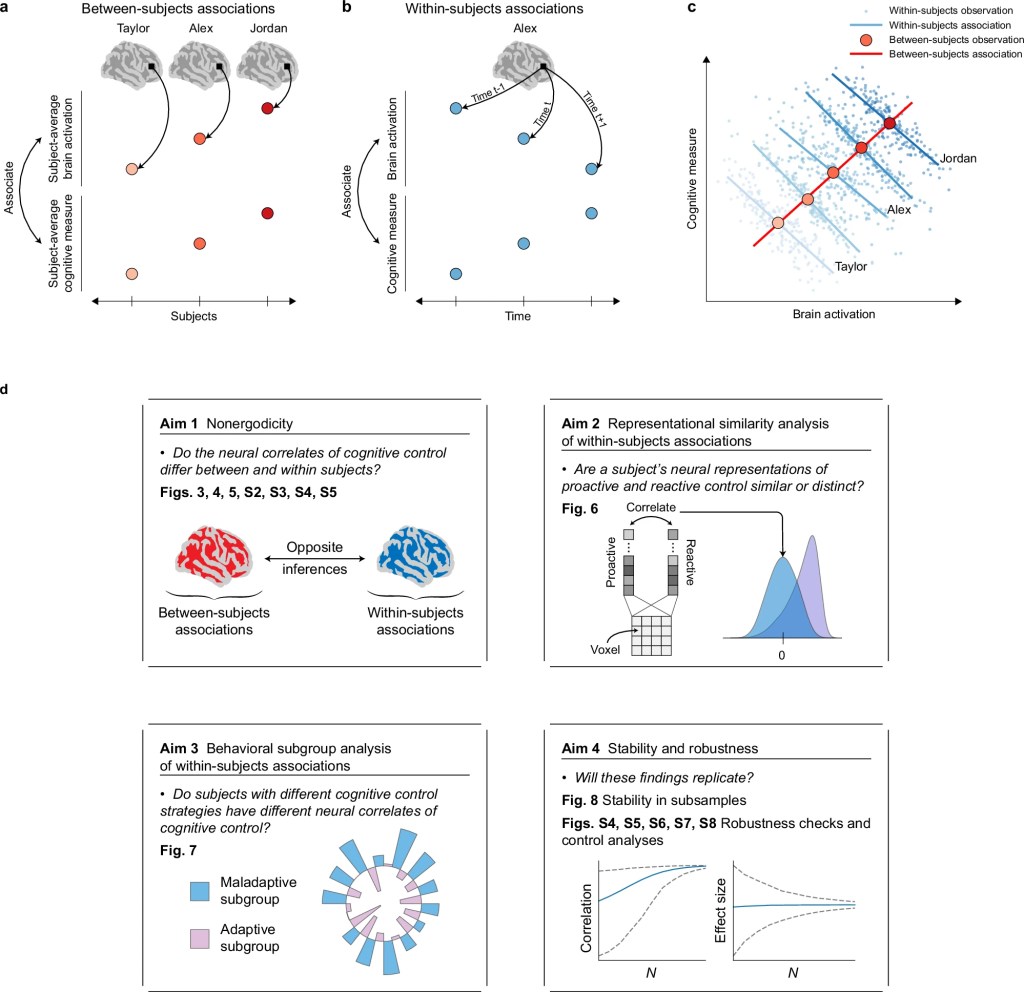
a Between-subjects analysis. Subject-average brain activation in each voxel is correlated with a subject-average cognitive measure across the population.
b Within-subjects analysis. For each individual, the time-series of brain activity in each voxel is associated with the time-series of a cognitive measure.
c Simpson’s paradox. Simpson’s paradox occurs when associations disagree between subjects and within subjects; it exemplifies nonergodicity in the brain and behavioral sciences.
d Study aims. We examined brain-behavior associations for nonergodicity; used within-subjects associations to probe the brain implementations of proactive and reactive control as well as adaptive cognitive control strategies; and tested our within-subjects results for stability and robustness. Nonergodic patterns in brain-behavior associations were consistently observed, revealing that group-level (between-subjects) and individual-level (within-subjects) associations yield divergent results for cognitive control processes. This challenges the common assumption that findings from such group-level analyses can be directly applied to understand individual-level cognitive processes.
By demonstrating that nonergodicity patterns are robust and detectable even in modest sample sizes, our study provides a foundation for future research into nonergodicity in brain function. It also suggests that meaningful insights into neurocognitive mechanisms can be gained from studies with more typical sample sizes, although larger samples provide greater precision and the ability to detect subtler effects. The stability and robustness of our findings suggest nonergodicity’s applicability to diverse research and clinical contexts, including understanding cognitive processes related to inhibitory control and studying psychiatric disorders.
Our study provides evidence for pervasive nonergodicity in the neurocognitive processes underlying inhibitory control. […] We demonstrate that brain-behavior relationships differ fundamentally when examined at group versus individual levels.
Critically, we found that group-level patterns not only disagreed with individual-level patterns but, in many cases, reversed them, exemplifying Simpson’s paradox at the neural level. Our results challenge the implicit assumption of ergodicity that pervades cognitive neuroscience research, and they invite neuroscientists to reflect on their questions and on their methods— between or within individuals?
Our work also has significance beyond neuroscientific methodology.
The results advance our understanding of cognitive control.
Within-subjects analyses revealed insights entirely unavailable from conventional approaches: dissociated neural representations of proactive and reactive control, dynamic interplay between cognitive control and default mode network areas, and systematic variation in neural mechanisms across individuals with different strategies. These findings,moreover, highlight an important direction for nonergodicity neuroscience: developing dynamic computational models capable of identifying elemental cognitive processes at the trial level.
The findings also have implications for medicine.
Neurobiological features that distinguish diagnostic groups may differ fundamentally from the mechanisms driving symptom fluctuations within individuals or predicting treatment response. Personalized interventions targeting cognitive control must be tailored to individual-specific neural dynamics rather than extrapolated from group-average patterns.
More broadly, appreciating the nonergodic nature of neurocognitive processes is essential for advancing our understanding of human cognition in health, development, and disease, and may have important implications for interpreting artificial neural networks.

