
“The Common Good Economy. A new compass”
Synopsis
Our economic system is broken. The climate crisis is accelerating. Inequality is deepening. Public trust is crumbling. Wealth concentrates in fewer hands while governments scramble to fix what markets can’t do, rather than to shape them from the outset.
For too long, economics has treated ‘the good’ – whether public goods or the commons – as merely correcting market or government failures. This economic framing traps us in an endless cycle of being reactive, patching problems rather than proactively building the economy we need.
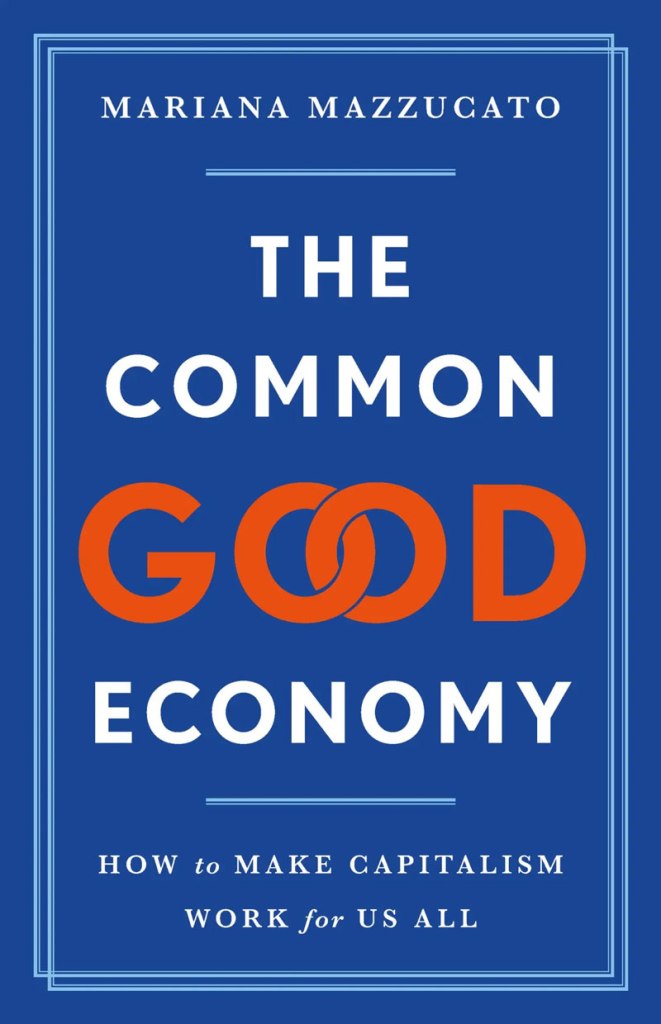
In The Common Good Economy, Mariana Mazzucato builds on her visionary ideas of the entrepreneurial state and mission-oriented policies to establish a new theory of the common good, one which allows governments and businesses to develop purposeful economic relationships, creating value and building spaces where human flourishing can happen. She argues that how we achieve collective goals – through collective action, participation and reciprocity – matters as much as what those goals are. The book provides a practical ‘common good compass’ to help navigate our economies in a radically different direction.
Full of compelling real-world examples, from governing water to transforming procurement and finance, this is a rigorous reimagining of economics and a manifesto for a future economy that serves people and the planet. It could not be more timely.
“Mariana Mazzucato wants liberals to talk less about the redistribution of wealth and more about its creation. Politicians around the world are listening”
The New York Times
Review
The Common Good Economy by Mariana Mazzucato review – how can Labour really turn things around? (The Guardian)
“a common good framework for the economy is about aligning goals, incentivising collaboration, fostering collective intelligence, and ensuring that all participants share knowledge, risks and rewards”
Economies work best, she believes, when they pursue grand collective goals – developing and distributing a vaccine for a pandemic; or confronting the climate emergency (or, though she doesn’t lean on the example here, tooling up for a new and more frightening geopolitical era). We should ask, she says, “not which market failure do we want to be fixed, but what direction do we want the economy to sail in”.
BOOK REVIEW
“Why people should work together to shape the economy” (Nature)
The book challenges the dominant narratives of power and value that many of us have internalized through the framework of neoclassical economics. Rather than treating capitalist markets as natural developments that allow for freedom and collective opportunity, Mazzucato draws on the work of economic historian Karl Polanyi to emphasize how markets are politically constructed and deeply embedded, often in ways that undermine the common good.
The real strength of Mazzucato’s “compass” — five principles that can guide the way to a better economy — is to leave the world of ideas and enter that of praxis: the translation of theories into actions.
Combining theoretical reflection with collective participation provides the most fertile ground for achieving forward-thinking institutional innovation. What cannot be learnt from academic economists can be gained only through engagement on the ground.
Mazzucato offers governments a powerful framework for evaluating policies and developing taxonomies of possible environmental and social projects.
If her refreshing compass was genuinely put into practice, it would directly confront today’s economic power structures, thus opening the path towards political transformation.
That is a good thing.

