
“To explore or exploit: Individual differences in preschool decision making”
- Adapting to novel situations requires balancing exploration versus exploitation.
- Examining patterns of explore/exploit in decision making provides a more ecologically valid measure of performance.
- Research indicates individual and developmental differences in explore/exploit strategies.
- Differences in strategy use have implications for social adjustment and development disorders.
esearch suggests a pattern of moderate early exploration (shifting from deck to deck) followed by exploitation (consistent choice from advantageous decks) characterizes good decision makers. The main goal of the current study was to use a person centered (latent profile analysis) to explore individual differences in strategy use for preschoolers (n = 274) on a variant of the Iowa Gambling task (IGT). The analysis resulted in three profiles: a profile made up of younger children who showed moderate initial exploration, but no exploitation, a profile of children who showed consistent high exploration, and a profile made up older children who showed initial exploration followed by high exploitation in the last half of the game. The profiles showed striking differences in choice and awareness on the preschool IGT variant.
Examination of strategy use during decision making in young children has the potential to provide insight into early adaptive functioning.
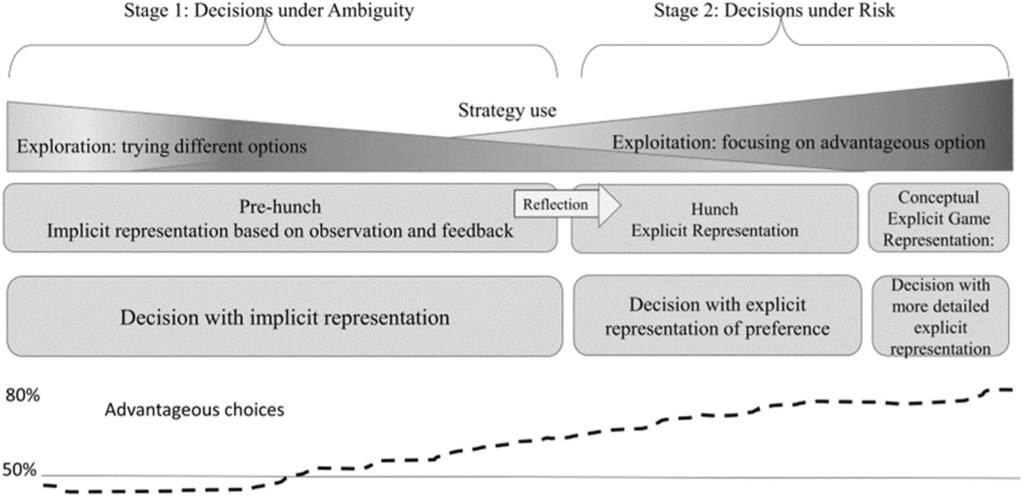
[…] the current findings contribute to the literature on decision making by suggesting that individual differences in strategy use are present by preschool.
The findings add to the literature on individual differences in decision making by applying a person-centered approach to decision-making strategies (i.e., exploration versus exploitation).
The results indicate three profiles with different approaches during a decision-making task under ambiguity. While the profile including the oldest children showed the expected reduction in exploration and increase in exploitation, the profile including the youngest children showed no increase in exploitation.
The most interesting profile showed a high exploration rate throughout the task. Unlike the other profiles, age in months was unrelated to the probability of being classified in this profile, suggesting this profile may be more strongly linked to individual differences rather than developmental differences in strategy.
This highlights the need to further investigate the use of exploration in other IGT-variant and in other populations.
Finally, these findings have the potential to provide a powerful lens into the process of learning and responding in situations where contingencies are unclear. These types of situations often reflect the very same situations where children with developmental difficulties struggle with the most and in this respect may provide clinicians with a tool for early diagnosis and intervention.

