
“Bullshit can be harmful to your health: Bullibility as a precursor to poor decision–making”
Bullshitting is characterized by sharing information with little to no regard for truth, established knowledge, or genuine evidence. It involves the use of various rhetorical strategies to make one’s statements sound knowledgeable, impressive, persuasive, influential, or confusing in order to aid bullshitters in explaining things in areas where their obligations to provide opinions exceed their actual knowledge in those domains.
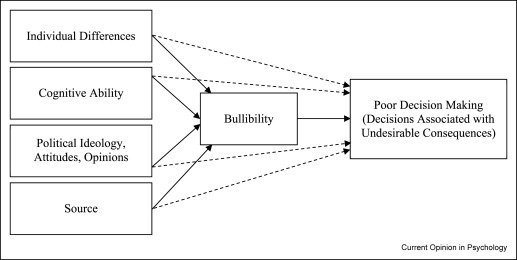
Distinct from gullibility (i.e., a propensity to accept a false premise in the presence of untrustworthiness cues), we highlight the research on bullibility (i.e., believing bullshit even in the face of social cues that signal something is bullshit) and its links to erroneous judgments and decisions.
A deeper understanding of bullibility is critical to identifying and correcting poor decision-making.
There are two ways to be fooled.
– SØREN KIERKEGAARD
One is to belleve what isn’t true;
the other is to refuse to believe what is true.
This article focuses specifically on bullshit’s harmful effects in decision-making, performance evaluation, and accountability reporting—contexts where factual accuracy is essential—while explicitly recognizing that strategic ambiguity, aspirational talk, and selective communication serve legitimate functions in vision-setting, coalition-building, and innovation contexts.
The analysis synthesizes experimental findings from social psychology to offer practitioners theoretically informed propositions for building more bullshit-resistant decision-making cultures.
A managerial playbook (described in the article) offers theoretically derived implementation frameworks with explicit boundary conditions, including proposed reality-testing protocols and meeting reform guidelines.
Organizational bullshit is most likely to thrive when three conditions exist: 1) people fear speaking up;
2) people are rewarded for confidence over evidence; and
3) careers advance based on looking good rather than being accurate.

Theoretically grounded propositions include:
(1) bullshit may trigger peripheral processing that bypasses critical evaluation;
(2) bullshit may produce stronger sleeper effects than lies;
(3) systematic, truth-focused cultures may create competitive advantages.
The managerial playbook provides a framework for implementing reality-testing protocols and reforming meeting practices—with a 30–60-90 day implementation timeline for building bullshit-resistant organizations.
A decision framework helps practitioners distinguish contexts requiring evidence-based clarity from contexts where ambiguity legitimately serves.
Drawing on scholarship in psychological safety, employee voice and silence, impression management, and organizational learning, the analysis explores why bullshit may flourish despite its harmful effects and identifies systemic organizational dynamics that warrant attention.
Organizations frequently tolerate communication delivered without regard for truth, evidence, or established knowledge in decision-making and accountability contexts—what philosophers and psychologists term bullshit.
Unlike lies, which deliberately subvert truth, bullshit represents an indifference to accuracy, which experimental research suggests may make it both more prevalent and paradoxically more persuasive in domains where evidence-based reasoning is critical. Studies indicate that bullshit-framed arguments may outperform evidence-based reasoning in influencing attitudes, and produce stronger sleeper effects over time, with the potential to gradually degrade organizational decision-making quality.

Note. Post-hoc counting of motives suggests that employees in our sample engaged in bullshitting mostly for the purpose of getting along (n = 69), followed by getting away (n = 64), getting ahead (n = 61), and getting around (n = 28).
The above exemplars are the top three occurring motives per quadrant.
From “Workplace Bullshitting: A Multidimensional Analysis of Motives”
These results […] suggest the conceptual distinction between lying and bullshitting is not meaningless semantics, but a meaningful difference with important consequences for all forms of communication.
Our investigation showed through the application of the illusory truth
procedural paradigm that not only is it easier to dismiss lies compared to bullshit, but that bullshit is perceived as more truthful than lies— repeated exposure to bullshit increased its perceived truthfulness compared to repeated exposure to lies when cues to deception come after initial exposure.
Support for both the lie dismissal and insidious bullshit hypotheses, suggest that being exposed to bullshit will have more deleterious effects on judgment and decision making relative to lies. Thus, compared to lying, bullshitting can be a more insidious form of communication by distorting the very beliefs upon which people base their judgment and decisions—and what people believe to be true is foundational to optimal decision making. In a world where truth-indifferent communication is pervasive and often goes unrecognized, these findings carry a sobering message: the communicators least concerned with truth may exert the greatest influence on what the rest of us come to believe. Understanding, detecting, and countering the insidious effects of bullshit is not merely an academic exercise—it is an increasingly urgent challenge for everyday reasoning, public discourse, and the health of democratic deliberation.

