
“What Lives? A Meta-Analysis of Diverse Opinions on the Definition of
Life”
The question of “what is life?” has challenged scientists and philosophers for centuries, producing an array of definitions that reflect both the mystery of its emergence and the diversity of disciplinary perspectives brought to bear on the question.
Despite significant progress in our understanding of biological systems, psychology, computation, and information theory, no single definition for life has yet achieved universal acceptance. This challenge becomes increasingly urgent as advances in synthetic biology, artificial intelligence, and astrobiology challenge our traditional conceptions of what it means to be alive. We undertook a methodological approach that leverages large language models (LLMs) to analyze a set of definitions of life provided by a curated set of cross-disciplinary experts. We used a novel pairwise correlation analysis to map the definitions into distinct feature vectors, followed by agglomerative clustering, intra-cluster semantic analysis, and t-SNE (t-distributed Stochastic Neighbor Embedding) projection to reveal underlying conceptual archetypes.
This methodology revealed a continuous landscape of the themes relating to the definition of life, suggesting that what has historically been approached as a binary taxonomic problem should be instead conceived as differentiated perspectives within a unified conceptual latent space. We offer a new methodological bridge between reductionist and holistic approaches to fundamental questions in science and philosophy, demonstrating how computational semantic analysis can reveal conceptual patterns across disciplinary boundaries, and opening similar pathways for addressing other contested definitional territories across the sciences.
Cluster titles and consensus definitions
Perceptual Categorization
Life is a perceptual category arising from how systems that consider themselves alive recognize and categorize others, rather than an objective distinction with intrinsic properties. The apparent boundary between living and nonliving exists primarily as an artifact of our sensory limitations that introduce artificial distinctions into what may be a more unified reality.
Self-Sustaining Dynamic Patterns
Life is a persistent dynamic pattern that sustains itself through recursive processes, creating and maintaining its own conditions for existence. It manifests as a self-aware system capable of transformation, emerging through the resonance and harmonic interaction of its components. This pattern exists in relationship with its environment, expressing consciousness while continuously recreating itself through mutually transformative connections.
Dynamic Relational Process
Life is a permanent movement characterized by dynamic exchange between internal and external environments, fundamentally requiring relationship with preexisting others. Life cannot exist in isolation or stasis, as its essential nature involves both movement and proliferation. Rather than being something humans can create, life is received and passed on, existing as an ongoing process of interconnection.
Pragmatic Definitional Skepticism
Life is a contextual construct better approached through functional utility than universal definition, where definitional efforts should serve specific research purposes rather than establish absolute boundaries. The concept
exists at the intersection of scientific and philosophical domains, requiring recognition of disciplinary limitations and pragmatic focus on what advances understanding rather than what constitutes a “correct” characterization.
Cognitive Autonomy
Life is a self-maintaining, goal-directed system that processes information to adapt to environmental changes while preserving its organizational boundaries. It operates as an autonomous agent that actively opposes entropy through energy exchange, making purposeful decisions that ensure its continued existence. Life functions as a cognitive process that senses, interprets, and responds to its surroundings, modifying itself when necessary to maintain stability despite changing conditions.
Dissipative Self-Organizing Systems
Life is a dynamic, far-from-equilibrium process characterized by self-organization and self-maintenance through controlled energy dissipation. It maintains semi-permeable boundaries that separate the system from its environment while allowing selective exchange of matter and energy. Living systems process, store, and transmit information through feedback mechanisms that enable adaptation and evolution over time.
Informational Self-Replication
Life is a self-replicating system of information encoded in a physical substrate, capable of reproducing itself while maintaining order against natural decay. This information-based process enables the transmission of
complex structural and functional data across generations, with the physical components serving primarily as carriers for this essential informational content.
Self-Replicating Thermodynamic Systems
Life is a self-sustaining physical and chemical system that reproduces itself while maintaining organization away from thermodynamic equilibrium. It interacts adaptively with its environment, absorbing and transforming resources to support its replication and growth. Living systems exhibit autonomy through self-regulation and response to stimuli, while their reproductive capabilities enable evolutionary processes.

This computational analysis demonstrates that contemporary scientific definitions of life cluster around the same philosophical fault lines that structured ancient Greek thought and have continued to shape scientific discourse about life throughout the centuries. The emergence of two interpretable dimensions in the t-SNE projection, despite the mathematical arbitrariness of t-SNE axes, recapitulates tensions that have organized thinking about life for thousands of years.
Dimension 1 (x), mapping observer-dependent frameworks to objective materialist approaches, resurrects the ancient vitalist-mechanist dialectic. The isolated Perceptual Categorization cluster (Fields, Hoffman) occupies a position that would have been philosophically impossible before quantum mechanics introduced observer effects into fundamental physics, yet it echoes vitalism’s insistence that life cannot be reduced to mechanism alone. The opposing pole, occupied by Informational Self-Replication and Self-Replicating Thermodynamic Systems, represents the ultimate realization of the Cartesian-Hobbesian program: life as matter in motion, fully explicable through physical law. Between these poles lies the high-density region where most contemporary scientists attempt to navigate this ancient tension through hybrid frameworks.
Dimension 2 (y) reveals the equally persistent Aristotelian question: is life a substance or a process? The topmost definitions (Baluška’s “Living Cells and All Their Constructs”, Pizzi’s emphasis on “carbon-based elements”, Sloman’s focus on “components”) reflect a substantialist ontology that would be recognizable to pre-Socratic atomists: life as particular kinds of matter with specific properties. The bottom region (Marshall’s “fire that lights itself”, Noble’s “self-creating agency”, Picard’s consciousness-centered definition) resurrects Aristotelian teleology: life as patterns of organization, self-actualization, and intrinsic purposiveness that cannot be reduced to their material substrates. This vertical gradient captures the perennial tension between substantialist perspectives that view life as collections of specified entities (echoing Cartesian and Hobbesian frameworks) and teleological views that conceptualize life as coherent patterns of organization, information flow, and emergent self-actualization.
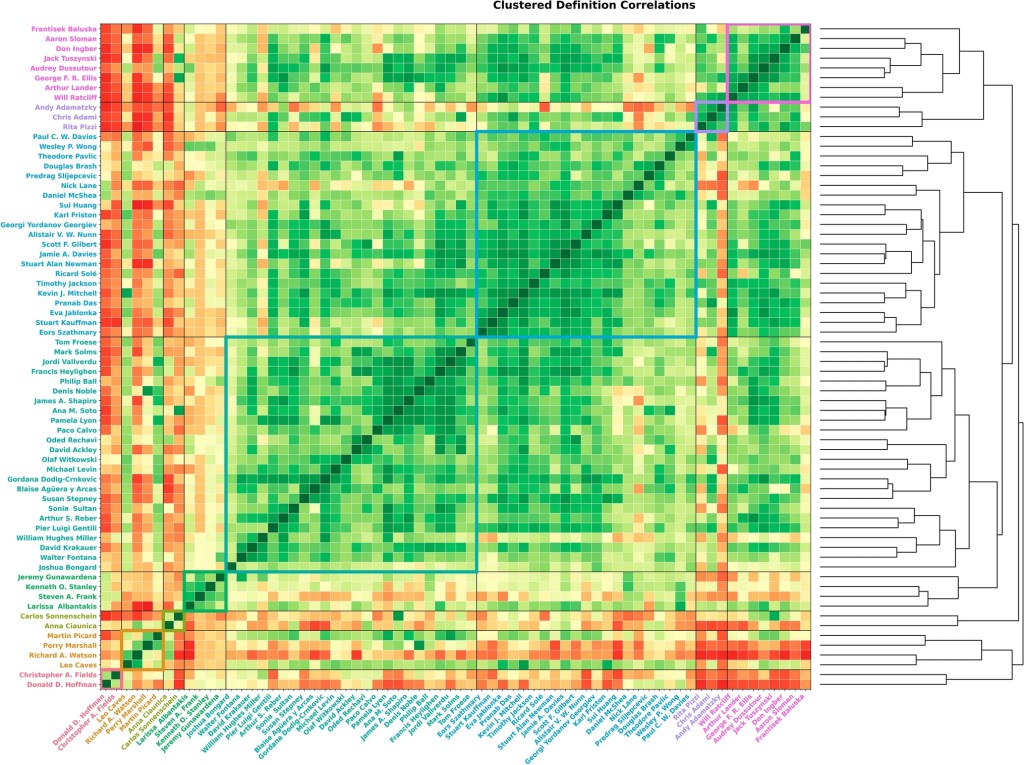
The central attractor, where Cognitive Autonomy and Dissipative Self-Organizing Systems overlap to contain 66% of all definitions, represents contemporary science’s attempt to transcend these dualisms through integration. Definitions in this region acknowledge both physical constraints (thermodynamics, energy flow) and emergent properties (agency, cognition, autonomy), attempting to bridge the explanatory gap between mechanism and experience that has haunted philosophy since Descartes split mind from matter. Whether this concentration indicates genuine conceptual synthesis or merely reveals the boundaries of professionally acceptable discourse within institutional science remains an open question.
The t-SNE visualization further reveals patterns in how expert perspectives distribute across this conceptual terrain. The highest density region centers on the overlap between Cognitive Autonomy (n = 24) and Dissipative Self-Organizing Systems (n = 21) clusters, containing 66% of all definitions. This concentration suggests emerging consensus around frameworks that integrate:
- Physical principles (far-from-equilibrium thermodynamics, energy dissipation)
- Informational processes (boundary maintenance, information storage, and transmission)
- Functional capacities (self-organization, environmental interaction)
- Agential properties (goal-directedness, adaptive behavior)
This convergence zone bridges traditionally separate disciplinary approaches, from physics and biology to cognitive science and information theory. The integrative nature of high-density definitions, exemplified by Agüera y Arcas’s “self-modifying computational phase of matter arising from evolutionary selection for dynamic stability”, suggests that the zeitgeist is moving toward hybrid frameworks that transcend historical dichotomies.

