
“Brain rhythms of depression: A predictive processing perspective”
Findings from electroencephalography studies converge on the notion that depression involves disrupted updating of beliefs, wherein positive and corrective information carries too little weight to revise rigid expectations about the self and the world.
Across a range of neural signals, the brains of individuals with depression register outcomes and errors and engage in monitoring processes, but these signals exert less influence on how beliefs are subsequently revised.
Higher-frequency and non-rhythmic components of neural activity point to a brain state biased toward stability over flexibility, potentially shaped by an altered excitation-inhibition balance in the cortex.
Framing depression in terms of how the brain processes and weighs new information offers a mechanistic bridge between neural measures, symptoms such as rumination, and emerging targets for stratification and treatment.
Depression is marked by anhedonia, social withdrawal, and a diminished capacity to learn from positive experiences—features that can be framed within predictive processing.
Here, we review findings from human electroencephalography (EEG) that, owing to its temporal resolution, can illuminate the moment-to-moment dynamics of inference in depression.
Across evoked, oscillatory, and aperiodic measures, incoming information appears to be registered yet may carry insufficient precision to revise higher-level beliefs about the self and the world. This imbalance may favour model maintenance over flexibility, with rumination as one possible subjective correlate of relative state stability.
Together, these findings motivate inference phenotypes as a complementary lens on depression and yield testable predictions for EEG-guided stratification and mechanistically targeted intervention.
The brain has been theorised to operate, in part, as a Bayesian predictive processing machine that integrates expectations about the world with incoming sensory evidence, learning by updating its predictions.
In depression, these processes appear disrupted: expectations seem to dominate over evidence, leaving them insufficiently updated by new input. Such impaired expectations could manifest across domains—anticipating rejection in social interactions, failing to expect pleasure from rewards, interpreting ordinary fatigue as exhaustion, or assuming that outcomes cannot be influenced, as in learned helplessness.
Altered expectations within predictive processing accounts need not reflect intrinsic cognitive dysfunction but may arise through learning under environments characterised by persistent uncertainty, limited control, and constrained opportunities for effective action.
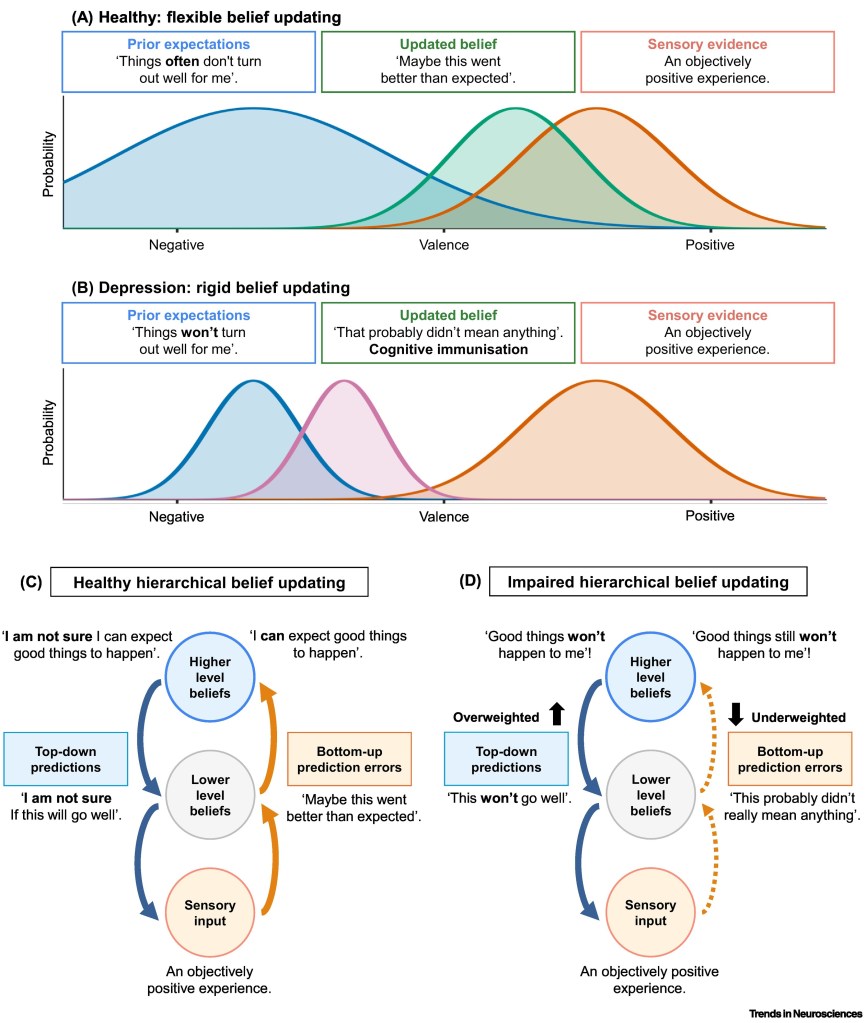
(A, B) Bayesian integration of prior expectations (blue) with sensory evidence (orange) to form posterior beliefs (green in A, purple in B). In this framework, depression is conceptualised as a disturbance of hierarchical Bayesian inference: overly precise prior beliefs attenuate the influence of incoming sensory evidence, so that prediction errors fail to propagate upward and higher-level beliefs about the self and the world remain insufficiently revised. We argue that the framework can generalise across symptom domains: prior expectations and updated beliefs can refer to social cognition (perceived regard from others), reward processing and anhedonia (hedonic responsiveness), or agency (perceived control over outcomes).
(A) In healthy individuals, priors are typically held with uncertainty (‘I’m not sure’), which we propose enables substantial posterior shifts towards positive evidence across social, hedonic, and agency domains.
(B) In depression, identical expectations might be held with greater certainty, which could cause the posterior to remain anchored near the prior despite equivalent positive evidence.
(C, D) A hierarchical predictive coding perspective. Arrows represent prediction errors (bottom-up) and predictions (top-down).
(C) In healthy cognition, positive sensory input generates prediction errors that propagate upwards, plausibly updating lower-level beliefs (‘I am not sure if this will go well’ → ‘Maybe this went better than expected’) and higher-level beliefs (‘I am not sure I can expect good things to happen’ → ‘I can expect good things to happen’).
(D) In depression, high-precision negative priors might attenuate bottom-up prediction errors (dashed arrows), such that beliefs may remain largely unchanged despite identical input. Lower-level beliefs could be reinterpreted in ways that preserve higher-level expectations (‘This probably didn’t really mean anything’), a process that has been termed ‘cognitive immunisation’.
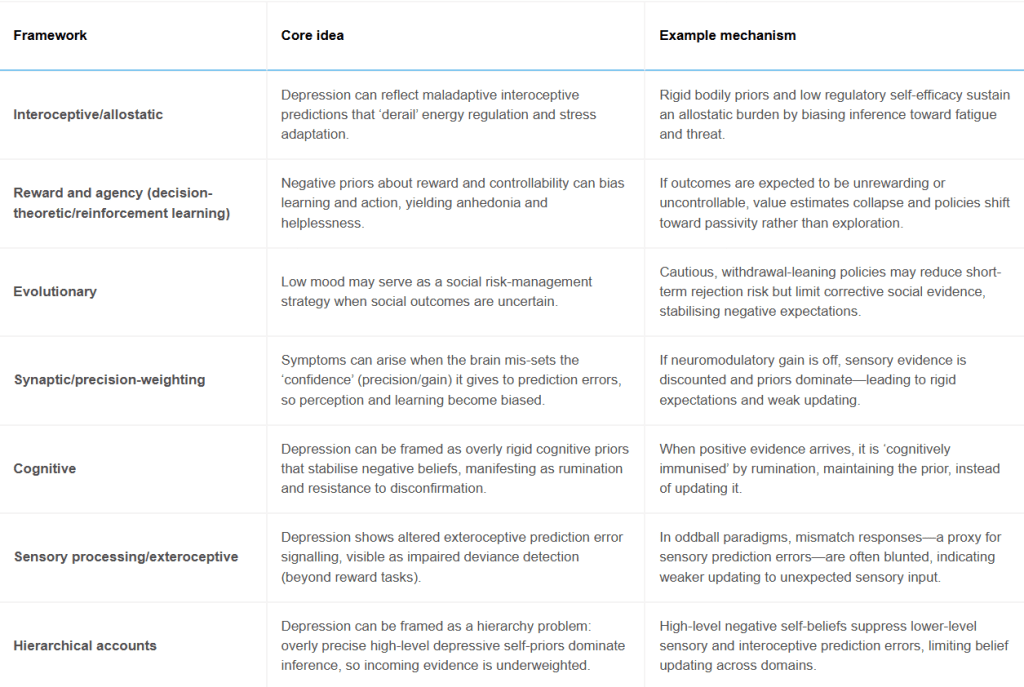
Neural oscillations provide complementary windows into inferential processes. Integrating these signatures enables a mechanistic account of depression that moves toward a process-based understanding of this condition as disrupted inference.
We distinguish empirical convergence from mechanistic interpretation by outlining four interpretative principles (i–iv). Across paradigms, the literature most robustly supports blunted reward-related signalling, altered P300 responses, and elevated tonic beta activity in depression, whereas the mapping of these signatures onto precision-weighting, Bayesian surprise, and model maintenance remains more interpretive.
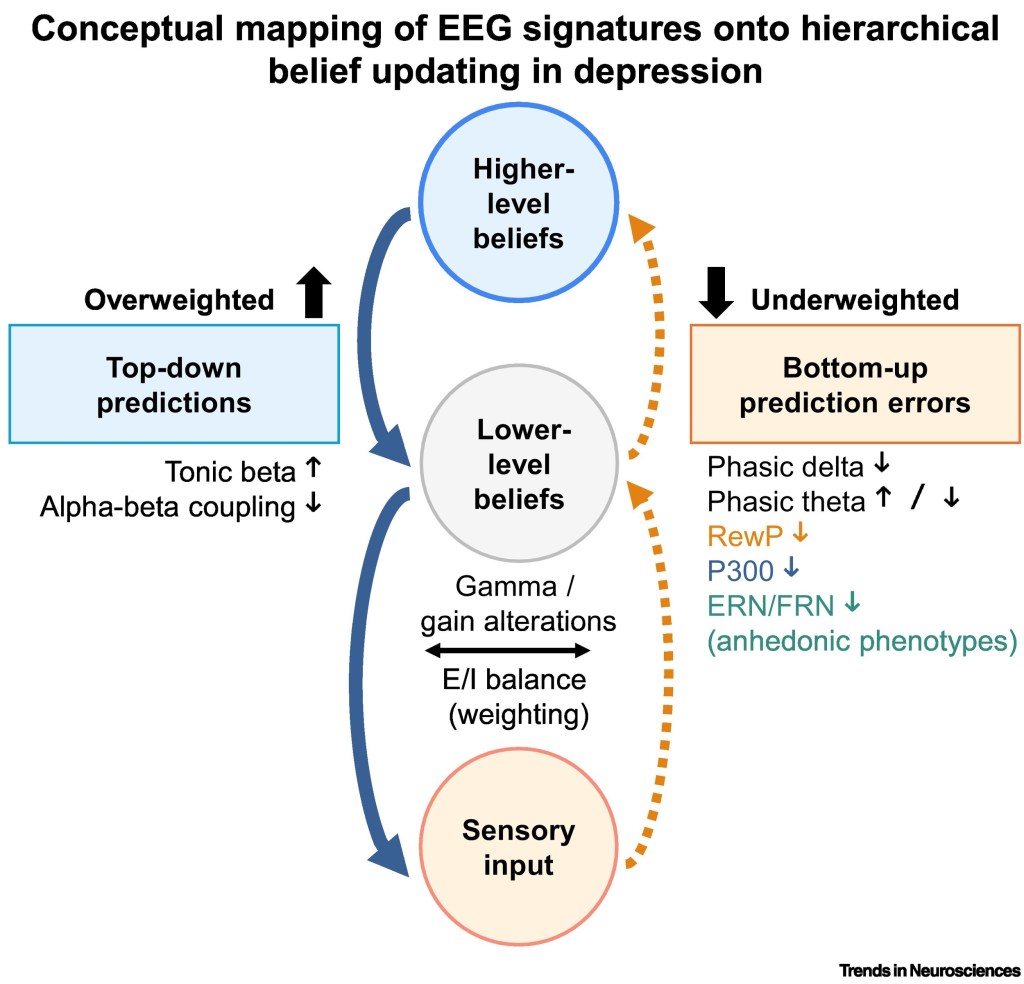
Predictive coding framework illustrating how depression may alter hierarchical inference: top-down predictions (blue) may be relatively overweighted, potentially reflected in elevated tonic beta and reduced alpha–beta coupling, whereas bottom-up prediction errors (orange) may be relatively underweighted, plausibly manifesting as attenuated phasic delta (2–4 Hz),
RewP, P300, and ERN/FRN. Phasic theta responses to feedback appear to be context dependent and may be exaggerated or reduced depending on motivational engagement.
Gamma activity and E/I balance might modulate precision-weighting at the sensory interface. EEG: electroencephalography.
Traditionally interpreted as a marker of context updating, the P300—in a predictive coding interpretation—might signify Bayesian surprise: the degree to which incoming evidence violates prior expectations. Depression is associated with reduced P300 amplitude across tasks, broadly compatible with attenuated precision-weighting of task-relevant information and evidence.
This domain-general impairment complements reward-specific blunting of RewP and delta responses, compatible with the idea that belief updating is compromised both in terms of what is updated and how strongly new evidence is weighted.
(i) From the lens of predictive processing, depression is characterised not by absent neural signalling, but rather by reduced leverage of positive, surprising, or corrective information on belief updating.
(ii) From a predictive processing account, this is compatible with the idea that reward signals are detected but fail to accumulate into expectations that guide future motivation, consistent with the attenuated precision of positive prediction errors.
(iii) A predictive processing interpretation: error and feedback signals remain largely intact, yet their translation into adaptive behavioural change may be deficient in anhedonic phenotypes, reflecting a dissociation between monitoring and effective control.
(iv) Elevated tonic beta activity and reduced alpha–beta coupling are compatible with excessive stabilisation of internal models, consistent with a gain regime biased toward model maintenance over revision—potentially shaped by altered cortical gain and E/I balance that attenuates the effective propagation of prediction errors.
This profile is compatible with a depressive inference style: a system where beliefs resist updating despite available evidence, and where new information fails to recalibrate prior expectations about the self, the world, and the future.

