
“A developmental framework of interpersonal neural synchrony”
Highlights
- Interpersonal neural synchrony (INS) emerges as early as four months of age.
- INS supports social learning, language acquisition, and attachment in development.
- Early INS is constrained to low-frequency rhythms, evolving with brain maturation.
- INS fosters mutual predictability and co-regulation in caregiver-child interactions.
- INS serves as both a marker and driver of developmental change across childhood.
Interpersonal neural synchrony (INS), the temporal alignment of brain activities between individuals, has been proposed as a biomarker for successful communication and smooth social interaction.
Surging empirical evidence shows that INS emerges spontaneously between infants, children, and their caregivers from early on in development. Yet, little is known about the developmental preconditions and functions of INS in childhood.
This paper presents a developmental framework for understanding INS, integrating insights from structural and functional brain maturation, as well as behavioral, social, and cognitive development. We discuss how early caregiver-infant interactions, characterized by shared perceptual rhythms, facilitate the emergence of INS. Given initial limitations in temporal precision of neural processing, early INS is likely constrained to low-frequency brain rhythms and evolves alongside the maturation of neural networks and socio-cognitive abilities. We outline how INS may support critical developmental processes, including social learning, language acquisition, and attachment formation, through enabling mutual prediction and co-regulation between caregivers and children. Furthermore, we hypothesize that tasks requiring higher-order mutual understanding are linked to qualitative changes in INS patterns over time.
This framework highlights the potential of INS as both a marker and a driver of developmental change, offering new avenues for research and intervention. Longitudinal studies and rhythm-based interventions could deepen our understanding of how INS supports development, with implications for enhancing social learning and attachment in populations at risk for developmental challenges.
This work underscores the importance of adopting a developmental perspective in INS research.

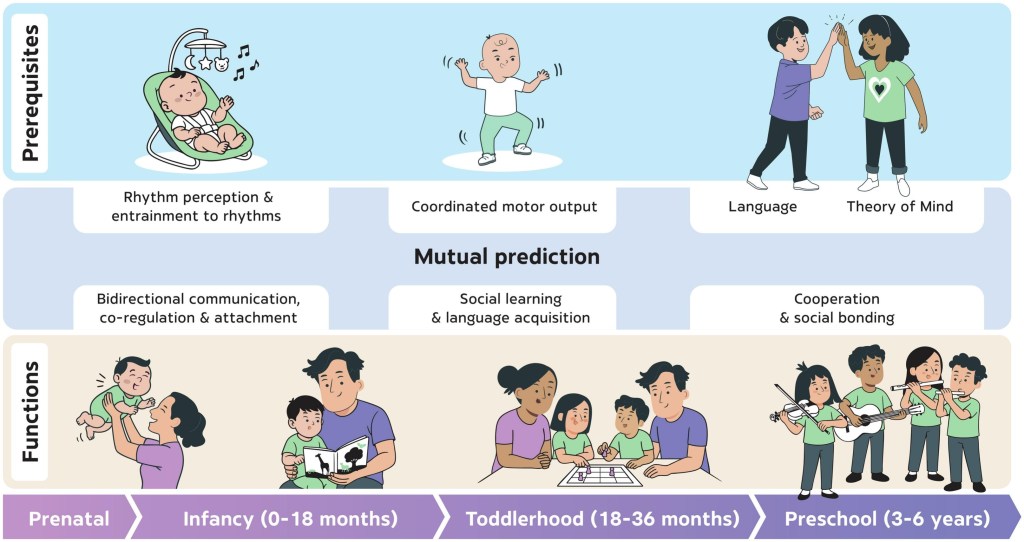
Infants are sensitive to internal and external perceptual rhythms from early on in life. Yet, their ability to synchronize with communicative rhythms undergoes considerable development.
Processes of brain maturation support increasing temporal precision, sensitivity for complex social rhythms, and the ability to produce synchronized motor responses within the first years. Despite initial limitations in temporal precision, INS emerges spontaneously in caregiver-infant interactions as early as four months of age. As longitudinal research into the development of INS is currently lacking, we have proposed a set of developmental hypotheses based on behavioral and neuroscience research to be tested in future studies. Specifically, we propose that INS may initially be constrained to low-frequency brain rhythms and that both the degree of INS and qualitative leader–follower patterns likely change across early development, along with variations in mutual predictability between children and caregivers. We further hypothesize that INS during tasks requiring higher-order mutual understanding is linked to progress in language acquisition and socio-cognitive development, allowing children to establish common ground with their caregivers and peers.
Longitudinal research, potentially implementing rhythm-based interventions, is required to corroborate the potential role of INS as a developmental mechanism underlying social learning and attachment formation.
This research will have great potential to deepen our understanding of child development, and it could point to new pathways for supporting social learning and attachment in caregivers and children with elevated risks for psychopathology and impaired social bonding.

