
“Making sense of wickedness: Directionality heuristics for challenge-led innovation policy”
Highlights
- Sense-making helps to understand how policymakers view and tackle wicked problems.
- Directionality heuristics are mental shortcuts used to interpret and address problems.
- Different degrees of wickedness call for different directionality heuristics.
- Nescience creates additional directionality challenges for challenge-led policies.
This article contributes to the burgeoning literature on directionality challenges by introducing directionality heuristics as a lens to conceptualize how policymakers and other stakeholders interpret and respond to problems in challenge-led innovation policy.
Our starting point is that the “wickedness” of problems is strongly shaped by subjective and context-specific perceptions. We therefore utilize and adapt a sense-making framework, originally developed in the management literature, to distinguish different ways in which actors engage with the complexity and uncertainty of such problems.
Building on this perspective, we conceptualize directionality heuristics as domain-specific rules of thumb that guide how policymakers interpret and address problems. We demonstrate the usefulness of this concept by applying it retrospectively to the Dutch Mission-oriented Topsector and Innovation Policy. The illustration highlights how stakeholders’ differing views on the wickedness of problems translate into particular directionality challenges as well as suitable practices to address those.
We conclude by outlining three key propositions, which emphasize the main conceptual contributions and provide concrete paths for future research and policy.
Innovation policy is increasingly expected to address societal challenges. This “normative turn” towards innovation policies “putting forward explicit directionality” is particularly notable in the renewed interest in mission-oriented innovation policy (MOIP), emphasizing the mobilization and alignment of innovation efforts by prioritizing societal problems and formulating clear, ambitious, and time-bound policy goals.
MOIP has been described as a problem-solving approach focused on translating grand societal challenges into “doable” problems . Depending on the political context, MOIP typically involves policymakers and diverse stakeholders working together in coordinated processes of defining problems and searching for solutions. In the case of addressing socio-economic and socio-ecological problems, rather than purely technical ones, such a coordinated approach to challenge-led innovation policy is, however, complicated by new and context-specific directionality challenges.
The motivation behind this article is to better understand how directionality challenges emerge and why they persist. So far, the literature on challenge-led innovation policy has largely neglected this issue of how policymakers interpret directionality challenges and how this influences the choice of (potentially inadequate) problem-solving approaches.
With our article, we aim to address this research gap.
The central argument is that a more nuanced approach, focusing on sense-making and heuristics, is necessary for a deeper comprehension of the new challenges policymakers face.
Generally, making sense of a problem pertains to individual and collective problem-solving heuristics, that is, rules of thumb followed for understanding and addressing problems. In this article, we explore a specific type of problem-solving heuristics, which we call “directionality heuristics”, that is, context-sensitive rules of thumb used to guide and orient innovation processes in response to a perceived problem.
Different directionality heuristics are associated with different interpretations of directionality challenges, diverse visions of policy outcomes, or even conflicting perspectives on which policy measures should be used to support (i.e., search for and develop) innovations that help achieve a particular mission.
Given its link to decision-making in the face of complexity and uncertainty, our article […] revolves around the question: “How do we make sense of the world so we can act in it?”
Put simply, taking “wickedness” more seriously means taking sense-making and heuristics more seriously.
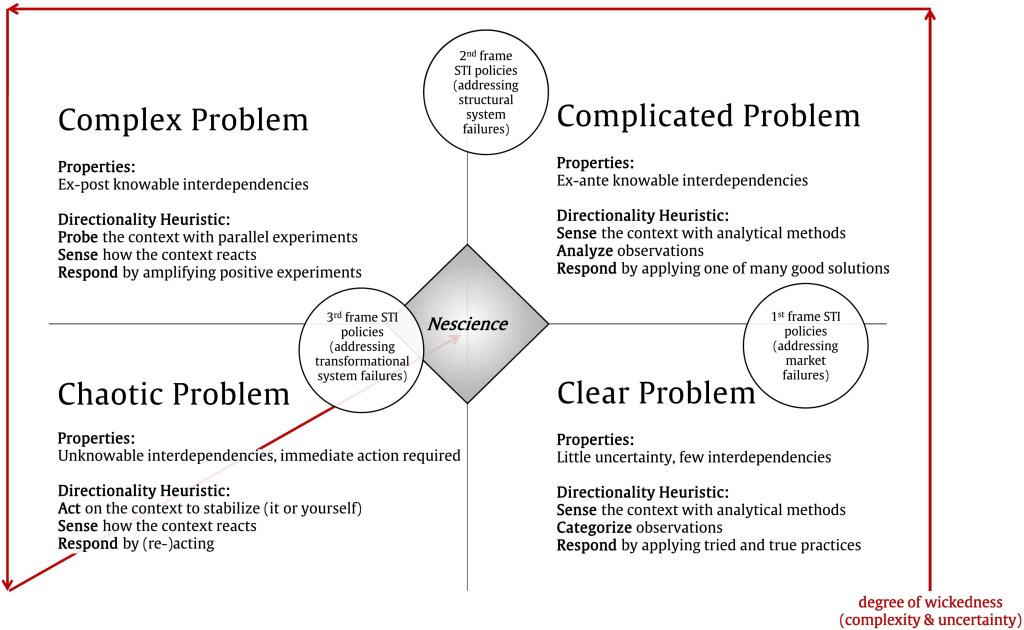
Note: The position of the three frames indicates a proposed relationship with their most relevant problem domains based on our subjective interpretation of their most salient degree of wickedness, which does not imply that respective policies are only relevant to these domains (e.g., 3rd frame policies such as MOIP can and must also address problems in the clear and complicated domains as they tend to be nested and/or embedded in broader policy contexts). The wickedness dimensions of complexity and uncertainty are directly reflected in the five domains of the framework (with clear representing the lowest degree and nescience the highest one). However, the third dimension of (normative) contestation is only indirectly reflected in the problem domains (e.g., resulting from divergent perceptions or lack of knowledge about which domain applies). Also note that this schematic representation does not depict the dynamics and liminal states, which are an important part of the original Cynefin® framework but would go beyond the scope of this article.
Three states of nescience: we extend the original Cynefin framework (which only distinguishes between the two states of aporia and confusion) by differentiating between three (ideal-typical) states of nescience, namely, confusion, conscious isomorphism, and aporia
| State of nescience | Awareness of “not knowing” the problem’s degree of wickedness (i.e., which domain applies) | Tolerance of “not knowing” | Consequences for the selection of directionality heuristics |
|---|---|---|---|
| Confusion | No | N/A | Application of “random” heuristics (potentially inadequate) |
| Conscious isomorphism | Yes | No | Sticking to the “status quo”/“business as usual”, application of imitation heuristics |
| Aporia | Yes | Yes | Reflexive and adaptive application of generic heuristics from any domain (other than clear) |
In the state of confusion, individuals are, by definition, unaware of the fact that they do not know which of the four outer domains applies to the problem they face. In other words, they do not know anything about the degree of wickedness and do not realize this.
Even if policymakers were aware of their nescience, however, this would not automatically mean that they can adequately deal with it, as being aware is only a necessary but insufficient condition.
Finally, aporia is a state of awareness and tolerance of one’s nescience. Notably, also in aporia, policymakers will still be unable to select adequate heuristics a priori. Yet, awareness and tolerance of one’s nescience can create conditions for embracing and actively engaging with one’s nescience. There, one can accept the fact that the situation calls for exploring different and unfamiliar types of directionality heuristics.
Science is not a system of certain, or well-established, statements; nor is it a system which steadily advances towards a state of finality. Our science is not knowledge … We do not know: we can only guess.”
K.R. Popper, The Logic of Scientific Discovery
To paraphrase Popper, we do not know what direction innovation processes should take nor how to steer them in this direction, we can only explore and acknowledge differences in sense-making.
challenge-led innovation policy by focusing on directionality heuristics has previously been overlooked.

