
“From Denial to Acceptance—Leveraging the Five Stages of Grief to Unlock Climate Action”
Climate change is not only a technical and environmental challenge but also an emotional and psychological one that affects public engagement, policy acceptance, and long-term sustainability.
This study presents a conceptual framework based on the Kübler-Ross model from psychotherapy to explore emotional responses to climate change: denial, anger, bargaining, depression, and acceptance.
Based on a thematic analysis of the interdisciplinary secondary literature and illustrative cases, we analyse how these emotional dynamics influence climate mitigation and adaptation efforts. Each stage reveals specific psychological barriers and entry points for communication, resilience-building, and policy design. We argue that emotional readiness is a critical yet underacknowledged factor in sustainable development and societal transformation.
Addressing emotional dimensions can support mental health, increase acceptance of climate measures, and improve the alignment between sustainability strategies and public responses. Our findings emphasise the importance of tailoring sustainability communication and policies to different emotional stages to foster inclusive, effective, and lasting climate action.
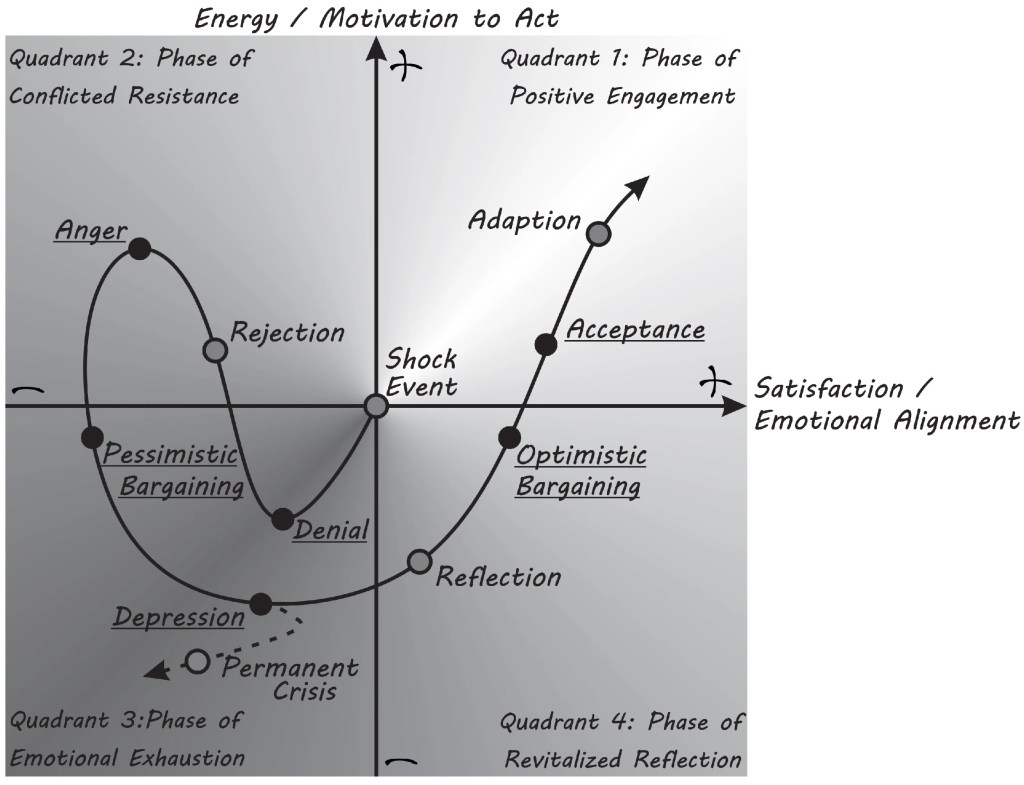
This diagram illustrates the emotional and motivational progression through the phases of grief following a significant shock event. The vertical axis represents the level of energy or motivation to act; the horizontal axis reflects emotional alignment or satisfaction, i.e., the extent to which individuals experience internal coherence and emotional stability in the face of climate change. The stages of grief are depicted as black points along the trajectory, with intermediate phases represented by grey points in between.
The grief model was further operationalised through the visual representation in the Figure, which maps the five stages onto an emotional trajectory defined by two axes: energy/motivation to act and satisfaction. Here, satisfaction is understood as emotional alignment, that is, the degree to which individuals experience internal coherence, clarity, and stability in the face of climate change. This trajectory is divided into the following four quadrants:
- the Phase of Conflicted Resistance (high energy, low satisfaction);
- the Phase of Emotional Exhaustion (low energy, low satisfaction);
- the Phase of Revitalised Reflection (low energy, increasing satisfaction);
- the Phase of Positive Engagement (high energy, high satisfaction).
The curve illustrates how individuals might move through these emotional stages. It identifies critical risks, such as the potential for a permanent crisis if progression stalls, and emphasises the goal of reaching acceptance and adaptation. While the original Kübler-Ross model places bargaining before depression, in the context of climate change, bargaining can also re-emerge in the form of constructive negotiation and reorientation after depressive states.
To reflect this dynamic more accurately, two forms of bargaining are shown in the diagram: “pessimistic bargaining” in the phase of emotional exhaustion and “optimistic bargaining” as part of revitalised reflection and the transition towards engagement. This conceptual distinction acknowledges both defensive and transformative expressions of bargaining in climate-related emotional trajectories.
| Grief Stage | Prevailing Barrier | Message Framing Cue | Participatory Lever | Indicator of Readiness |
|---|---|---|---|---|
| Denial | Psychological distancing, minimisation of risk | “These changes affect our community now.” | Localised education, infographics, serious games | Willingness to acknowledge local climate impacts |
| Anger | Distrust, blame, perceived unfairness | “Your frustration is valid. Let’s talk about just solutions.” | Structured dialogue forums, climate assemblies | Initial openness to hear opposing views or collaborate |
| Pessimistic Bargaining | Overwhelm, disengagement, symbolic actions | “Small steps matter, but we must act meaningfully together.” | Low-threshold involvement (e.g., idea boxes, surveys, consultations) | Participation in small-scale or token efforts |
| Depression | Powerlessness, grief, withdrawal | “You’re not alone. Together we can make a difference.” | Community-building, peer support, creative formats | Renewed interest in group activity or shared emotional expression |
| Optimistic Bargaining | Strategic avoidance of deeper change | “These actions are a step forward, How can we do more?” | Co-creation workshops, feedback loops, deliberative processes | Proactive suggestions or demand for deeper, systemic engagement |
| Acceptance | Emotional fatigue, residual uncertainty | “Adaptation is possible. Here’s how we already succeed.” | Institutional commitment, scenario planning, youth leadership | Integration of adaptation into strategies, policies, or long-term vision |
Linking grief stages to barriers, communication strategies, participatory tools, and indicators of engagement. This table provides a diagnostic overview of emotional phases in climate engagement and helps practitioners assess where individuals or groups currently stand. By identifying typical barriers and appropriate communication cues, it supports the targeted use of participatory strategies and helps determine readiness for progression toward deeper engagement or adaptation
Applying Kübler-Ross’s five stages of grief to climate change provides a process-oriented perspective to interpret emotional responses and identify barriers and enablers of climate action.
Future research should not only examine what people feel in response to climate change but also how these emotions unfold, shift, and can be constructively addressed.
Deepening our understanding of these emotional processes is vital to designing effective, inclusive and resilient climate strategies.

