
Becoming aware of previously unrecognized aspects of one’s psychological and behavioral challenges is one of the central mechanisms of positive psychotherapeutic change.
Yet the specific neurocognitive processes that underlie new realizations remain poorly understood.
What must occur in one’s mind and brain for awareness to emerge?
Here, we present a novel, detailed, process-based framework for understanding how new awareness arises during psychotherapeutic dialogue. Central to this framework are the concepts of “mental navigation” and “cognitive map expansion,” which we explain at both the conceptual and neuroscientific levels. Namely, individuals construct internal world models in the form of cognitive maps.
Mental-health difficulties may reflect maps that are overly rigid or narrow. Therapeutic change may thus involve expanding these maps by mentally navigating beyond their current boundaries and forming new trajectories in the conceptual and neural activity space.
We conclude by exploring clinical-practice implications as well as offering directions for empirically validating this model.
Every now and then a man’s mind is stretched by a new idea or sensation, and never shrinks back to its former dimensions.
— Oliver Wendell Holmes, The Autocrat of the Breakfast-Table
For more than a century, psychotherapy has operated on the principle that making unconscious aspects of an individual’s internal world conscious leads to positive therapeutic outcomes. Despite the evolution of psychotherapeutic practices, this core principle remains largely unchanged to this day
| Therapeutic modality | Method | Outcome |
|---|---|---|
| Cognitive-behavioral therapy | Identify patterns of negative thinking, understand their underlying causes, and challenge and reframe these thoughts to promote more adaptive behaviors; conduct (imagined) exposure and behavioral experiments | Increased awareness of the patterns underlying maladaptive thoughts and moods; experiential learning through the process of guided discovery during, e.g., cognitive reappraisal or belief modification |
| Psychodynamic psychotherapy | Understand how unconscious factors influence life through the exploration of past experiences, transference dynamics, and hidden conflicts | Increased awareness and self-understanding of the previously unconscious factors driving one’s thoughts and behavior |
| Narrative therapy | Achieve innovative moments by broadening one’s narrative to a more adaptive one, exploring alternative perspectives and co-constructing empowering life stories | Increased awareness of how the previous narrative has been driving one’s life and understanding of how it can be changed by incorporating broader explanations |
| Coherence therapy | Explicate underlying implicit schemas, find an adaptive alternative view, and identify discrepancies with current views | Increased awareness of the implicit schema and awareness of its discrepancy from the actual world |
| Mindfulness-based therapy | Cultivate present-moment awareness through mindfulness practices and observe thoughts and emotions without judgment | Increased awareness of internal experiences, emotions, physical sensations, and thoughts |
| Emotion-focused therapy | Access and externalize emotional responses to be better aware of how they function in different situations | Increased awareness of emotional responses and their impact on behavior and relationships |
| Schema therapy | Identify and modify deeply ingrained maladaptive schemas through cognitive, behavioral, and experiential techniques | Increased awareness and understanding of maladaptive schemas and better emotional regulation |
As can be seen from this table, psychotherapy involves the emergence of awareness about some aspect of mental life, irrespective of the modality used to achieve it. Although this is just one possible sample of prominent approaches in psychotherapy showing how they lead to increased awareness, we believe the same principles could be abstracted from many more therapeutic modalities. Note that the methods and outcomes presented in this table are a simplified version of the actual principles to which these modalities adhere.
Becoming aware is a crucial component of psychotherapy. Given this importance, we believe it is vital to understand
(a) the process and mechanism leading to becoming aware and
(b) how it can be facilitated by therapists in a real-world setting.
Although most studies focus on the impact and role of awareness in achieving therapeutic outcomes, little attention is devoted to the specific process that should occur in one’s mind and brain for awareness to emerge.
To illustrate the importance of this process, let us consider a brief thought experiment. Imagine that a client explains their problem to a therapist and describes their symptoms and thoughts. The therapist then immediately offers an “insight” by explaining the root causes, reasons, and mechanisms of their issues and advising them on steps to solve the problem. Would this kind of straightforward explanation instantly lead to a resolution of the problem?Although this might seem like a fundamental goal of psychotherapy science, there is a notable lack of knowledge about how awareness comes about, both conceptually and neurobiologically. Therefore, in the following section, we introduce a novel framework to advance our understanding.
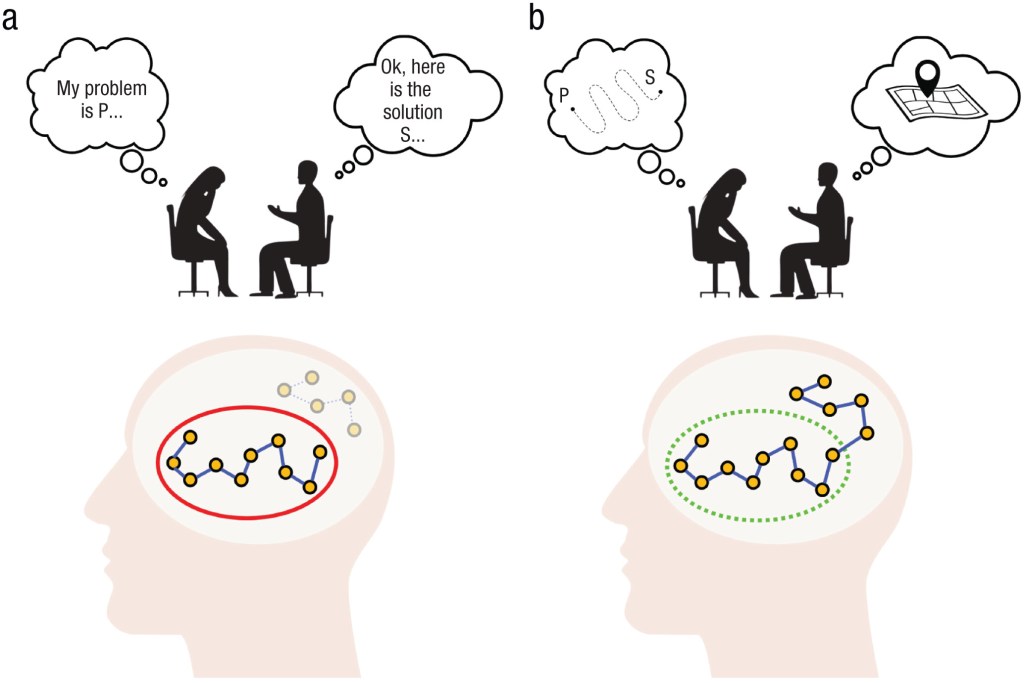
Within our framework, if (a) the solution (S) to a problem (P) is presented to the client straightforwardly and without exploration, it cannot be integrated into the cognitive map and remains abstract and unattainable. Consequently, the cognitive map remains narrow (red circle), and the solution remains detached from this cognitive structure. When (b) the internal search is successful, meaning the therapist guides the client toward a novel understanding and the client actively explores and navigates toward it, the expansion of the cognitive map (dotted green circle) becomes possible.
To understand the current framework, it is essential to grasp how individuals
(a) store and structure information about the world in their minds (i.e., through the establishment of cognitive maps) and
(b) further explore the contents of these cognitive maps (i.e., mental navigation).
“cognitive map” refers to structured mental as well as neural representations of life’s phenomena and their relations (e.g., physical, social, or conceptual space). Cognitive maps presumably house the representations of different objects, concepts, people, memories, and so on, as well as the relationships among them. These mental representations are then used for flexible cognition and manipulation in working memory to make decisions, think, and solve problems. These cognitive maps can be considered constituent parts of internal world models—a compressed, abstracted, and simplified representation of how the world works that allows individuals to understand, predict, and interact with their environment.
An internal world model is thus a collection of diverse cognitive maps applicable to different contexts. The individual’s world model may be depicted as a large graph containing different interconnected concepts or as neural networks representing objects and relations between them. That said, brain correlates for cognitive maps have long been identified in the hippocampal-entorhinal system.
It should be mentioned that cognitive maps and schemas are related constructs. They are not quite the same, however. Cognitive maps have well-characterized neural substrates in the hippocampal-entorhinal cortex, with mechanisms such as place cells, grid cells, and map-like coding of conceptual spaces. One can literally observe map-like coding in functional MRI (fMRI) and electrophysiological data.
Schemas in psychotherapy discourse, on the other hand, are most often treated as broader, more abstract cognitive structures. Hence, research suggests that cognitive maps are a more precise, structurally grounded, and neurally plausible way of modeling what schemas describe at a higher level of abstraction.
In this regard, cognitive maps offer greater granularity: Whereas schemas represent overarching frameworks that shape cognition, cognitive maps can be thought of as a network composed of individual conceptual units that can be navigated one at a time within therapeutic dialogue. That said, a further reason for favoring the term “cognitive map” is its grounding in research on mental navigation, which has been shown to operate within cognitive maps specifically, not schemas. Last, the cognitive map and its expansion via navigation might serve as a powerful conceptual metaphor for understanding the crucial detail of the process of becoming aware.
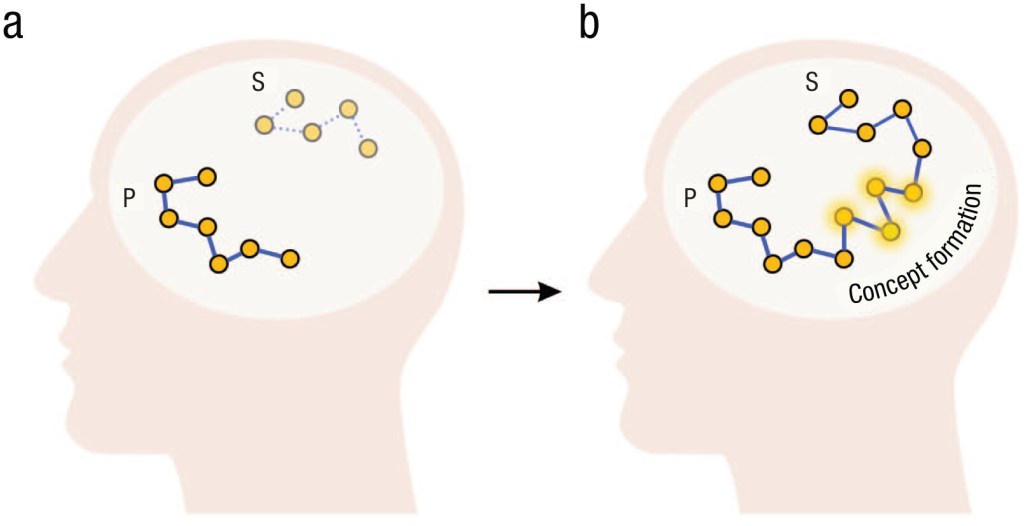
Network P in (a) the narrow cognitive map represents the client’s problem. The network representing the solution (Network S) is currently out of reach of the client’s current understanding (i.e., they cannot come to the realization because it lies several steps away from their current cognitive map). Network S is a direct solution that a therapist gives to the client. In contrast, with the help of a psychotherapist, the client paves the way for connecting the previously limited trajectory with (b) a new trajectory, thus achieving insight. Newly formed concepts (highlighted nodes) could be the concepts the client “maps out” within their cognitive map, led by the therapist’s questions.
Relying on a previous experience too much can be seen as overly exploiting preexisting trajectories while not being aware of other, more adaptive ones. In essence, it could be seen as people mentally navigating around in circles, using the most exploited connections, and failing to discover shortcuts or more effective pathways to solve their problems. Hence, for a cognitive shift, novel connections and trajectories must be developed, restructured, and augmented; that is, the cognitive map must be expanded. In keeping with the metaphor, the expansion of the cognitive map through mental navigation can be seen as analogous to the expansion of a geographical map when new territories are discovered through physical navigation.
Expanding one’s cognitive map means mentally navigating beyond one’s habitual trajectories for thinking about or explaining a problem so that new trajectories become available to the person in the conceptual as well as neural activity space. These new mental areas become “mapped” and can be revisited—something that was not possible before. If previously a person’s habitual trajectory entailed a path of minimal resistance, with a more expanded repertoire, that person can choose a new direction with more agency and choice.
the therapist should be able to detect the problematic (or narrow) patterns within the client’s navigation process and try to redirect their attention to the “unexplored territory,” often entailing a broader view of the problem.
For example, a CBT-oriented therapist who detects a negative self-referential bias would try to redirect the client’s attention to consider a broader picture by using guided discovery or Socratic questioning
The advantage of psychotherapeutic work is that, with the help of psychotherapists, clients are able to pave the way for their conscious attention to “reach” previously hidden places that influence their lives. By further working on these places, clients incorporate them into their cognitive landscape. This incorporation of previously inaccessible information allows one to “unlock” broader possibilities to apply in different situations and ultimately change the perception of the problem
the majority of people with mental-health problems are unaware of the structure of their cognitive map or the maladaptive rules and convictions they unconsciously follow
[…] a successful change through cognitive map expansion would encompass three key domains of everyday human functioning.
First, it might facilitate cognitive change by enabling individuals to revise rigid or maladaptive beliefs and to adopt more flexible, nuanced perspectives on the cognitive level.
Second, it might result in emotional change by increasing access to underlying feelings and enhancing the ability to regulate emotional responses by better understanding their explicit meanings, goals, and so on.
Third, it might mediate interpersonal change by allowing individuals to better understand their role in social dynamics and to modify unhelpful relational patterns as they become increasingly aware of how they contribute to their social relationships
The modern era of psychotherapy began more than 100 years ago with a suggestion that becoming aware of previously unconscious experiences brings positive therapeutic results.
Despite the accumulated knowledge and the evolution of psychotherapy practice and science, the general assumption remains largely unchanged to this day.
Remaining unrecognized, emotions, drives, convictions provide a basis for maladaptive behavior and decreased well-being.
Directing internal attention to these aspects and translating them into concepts turns the experiences into stable, well-differentiated mental representations that can be accessed and built upon for future decision-making, voluntary control, and further conscious elaboration.
We have shown that each therapeutic modality and theoretical framework of therapeutic change conceptualizes this process in its own way. Despite this theoretical convergence, the question of how exactly awareness emerges and how the process of becoming aware unfolds remains unanswered.
Here, we attempted to construct a metaframework that would advance our understanding of this question.
We have argued that the process of becoming aware would be better understood if framed as a cognitive map expansion via mental navigation. Mental navigation outside the boundaries of previously established and narrow cognitive maps allows one to expand the cognitive map for more adaptive navigation in the future.
We hope to have directed the attention of researchers to the importance of the internal exploration process and that future studies will shed a more empirically based light on our suggestions.

