
“Life-inspired interoceptive artificial intelligence for autonomous and adaptive agents” and free to read
Despite remarkable advances in artificial intelligence (AI), building agents that can autonomously pursue goals while adapting to continuously changing environments remains a fundamental challenge. Living organisms naturally exhibit such adaptive autonomy, offering a compelling source of inspiration for how artificial systems might achieve similar capabilities. Here we focus on interoception—the process of monitoring and regulating internal bodily states to maintain internal homeostasis—which underwrites an organism’s survival. Developing interoceptive AI requires abstracting internal states from their biological instantiation into functional and mathematical representations that are applicable to artificial systems. This requires explicit factorization of state variables representing internal and external environments, together with mathematical formalization of life-inspired properties governing internal-state dynamics. Importantly, internal states can also function as universally available and intrinsically valuable contexts, serving as stable reference signals that modulate learning and behaviour under changing external environments. In addition, interoception-related biological processes, such as neuromodulatory mechanisms, can be incorporated to support context-dependent adaptive behaviour. Overall, this Perspective presents a unified account on how interoception can enhance autonomy and adaptivity in artificial agents by integrating insights from cybernetics with recent advances in theories of life, reinforcement learning and neuroscience.
“Any autonomous agent needs to be able to resolve two things: what to do next and how to do it”
Spier, E. & McFarland, D.
Possibly optimal decision-making under self-sufficiency and autonomy.
J. Theor. Biol. 189, 317-331 (1997).
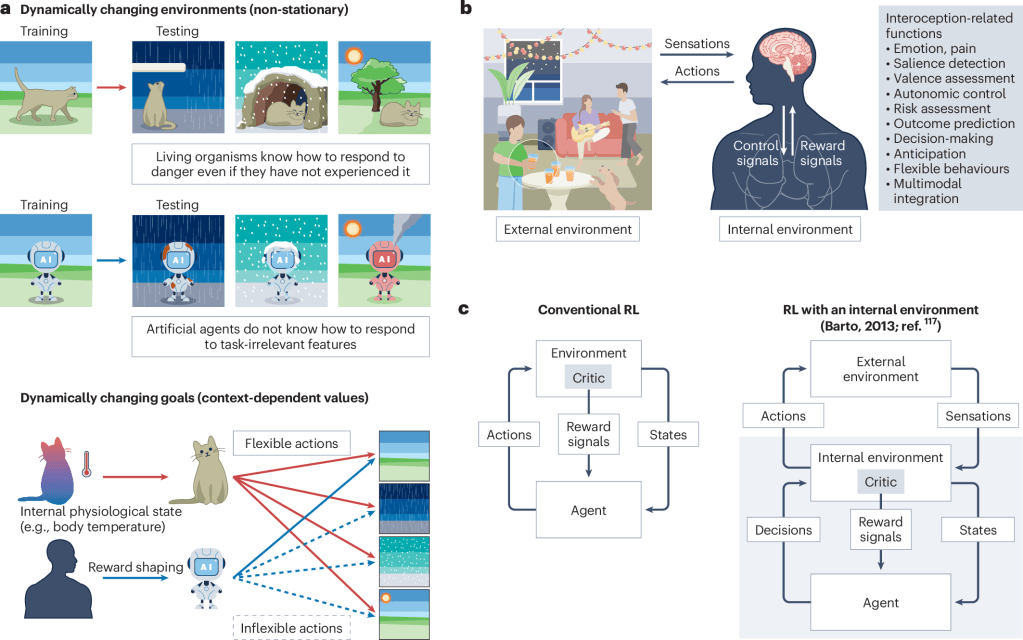
(A) Challenges in training artificial agents. Examples of dynamically changing environments (top) and goals (bottom), which are the two main targets of the interoceptive AI framework. These are substantial challenges in current AI systems.
Top (adaptivity): animals can adapt to novel and changing environments by utilizing stable internal values (for example, the cost of being too hot, cold or wet) without explicit training. Unlike animals, however, robots have no internal values and thus find it difficult to adapt to changing and new environments.
Bottom (autonomy): animals can easily perform flexible actions with dynamically changing goals, but robots need a designer’s additional instructions to change their goals
(B) Interoception in the brain. Interoception has a crucial role in providing a stable and context-dependent reference for humans and animals. For example, reward signals are generated from the internal environment (upwards arrow) and report an organism’s homeostasis (for example, thirst). Interoception then serves to contextualize exteroception in the brain, making some stimuli (for example, beverages) more salient than others to achieve homeostasis (for example, amount of water in the body). The brain can also send a descending control and regulatory signal (downwards arrow) to the body (for example, allostasis). Interoception is known to have an essential role in diverse cognitive and affective functions and their interactions.
(C) Relevant RL frameworks. Left: the conventional reinforcement learning (RL) framework without an internal environment state. In conventional RL, rewards stem from the external environment state. Right: a previous study proposed an alternative model to study intrinsically motivated behaviours, which suggests that reward signals should come from the internal environment.
Interoception indicates a biological process to monitor the physiological variables constituting internal states (or internal milieu), such as glucose levels, oxygen levels and blood pressure. This internally oriented process is, as the name indicates, a contrasting concept to its counterpart, ‘exteroception’, a typically known perceptual process to monitor sensory stimuli in the external environment. In neuroscience, interoception has been actively studied in conjunction with other mental faculties such as feelings, emotions, cognition, psychopathology and consciousness, highlighting its pivotal roles across various mental functions of agents. While interoception is traditionally defined as afferent sensing, its functionality is operationally part of a closed feedback loop with efferent regulation. This core cybernetic principle, which integrates the interoceptive sensing with control to enable stability and error correction, has also been adopted in diverse engineering fields. For instance, in the field of space robotics and aerospace, methods for monitoring the structural integrity of hardware, such as plastic deformation and fatigue damage, or overall system fault detection, have been studied and implemented, yet under different names, such as ‘prognostics and health management’ or ‘integrated system health management’. Modern AI technologies, such as deep learning, have recently been integrated with these systems to predict and manage complex system health. Building on this principle of internal monitoring, the interoceptive AI framework provides a unifying abstraction that can help extend such capabilities to a broader class of embodied agents. For example, in physical AI systems, interoceptive representations can support disaster-response robots in regulating internal stress or pressure under extreme conditions, assist household service robots in managing overheating and mechanical wear, and enable logistics agents to track actuator fatigue over prolonged operation. A critical aspect of interoception lies in its integrative and regulatory functionality. For example, natural agents (that is, living organisms) continuously monitor their internal physiological states while performing complex tasks and adapt their actions based on their internal states. Significant deviations in variables such as glucose levels or body temperature prompt animals to prioritize restoring these variables to homeostatic ranges. This results in autonomous shifts in goals, such as switching from exploring the environment to foraging for food or seeking a suitable place to regulate body temperature. This adaptive mechanism, often described as allostasis, reflects predictive and context-sensitive regulation driven by learned expectations and anticipated future demands, in contrast to the more reactive nature of homeostasis. Within the brain, such mechanisms depend on coordinated, distributed modulation across multiple brain systems. The neuroanatomical structure of the interoceptive signal pathway, which passes through the brain’s modulatory centres, is positioned to influence higher-order association brain areas, including the prefrontal cortex, insula and anterior cingulate cortex, regions important for abstracting value representations and multimodal integration. These characteristics may provide valuable insights for the development of autonomous and adaptive artificial agents.
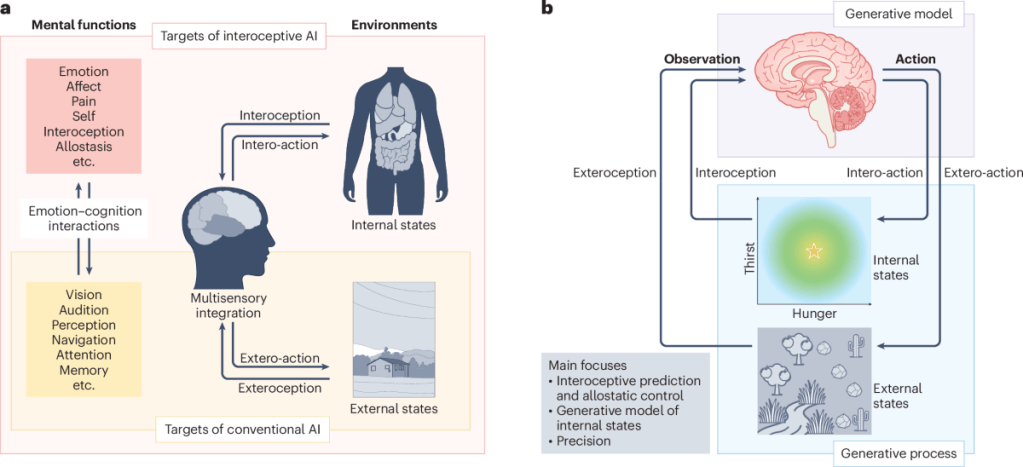
(A) Interoceptive AI as a computational model of interoception and affect. Conventional AI models have provided a useful framework for the study of perceptual and cognitive functions, such as vision, navigation and memory (the yellow area). They usually consider only the mental functions and processes pertaining to extra-personal environments (for example, exteroception), and thus they are not suitable for studying internal environment-related functions, such as emotion, pain and interoception (the red area). Alternatively, the interoceptive AI framework encompasses an internal environment, providing a computational model for interoception-related functions and their interactions with exteroception-related functions.
(B) Interoceptive active inference: a computational model of interoception. According to interoceptive active inference, an internal environment state is considered hidden from the brain.The brain only has access to the observations that the internal and external states generate (the generative process), and, based on the observations, the brain forms an internal model of how the observations are generated (the generative model). In interoceptive active inference, the brain is assumed to engage autonomic reflexes to realize homeostatic set points for attracting sets. The distance between interoceptive inputs and set points is measured by the surprisal (or prediction error) in the same way that exteroceptive predictive coding uses surprisal or prediction errors for perception and proprioceptive prediction errors for motor function. The main focuses of interoceptive active inference include belief updating, required to generate appropriate (interoceptive) set points in the form of predictions and allostatic control and contextualizing the precision of accompanying prediction errors.
Drawing inspiration from living organisms, here we introduced the interoceptive AI framework, crafted to enhance the autonomy and adaptivity of artificial agents through the incorporation of an internal environment into the traditional AI framework.
The proposed system enables an agent to monitor its internal state and adaptively recalibrate its goals and responses to cope with environmental changes. According to Claude Bernard, “the stability of the internal environment is the condition for the free and independent life,” and Singh et al. noted that “all rewards are internal.”
We believe that our life-inspired ideas of state factorization, mapping
rewards onto the internal state dynamics, and integrating neuromodulatory mechanisms will serve as essential building blocks for building autonomous and adaptive intelligence. More importantly, we aspire that our interoceptive AI framework will deepen our understanding of animal and human intelligence.
Notably, the capabilities enabled by interoception in AI systems could potentially raise ethical and moral considerations. Recognizing these concerns, we emphasize the importance of fostering careful discussions and building a consensus aligned with human values on ethical and
governance issues with the development and application of interoceptive AI systems. Such efforts are essential to ensure that these technologies are developed and utilized in ways that uphold societal values and benefit humanity.

