
“Dissent enhances the credibility of groups of Bayesian conformist decision-makers “
When making a decision, individuals use their private information to evaluate the available options.
In a group, they can also learn from other group members’ choices, which partially reveal their own private information.
Bayesian estimation provides tools for modelling decisions that optimally balance these two sources of information and can incorporate empirically documented cognitive biases, such as the conformity bias, which promotes consensus at the expense of accuracy.
[…] A more realistic model that describes groups with different degrees of conformity shows that unanimity is not an indicator of high reliability. Instead, the most reliable groups are those with relatively high levels of agreement, but not reaching total consensus.
This result shows that moderate levels of dissent are not only useful as an error-correcting mechanism but are also a characteristic of trustworthy groups.
We first consider unbiased individuals, who use information optimally to maximize the probability of choosing the correct option, without considering any other motivations and unaffected by conformity bias.
The individual will not always choose the option most likely to be correct.
The most straightforward consequence of the conformity bias is to change the group’s level of agreement.
Conformity also changes the accuracy of individual decisions. Mild anti-conformity can improve accuracy for individuals in later decision positions by preserving informational diversity. Despite this increased accuracy for a narrow range of anti-conformity, in most cases, biased individuals have lower accuracy than unbiased ones. In particular, positive conformity always decreases individual accuracy.
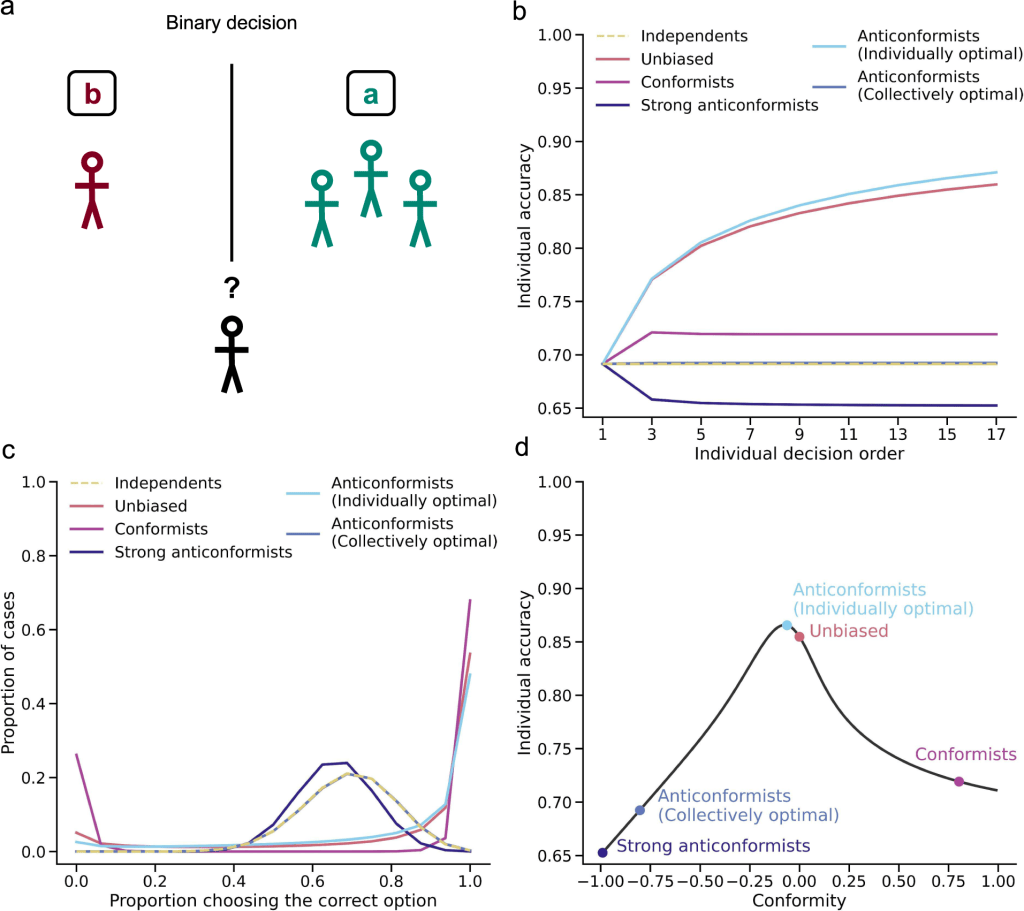
(a) Schematic of a decision-making process between two options (a and b). Four individuals have already decided, one choosing b and three choosing a. The fifth individual combines this social information with its private information about the quality of the options to make a decision.
(b) Probability that each individual of a group makes the correct choice, as a function of the order in which each individual makes the decision. Dashed yellow: independent individuals who only use private information. Red: social unbiased individuals, who use both private and social information and have no conformity bias (C=0). Purple: conformist individuals with a positive conformity bias (C=0.8). Light blue: anti-conformist individuals with a small negative conformity bias (C=-0.07) that leads to maximum individual accuracy. Medium blue: anti-conformist individuals with a moderate negative conformity bias (C=-0.8) that leads to maximum collective accuracy. Dark blue: anti-conformist individuals, who use social information and have a strong negative conformity bias (C=-0.99). In all cases, the quality of private information leads to individuals without social information having a probability of 69.15% of making the correct choice.
(c) Histograms showing the fraction of cases in which a given proportion of individuals chose option a , for groups of 17 individuals. Colours have the same meaning as in (b). (d) Probability that the last individual of the group makes the correct choice, as a function of conformity (C). Coloured dots correspond to the levels of conformity used in (b).
We now turn to collective decisions, in which we consider the choice made by the group as a whole, rather than by each individual. We define the decision of the group as the one made by the majority. In general, group accuracy (i.e. the probability that the majority makes the correct choice) increases with group size because a larger group has access to the private information of more individuals. How individuals access each other’s private information is key to modulating group accuracy.
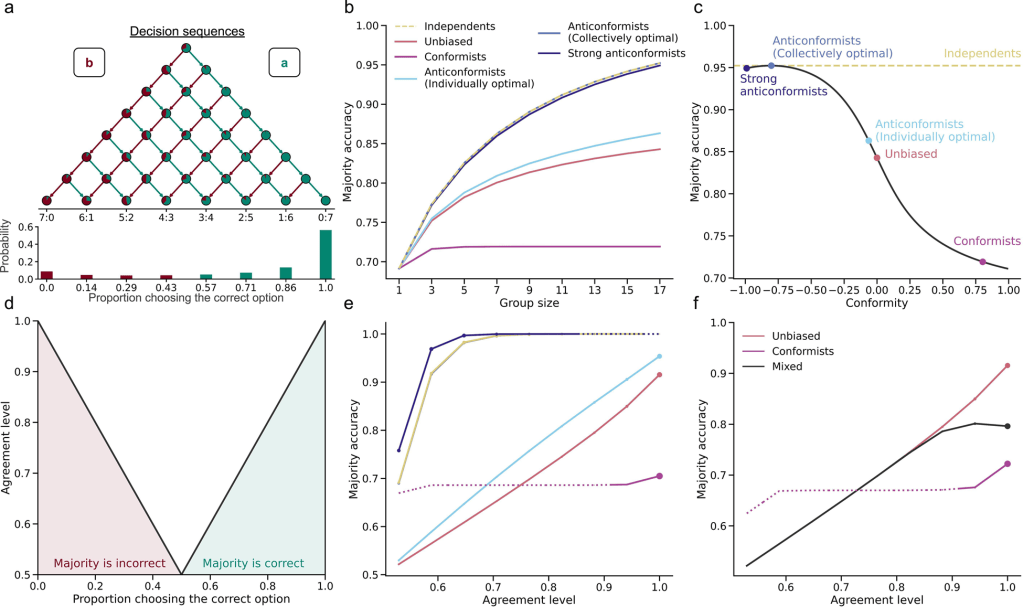
(a) Schematic of the decision-making process for a group of seven individuals. Top: decision-making sequence. Each row represents the decision of one individual in the decision sequence. Each circle corresponds to a possible social state, characterized by the number of individuals who chose each option previously. The relative amount of green/red in each node represents the probability that the focal individual chooses each option (the last line displays these probabilities for a hypothetical eighth individual). Bottom: probability of each of the eight final possible outcomes. The colour of the bars indicates whether the majority choose option a (green) or b (red).
(b) Probability that the majority of individuals in a group choose the correct option, as a function of group size. Line colours have the same meaning as in previous figure.
(c) Probability that the majority of individuals in a 17-individual group choose the correct option, as a function of conformity (C).
(d) Agreement level (i.e. proportion of individuals making the same choice as the majority), as a function of the proportion of individuals choosing the correct option.
(e) Probability that the majority of individuals in a 17-individual group choose the correct option, as a function of the agreement level and for different levels of conformity. Colours have the same meaning as in previous figure. The area of the dots is proportional to the probability of each case. Dotted lines represent cases with probability < 0.01.
(f) BI Same as (e), but for a pure population of unbiased individuals (C=0, red), a pure population of conformist individuals (C=0.8, purple) and a mixed population with 50% unbiased and 50% conformist individuals (black).
[…] Our model provides a simple formal framework to describe the effect of conformity and dissent on the credibility of collective decision-making. Owing to the simplicity of this framework, it is possible to trace the qualitative elements that produce credibility-enhancing dissent: dissent within a group correlates with low conformity of its members, which in turn increases group accuracy. This qualitative principle suggests promising avenues for empirical research examining how collective accuracy varies across agreement levels, while identifying additional factors beyond inter-group conformity variation that influence optimal accuracy in social systems.
Although our conclusions have implications when interpreting collective decisions in the real world, they must be interpreted carefully and cannot be considered universal. In some cases, the most trustworthy groups are those with some dissent, but in many other cases, unanimity does signal high trustworthiness. Our model suggests some features that distinguish these two situations, such as the quality of private information (which must be relatively low for credibility-enhancing dissent to emerge).
However, distinguishing reliably between these two types of situations would require a model that includes enough of the complexities of real-world collective decisions and enough knowledge about the specific situation to parametrize that model. Our results open the door to investigating this question, but we are still far from being able to provide normative advice.

