
“Beyond accuracy: interoceptive self-appraisal and the meaning of bodily signals”
Highlights
- Large-scale psychophysical studies find interoceptive accuracy largely unrelated to affective and mental health.
- Interoceptive ability dissociates across cardiac, gastric, and respiratory channels, undercutting single-signal measures.
- Bodily signals become most informative during arousal and physiological challenge, not in the resting states where they are typically measured.
- Appraisal, constructionist, and predictive processing accounts converge on a new target: how bodily signals are metacognitively interpreted, not detected.
- Wearables, ecological sampling, and neuromodulation now allow interoceptive self-appraisal to be measured and manipulated in context.
For decades, accuracy in detecting internal bodily signals has been considered an important component of emotional experience.
Yet this link remains elusive.
Across methods and domains, interoceptive accuracy shows inconsistent associations with emotion and psychopathology.
We argue this mismatch reflects a hierarchy of interoceptive processing: accuracy measures capture how bodily signals are detected, whereas emotion depends on metacognitive appraisals of what those signals mean, their reliability, and what they imply about the self.
We introduce interoceptive self-appraisal (ISA) as a higher-order process through which bodily sensations are interpreted in context and assigned significance. ISA provides a framework for investigating affective vulnerability and developmental pathways to psychopathology.
By integrating disparate theories of bodily appraisal, we outline a roadmap for interoception research.
We synthesize fragmented theoretical perspectives into what we term interoceptive self-appraisal (ISA), a higher-order dimension of interoception that captures how individuals interpret and assign adaptive or maladaptive meaning to bodily signals. By integrating insights from appraisal, constructionist, cognitive clinical models and predictive processing accounts, ISA provides a parsimonious explanation of how interoceptive information shapes emotion beyond perceptual detection, with important implications for explaining affective vulnerability across clinical and developmental trajectories.
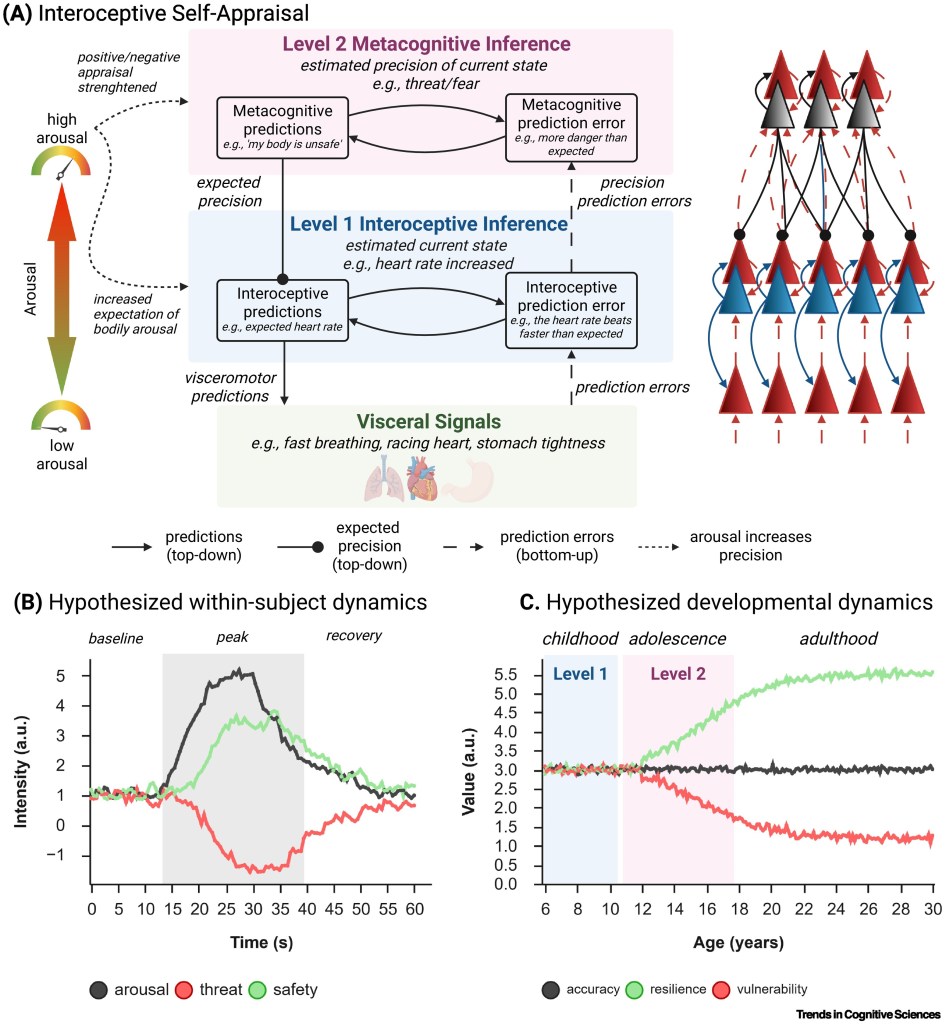
(A) ISA as a hierarchical inferential process. Visceral bodily signals provide bottom-up sensory evidence that supports level 1 interoceptive inferences about the current physiological state (e.g., ‘my heart rate is increased’). These first-order representations are integrated within level 2 metacognitive self-inference, where higher-order self-belief priors shape interpretations of bodily changes (e.g., ‘my body is unsafe’). At both levels, predictions are updated through precision-weighted prediction errors. Level 2 appraisals also modulate the expected precision assigned to lower-level interoceptive information, determining how strongly bodily signals constrain belief updating. Physiological arousal is hypothesized to modulate gain across both levels; emotional expectations predict this dynamic trajectory and elicit increased gain in contextually relevant bodily channels.
(B) Simulated illustration of hypothesized within-subject dynamics. ISA unfolds continuously across physiological perturbation and recovery. The trajectories shown are simulated and schematic and do not represent empirical data. During baseline states, bodily signals may provide limited information, and appraisal relies more strongly on prior expectations and contextual cues. Rising arousal can increase gain, while emotional expectations predict how arousal and precision will evolve; nevertheless, similar physiological trajectories may support distinct self-appraisals. During recovery, appraisals may update toward safety, facilitating emotional recovery, or remain threat biased, prolonging distress despite declining physiological activation.
(C) Simulated illustration of hypothesized developmental dynamics. ISA is acquired through developmental experience and social learning. The trajectories shown are simulated and schematic and do not represent empirical developmental data. Level 1 interoceptive accuracy may remain relatively stable across development, whereas adolescence may represent a sensitive period for consolidating level 2 self-belief priors. Flexible appraisals may promote resilience, whereas persistent threat-biased appraisals may increase emotional vulnerability and risk for psychopathology.
Interoceptive signals, particularly under quiescent conditions, are often ambiguous and therefore subject to interpretation and conceptualization. We use the term ISA to refer to the self-relevant evaluative process through which bodily sensations are assigned significance in context. Emotional stimuli, whether experienced or anticipated, elicit physiological changes. Once such changes catch our attention, they become something we actively evaluate. Moreover, appraisals can also shape interoceptive signals, highlighting the bidirectional nature of this relationship. For example, perceiving a rapid heartbeat as threatening may trigger worry or anxiety, which, in turn, can further increase physiological arousal and intensify the very sensation being appraised. This interpretive process operates at a higher-order level of interoceptive processing, involving metacognitive self-inferences about autonomic trajectories. Further characterizing these appraisal processes may help clarify interoception’s contribution to emotion and address the limitations highlighted by the ‘quiescence trap’.
Predictive processing frameworks provide a candidate mechanism for formalizing how this interpretative process may be implemented. These frameworks conceptualize emotion as arising from the brain’s ongoing attempt to infer the causes of bodily sensations and to regulate precision-weighted prediction errors within a bidirectional flow of information between the body and the brain. Crucially, predictive coding is concerned with predictions about not only sensory content but also the precision, or expected reliability, of prediction errors. At lower levels, predictive loops generate and update predictions about bodily states, supporting interoceptive inference, homeostatic regulation, and the psychophysical processes typically measured as interoceptive accuracy (level 1). At higher levels, inferred emotional states predict bodily trajectories and their expected precision; precision prediction errors signal when bodily evidence is more or less reliable than expected (level 2). We propose that ISA operates at this metacognitive level, integrating the content, reliability, and self-relevance of bodily signals as arousal unfolds. Crucially, such self-inferences also effectively modulate lower-order precision signals, acting to amplify the felt intensity of anticipated visceral channels in a spotlight-like manner.
This recursive process is also organ-specific because the bodily channels evaluated by ISA are not interchangeable.
Cardiac, respiratory, gastrointestinal, and metabolic signals differ in temporal dynamics, salience, and context-dependent relevance and may therefore acquire distinct meanings within the same individual. A racing heart may be appraised as danger, breathlessness as loss of control, gastrointestinal sensations as disgust or contamination, and fatigue as incapacity or defeat. Therefore, ISA does not posit a single global appraisal of ‘the body’, nor a unitary interoceptive trait. Rather, it describes a higher-order framework that flexibly weights channel-specific bodily evidence in context and integrates it into self-relevant affective meaning.
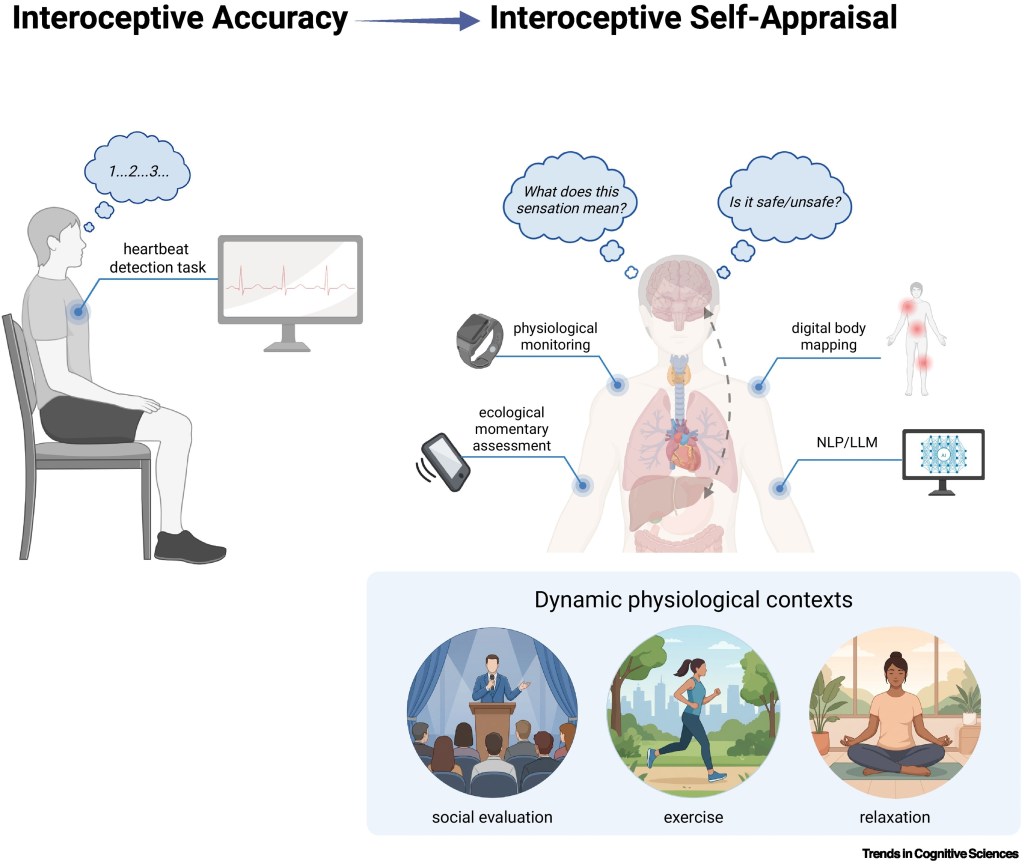
A schematic representation of the transition from traditional, static laboratory measures of interoceptive accuracy (e.g., resting heartbeat detection tasks) to the dynamic, multisystem framework of ISA. Rather than tracking isolated sensory channels at rest, ISA captures how individuals interpret and assign emotional meaning to bodily signals during real-world dynamic physiological contexts such as social evaluation, exercise, or relaxation. This paradigm shift leverages cutting-edge methodology to quantify bodily interpretations beyond standard self-reports, integrating wearable physiological monitoring, ecological momentary assessment, interactive digital body mapping, and computational language analyses to map the dynamic appraisal of interoceptive signals.
Because ISA is context dependent, ecological and translational approaches will be critical. Combining wearable physiological monitoring with ecological momentary assessment (EMA) offers the opportunity to observe how interoceptive fluctuations are interpreted in everyday life. Such approaches could identify the circumstances under which otherwise benign physiological states become associated with a sense of unsafety, clarifying both within-subject fluctuations and between-person differences in the capacity to flexibly update interoceptive appraisals across situations, and provide novel opportunities for intervention. Indeed, many established clinical approaches already target maladaptive bodily appraisal through cognitive-behavioral, exposure-based, and mindfulness-informed techniques.
Interoceptive research has spent decades attempting to explain emotional experience and vulnerability through the accuracy with which internal bodily signals are detected. Yet the persistent inconsistency of these findings suggests that detection fidelity alone cannot account for how interoceptive sensations become meaningful.
Rather than viewing these inconsistencies as a failure of individual measures, we argue that they expose a broader mismatch between the phenomena being studied and the level of analysis at which emotional experience operates.
Across appraisal, constructionist, predictive processing, and clinical models, a common insight emerges: interoceptive signals matter not simply because they are perceived but because they are interpreted.
ISA makes this shared assumption explicit, organizing a set of ideas that have long existed across adjacent traditions into a common interoceptive framework.
This shift does not diminish the importance of interoceptive signals. Instead, it redirects attention toward the processes through which they acquire personal affective meaning.
Understanding these processes requires measuring how interoceptive performance and appraisal interact during physiological change, using developmental, ecological, multisystem, and causal approaches.
If the field is to move beyond the ‘quiescence trap’, the central question can no longer be only whether the body is accurately detected but how bodily information becomes meaningful for the self.

