“Beyond representations: from active inference to active interference”
Active inference describes the system–environment boundary through statistical constructs such as the Markov blanket, a substrate-independent formalism that specifies a boundary’s functional role without committing to the physical structure realizing it.
We ask what structure can perform that role, and propose Active Interference as a complementary, biophysically grounded layer beneath the statistical description.
We argue that biological boundaries are physically instantiated, resonant interfaces—lipid membranes coupled to vicinal water and endogenous electromagnetic fields—capable of wave superposition and history-dependent feedback.
We present a minimal formalism for interference-based write/read cycles in which the substrate does not carry a representation but constitutes it. Inference is thereby grounded in interference, yielding an ontology of biological autonomy with phase-specific, falsifiable predictions.
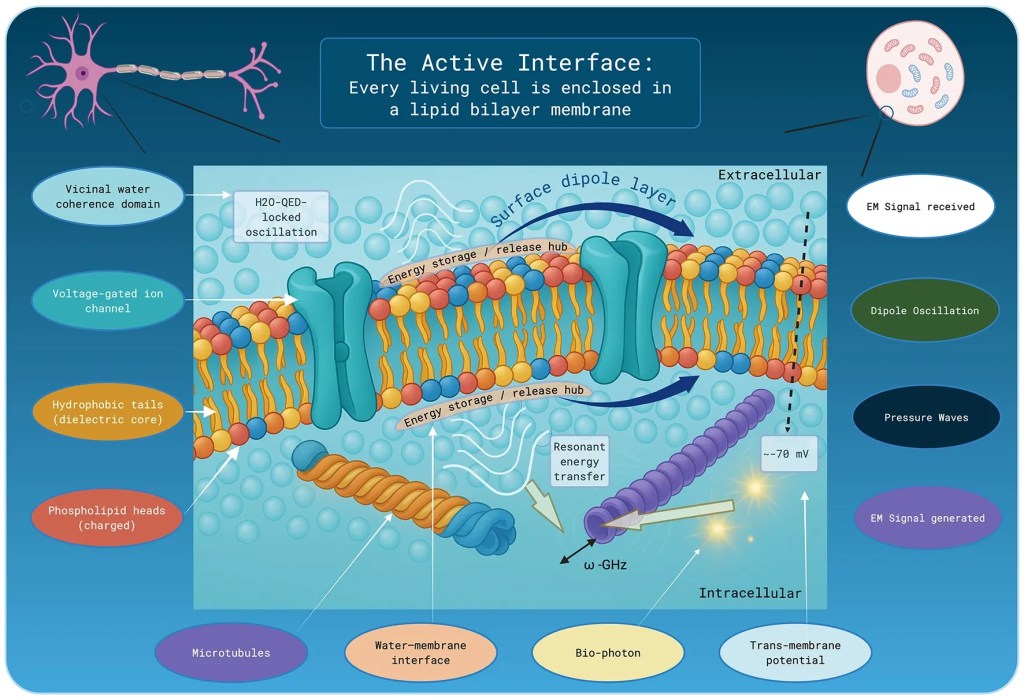
Left: cross-section of the lipid bilayer (charged headgroups, dielectric tails, voltage-gated channels, and intracellular microtubules) coupled to vicinal water coherence domains; the surface dipole layer stores and releases energy, supporting GHz biophoton emission under the transmembrane potential (~−70 mV).
Right: the membrane in exclusion-zone water, with pressure waves, dipole oscillations, and EM signaling. This universal lipid membrane is the physical boundary that active inference formalizes as the Markov blanket.
The membrane–water system constitutes a complete active interface, combining six physical properties that no statistical partition specifies:
(i) Nonlinear excitability. Far from the passive bilayer of the fluid mosaic model, biological membranes display broad chain-melting transitions reaching physiological temperatures, shiftable by membrane tension, pH, ionic strength, and anesthetics. Near the transition the membrane becomes excitable, with lateral compressibility rising by orders of magnitude alongside anomalous permeability and fluctuation-induced channel-like conductance events.
(ii) Solitonic wave propagation. We treat the action potential as a coupled electromechanical perturbation that reorganizes headgroup dipole order and generates the phase-structured excitations ψ(x, t), converging with Heimburg and Jackson’s soliton theory, in which a density pulse propagates by transiently driving the bilayer through its chain-melting transition, accounting for the mechanical, thermal, and optical signatures of nerve impulses left unexplained by Hodgkin–Huxley. Protein-free lipid monolayers independently support two-dimensional solitary waves with action-potential-like properties (threshold excitation, all-or-nothing behavior, annihilation upon collision), with adiabatic phase transitions during propagation describable by the Zel’dovich–von Neumann–Döring (ZND) detonation framework. These wave-propagating properties are intrinsic to the lipid interface itself.
(iii) A strong, composition-dependent dipole potential. Oriented headgroup dipoles, ester linkages, and interfacial water produce an electrostatic dipole potential of hundreds of mV and local fields on the order of 109 V/m, making the interface a phase-sensitive electrodynamic surface at which information is represented by spatiotemporal phase patterns. Ephaptic coupling modulates firing thresholds in a phase-dependent manner, so the membrane responds to the temporal structure, not merely the amplitude, of incident fields.
(iv) Mesoscale compartmentalization. Lipid rafts, cholesterol- and sphingolipid-enriched nanoscale domains, tune local phase sensitivity and coupling efficiency, functioning as resonant subunits of the interface.
(v) Vicinal water as a coherence medium. Water adjacent to membranes [vicinal or exclusion-zone (EZ) water] displays altered hydrogen-bond networks, increased effective viscosity, and modified dielectric response. Within UHF (Unified Holographic Framework) it is an effective coherence medium that modulates EM field propagation, stores phase-sensitive energy, and is bidirectionally coupled to membrane state, making the boundary a self-modifying surface whose properties depend on its own history: the dynamical memory the Markov blanket presupposes but does not explain.
(vi) Multiscale boundary conditions. Cerebrospinal fluid (CSF) occupies cavity-like spaces sustaining standing and traveling modes in the 0.1–30 Hz range, coupled to cortical slow oscillations; within UHF its geometry links the mesoscale interface to whole-brain coordination. Endogenous electromagnetic fields drive write/read cycles at the interface, while ultra-weak photon emission may report interface state non-invasively. The electrostatic energy dissipated during a cortical action potential suffices to drive weak Fröhlich-like condensation in the phospholipid dipole ensemble, so the interface is an active source of coherent radiation; the non-linear frequency-scaling cascade of UHF, from molecular GHz vibrations through kHz membrane solitons to Hz-band cortical rhythms, projects microscopic interface dynamics into the brain’s macroscopic electromagnetic architecture.
| Dimension | Active inference | Active interference |
|---|---|---|
| Boundary | Statistical (Markov blanket) | Physical (resonant membrane–water interface) |
| Information carrier | Probabilistic states, belief distributions | Wave dynamics, phase patterns |
| Core process | Inference (Bayesian updating) | Interference (constructive/destructive superposition) |
| Prediction | Generative model encoding expected causes | Standing interference pattern biasing interface response |
| Prediction error | Mismatch between prediction and sensory input | Perturbation of attractor landscape by incoming wave |
| Belief updating | Revision of posterior distribution | Phase reconfiguration into new attractor state |
| System–environment coupling | Conditional independence | Resonant coupling |
| Memory | Updated prior distributions | History-dependent interface state (hydration, raft configuration) |
| Energy | Free-energy minimization (info-theoretic) | Thermodynamic energy exchange at phase transition |
| Falsifiable signature | Prediction error signals in neural recordings | Phase-specific degradation under interface perturbation |
We define active interference as the formation, stabilization, and reconfiguration of coherent interference patterns at resonant biological interfaces, through the superposition of internal and external oscillatory dynamics. The term captures three features.
Interference: wave-like excitations superpose into constructive and destructive patterns that encode relational information in their phase structure, a substrate-neutral principle in which relative phase, not amplitude, carries the encoded relations.
Active: the interface is not a passive reflector but an energetically sustained, non-linear medium that amplifies, gates, and reconfigures these patterns, driven by the energy dissipated during action potentials and sustained by the non-equilibrium thermodynamics of the membrane phase transition.
Pattern: the resulting structures are attractor-like configurations constrained by interface geometry, composition, and history, constituting the physical basis of what active inference describes as beliefs, predictions, and model updating.
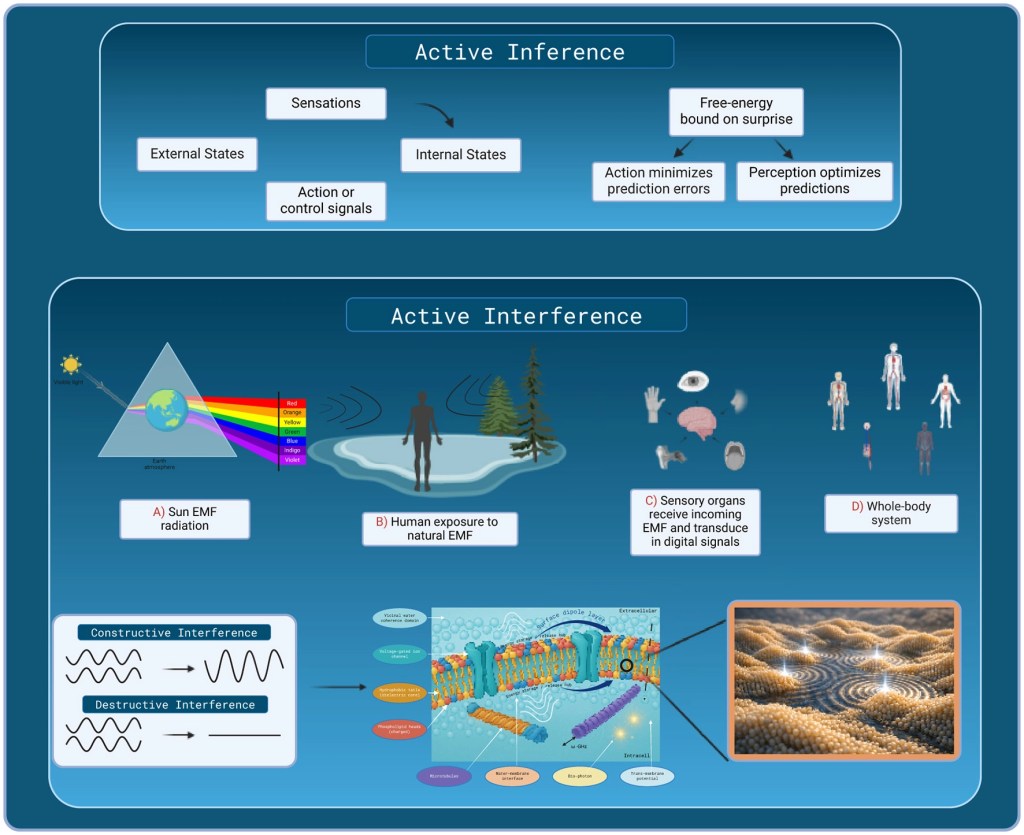
[(Top) panel]: the active inference architecture, in which external and internal states are coupled through sensory and active states across a statistical Markov blanket; perception optimizes predictions and action minimizes prediction errors, bounded by variational free energy.
[(Bottom) panel]: the active interference framework, in which the same functional architecture is grounded in biophysics. Electromagnetic fields from the environment (A) impinge on the organism (B), are transduced by sensory organs and interoceptive systems (C,D), and processed at membrane–water interfaces through constructive and destructive wave superposition. The interference patterns formed at the lipid bilayer (center) constitute the physical substrate of what the statistical formalism describes as beliefs, predictions, and model updating.
Active interference is not a competitor to active inference but a specification of its physical implementation: the relationship is one of containment, not opposition. The decisive implication is that inference does not generate biological agency, it traces it: the organism does not compute a posterior, it resonates into a new configuration. Active inference characterizes adaptive behavior through information-theoretic quantities (free energy, surprise, and posterior beliefs); active interference specifies the physical process from which those quantities are abstracted. The information-theoretic description is the more restricted of the two, being what remains once the phase structure of the interface is coarse-grained into conditional-independence relations and its thermodynamics re-expressed as a divergence between probability densities.
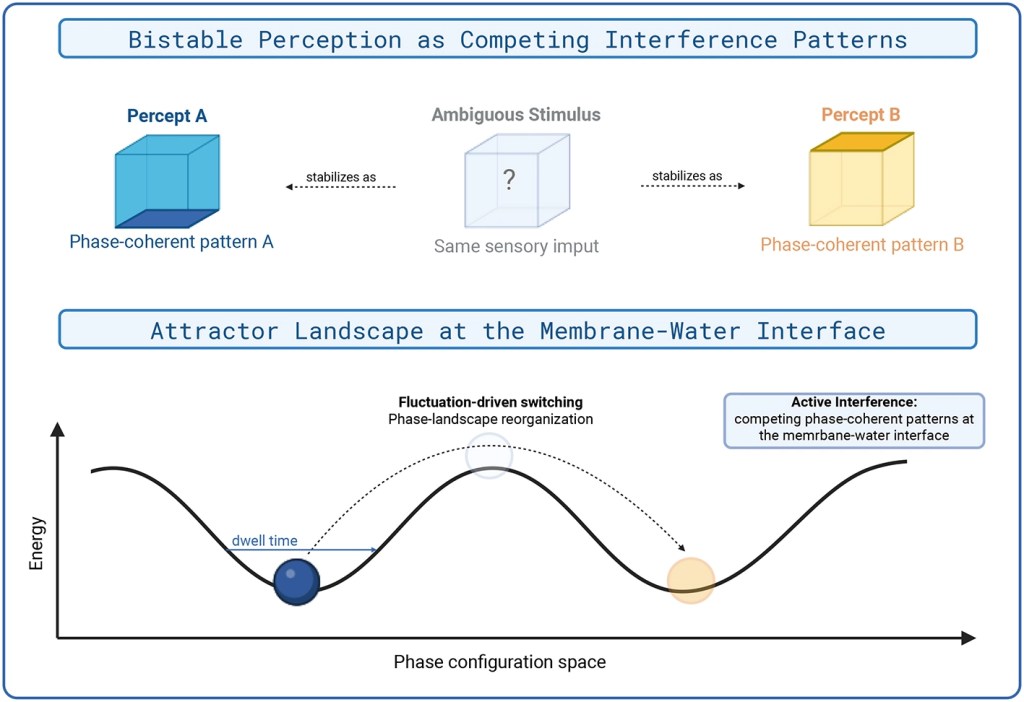
(Top): an ambiguous stimulus (e.g., Necker cube) supports two mutually incompatible percepts (A and B), each corresponding to a distinct phase-coherent pattern stabilized across the membrane–water interface. The same sensory input resolves into one or the other configuration depending on the current state of the phase landscape.
(Bottom): the corresponding attractor landscape in phase configuration space. Each percept occupies a local energy minimum; perceptual switching corresponds to fluctuation-driven transitions between wells, with dwell time reflecting attractor depth. Active interference is the dynamical process by which competing phase-coherent patterns at the membrane–water interface settle into one stable configuration—and periodically reorganize into the alternative.
The transition from active inference to active interference is not a play on words. It marks a shift in explanatory ontology:
– from statistical partitions to physical interfaces,
– from probabilistic representations to dynamical phase patterns,
– from computational metaphors to wave superposition at resonant boundaries.
This does not invalidate active inference; it grounds it in a biophysical mechanism and opens it to a new class of falsifiable predictions.
Three propositions summarize the framework.
First, biological autonomy is constituted by physically instantiated, resonant interfaces. In the cases considered here these are lipid membranes coupled to vicinal water and to endogenous electromagnetic fields. Their nonlinear, excitable, history-dependent properties generate the dynamics that statistical formalisms only describe.
Second, biological information is form-in-action, not a static representation of external causes.
Third, this principle is already independently validated biophysically (UHF–EMI) and through engineering, with a formal framework connecting interface physics to the information-theoretic quantities of active inference.
Whether the framework withstands experimental scrutiny remains open; what it offers immediately is a sharply framed, testable account of how energy, mass, and information converge at the boundaries of living systems.
This reframing carries an ontological corollary. In an engineered system, hardware and software are separable: the same algorithm runs on any substrate, and a simulation of a physical process is not that process.
At a resonant biological interface this separation collapses. The dynamics and what they encode are two faces of a single physical event, and the membrane therefore does not operate upon a representation: it is the configuration it instantiates.
Chemical Artificial Intelligence makes the same wager on different material, treating molecules and macromolecules as hardware and the non-equilibrium processes of the liquid phase (chemical reactions, diffusion, migration, convection, chemical waves) as software.
Active interference contributes one further process to that list and gives it a boundary.
The two frameworks also share a consequence that can be tested: substrate-independent emulation should reproduce what depends only on the computational rule and fail on what depends on the physical phase state itself.

