
“Can artificial systems become conscious?—Recursive embodied closure as an integrative framework”
Recent advances in artificial intelligence, connectomics, and computational neuroscience increasingly raise the question of whether artificial systems—or even pure computer simulations—could become conscious.
Contemporary theories emphasize embodiment, predictive processing, homeostatic regulation, and continuous interaction between cognition, body, and environment rather than isolated computation. We propose recursive embodied closure as an integrative framework linking embodied, predictive, functionalist, and dynamical approaches to consciousness.
Rather than replacing existing theories, the framework identifies a shared organizational principle: the continuous recursive coupling of cognition, bodily regulation, action, and environmental feedback.
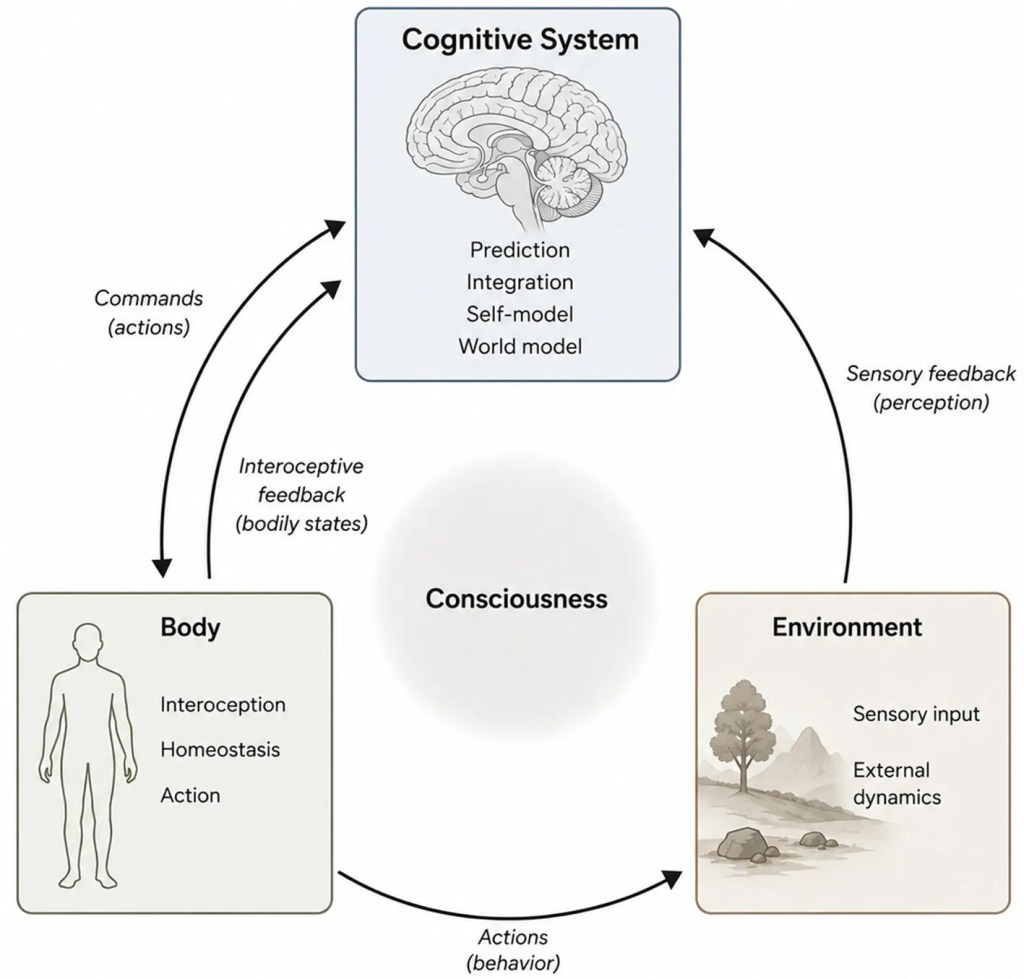
[..] Consciousness is best understood as an emergent property of recursively embodied, environmentally embedded cognitive systems rather than of biological matter itself.
Consciousness may, in principle, emerge in artificial systems, including computational simulations, for three reasons.
First, consciousness may depend on recursively closed loops linking cognition, body, and environment, and such loops could also be realized in robotic, neuromorphic, or virtual embodiments.
Second, evidence from comparative neuroscience, convergent evolution, neurotechnology, and philosophy of mind suggests that the mechanisms relevant for consciousness are largely substrate-independent and may therefore be implemented in both biological and artificial systems.
Third, although unknown physical mechanisms cannot be excluded, there is currently no empirical evidence for biological processes that are uniquely necessary for consciousness.
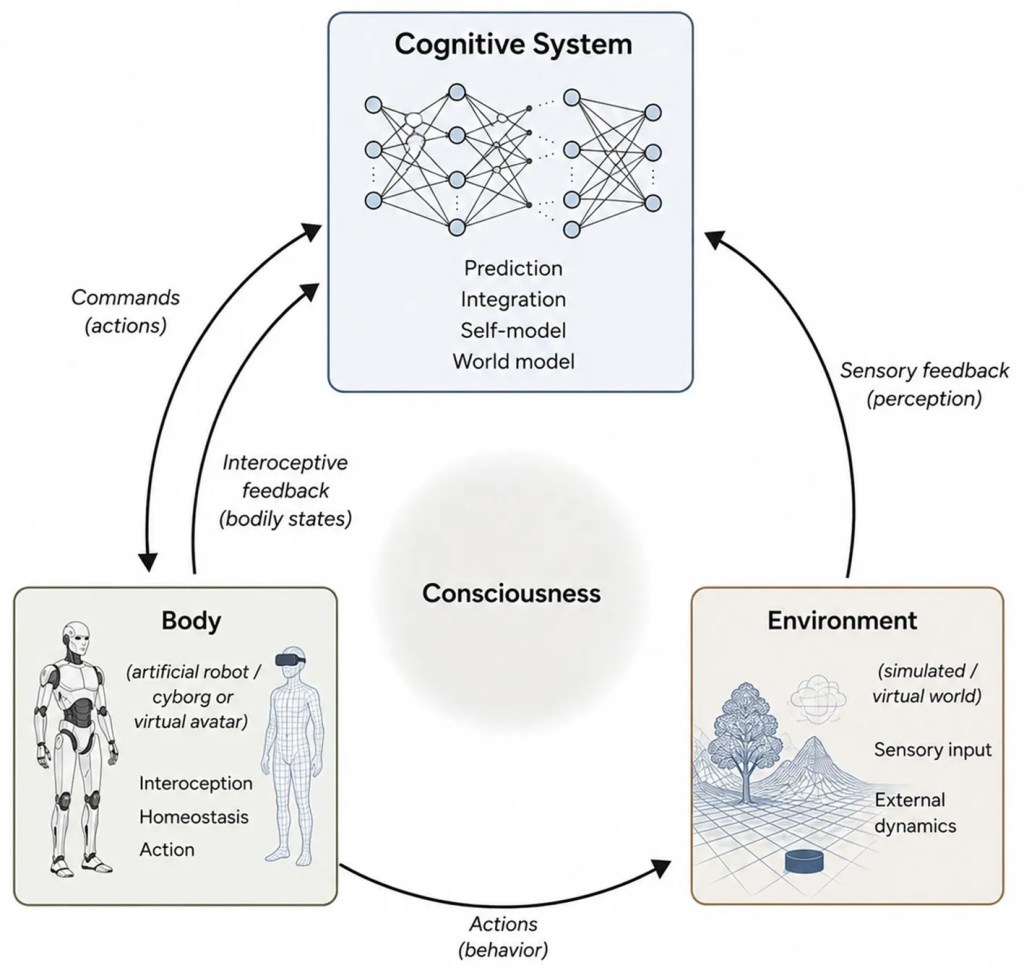
If so, biological brains, artificial neural networks, neuromorphic hardware, and even virtual agents may constitute plausible candidates for future artificial consciousness.
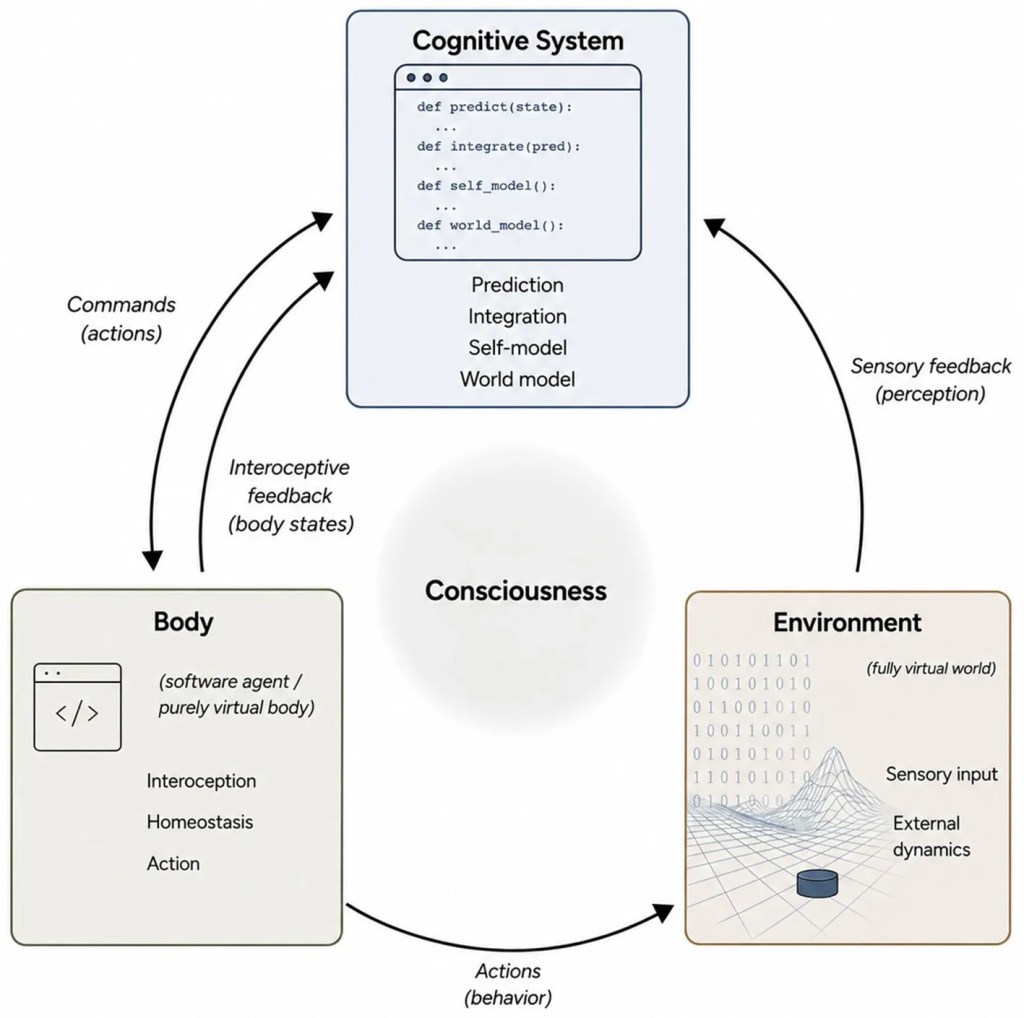
If this view is correct, neither the body nor the environment necessarily need to be biological or even physically real, but may in principle also exist as virtual or simulated systems. Within the framework of the Platonic Representation Hypothesis, similar representational and cognitive structures may emerge across different substrates whenever sufficiently similar organizational principles are realized.
Consequently, biological brains, artificial neural systems, neuromorphic hardware, and potentially even fully virtual agents may converge toward functionally and phenomenologically similar states.
Although the possibility remains that consciousness depends on currently unknown physical mechanisms, this assumption would ultimately require empirical specification. Until such evidence exists, increasingly sophisticated artificial agents embedded in coherent sensorimotor interaction loops may represent plausible candidates for future forms of artificial consciousness.
Three central claims.
- Consciousness does not emerge from cognition alone, but from a dynamically closed loop between a cognitive system, a body, and an environment.
- Consciousness-relevant cognitive organization may be multiply realizable in biological brains, artificial neural systems, neuromorphic hardware, or computational simulations.
- Neither body nor environment necessarily need to be biological or even physically real, but may in principle also exist as fully virtual or simulated systems.

