“Contagion and escalation of rule violations”
In many real-world settings, rule violations are not simply binary but vary in severity: individuals may deviate slightly or substantially (e.g. driving at 75 vs. 100 mph in a 70-mph zone). While existing theoretical and experimental approaches have treated rule-following as a graded behaviour, less is known about how the severity of observed violations shapes subsequent behaviour, and whether such responses can trigger escalation, where individuals exceed the violations they observe.
Human societies rely on rules to coordinate behaviour, sustain cooperation and maintain social order.
Yet compliance can be fragile when rules are weakly enforced and individuals observe others violating them.
Prior research shows that rule violations and other antisocial behaviours can spread through social influence, but less is known about how the severity of violations shapes these dynamics. In many real-world settings, rule-breaking occurs in degrees, from minor infractions to major violations, and individuals may not only imitate others but sometimes exceed the violations they observe.
Here, we combine simulations and a behavioural experiment (n = 750) to study how the magnitude of observed rule violations shapes subsequent violations, and how this can generate escalation dynamics. Our simulations show that when individuals occasionally escalate beyond observed violations, even rare escalation can trigger a rapid shift from widespread compliance to collective rule-breaking. In our pre-registered experiment, observing major violations strongly increased rule-breaking, especially when committed by socially close others.
Observing minor violations prompted many participants to follow suit and a minority to escalate beyond the violations they observed. Parameterizing the simulations with these behavioural responses shows that such escalators can disproportionately undermine collective compliance.
These results highlight how asymmetric responses to rule violations and rare escalatory behaviour can transform small deviations into large-scale breakdowns of rule compliance.
Rule-following is a central feature of human societies and a key mechanism for coordinating behaviour in groups. Rules, including formal laws and regulations as well as informal social and moral norms, prescribe or proscribe particular behaviours, thereby creating the predictability needed for cooperation, social order and collective action. Understanding when and why individuals follow or violate rules is therefore a fundamental question across the biological, behavioural and social sciences, including evolutionary biology, behavioural ecology, economics and psychology. People often comply with rules voluntarily, even when doing so goes against their immediate self-interest and when enforcement is weak. For example, people often queue in public spaces, avoid littering and report taxes honestly despite limited formal oversight. However, such voluntary rule compliance is fragile: observing others violate rules can give rise to behavioural contagion, whereby rule violations spread through social influence, potentially undermining cooperation, eroding social order and contributing to undesirable outcomes such as vandalism, rioting and group bullying.
Many real-world rule violations occur in degrees rather than as all-or-nothing decisions. For example, speeding in traffic ranges from adhering to limits to slight speeding to reckless racing; plagiarism ranges from paraphrasing without citation to outright copying and tax evasion ranges from minor underreporting to large-scale fraud.
Some theoretical models represent behaviour as a gradual action space in which social influence shapes dynamics within a bounded range of possible behaviours, and some experimental paradigms likewise allow participants to vary the extent to which they follow a rule. However, less is known about how the magnitude of observed violations shapes the magnitude of subsequent violations. In particular, existing work has focused on imitation and convergence, largely overlooking the possibility that individuals may respond by exceeding the violations they observe. Such responses could generate escalation dynamics, whereby small initial deviations progressively expand the range of acceptable behaviour, for example, minor speeding may encourage others to drive even faster, just as shouting and gesturing can escalate into violent action
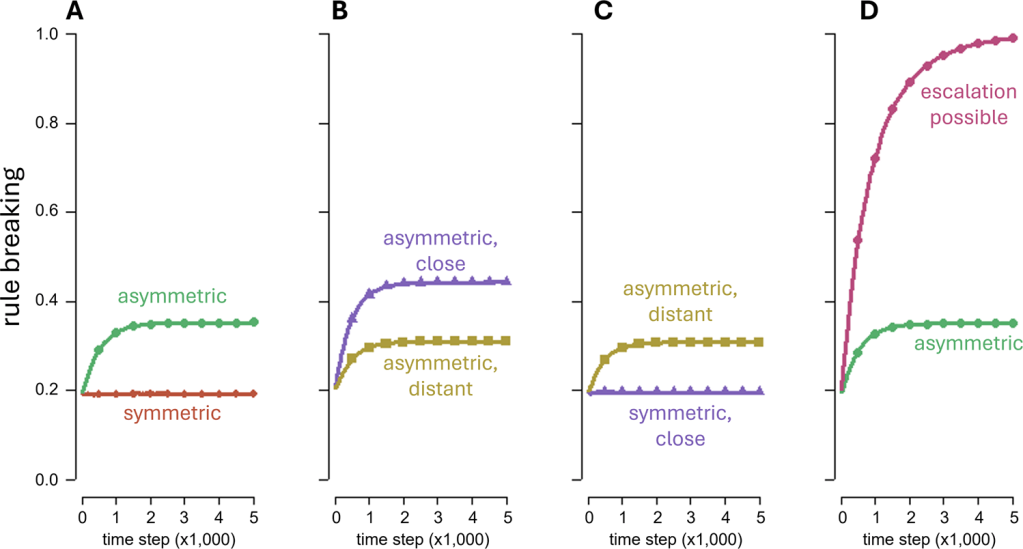
Lines show mean rule-breaking across 30 simulation runs.
(A) Symmetric influence of rule-following and rule-violating examples maintains initial levels of rule-breaking (red diamonds), whereas stronger influence of rule-violating examples increases rule-breaking (green diamonds).
(B) When social proximity strengthens social influence, this asymmetric effect is exacerbated in socially close groups (purple triangles), and attenuated in socially distant groups (golden squares).
(C) When social proximity strengthens influence of rule-following examples—such that rule-following and rule-violating examples are more symmetric—rule-breaking is highest in socially distant groups.
(D) When agents can ‘escalate’ observed rule violations—exceeding others’ transgressions, rule-breaking rapidly intensifies and results in collective rule-breaking
To explore how social influence shapes the dynamics of rule-following and rule violation on a graded scale, we developed a simulation model in which agents update their level of rule-following over time. The aim is to map a possibility space of group-level consequences that emerge from different patterns of individual responses, rather than predict precise real-world outcomes. Specifically, we focus on how social influence can transform an initially orderly population—in which most agents follow rules—into one where rule violations may arise and spread. We examine how different (symmetric or asymmetric) reactions to observing rule-following and -breaking scale up to collective dynamics. To this end, we keep the model simple and abstract away from cognitive mechanisms and payoff consequences of behaviour.
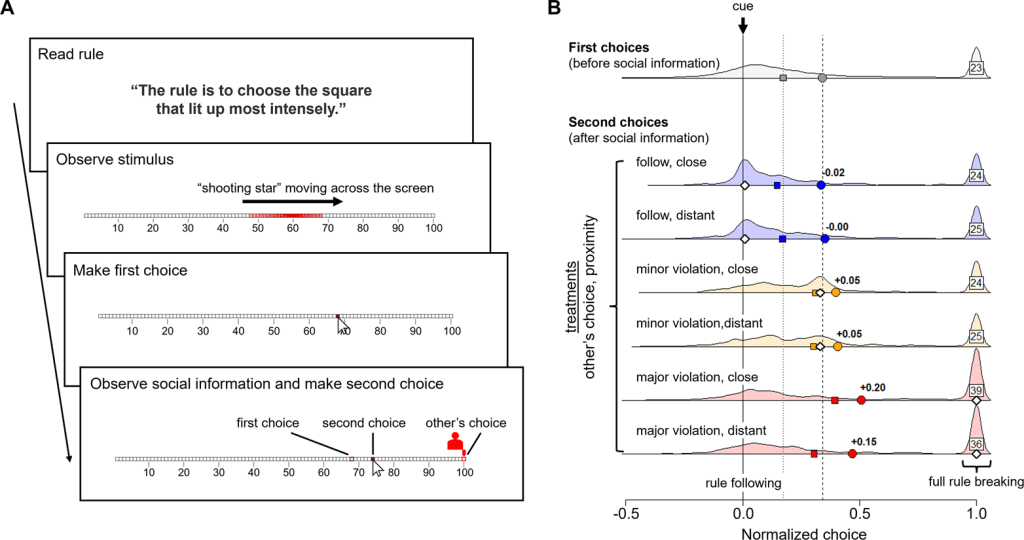
(A) Participants observed an animated ‘shooting star’ moving across 100 squares. […] Participants made a first choice. Then, they observed the choice of a previous (‘other’) participant who was labelled as either a Democrat or a Republican. This social information, together with the participant’s own first choice, remained visible on the screen while participants made their second choice.
(B) Distributions of first and second choices. Second choices are shown by treatment, varying the other’s behaviour (rule-following, minor violation, major violation) and social proximity (as reflected by their political identity). White diamonds indicate mean social information, filled coloured circles indicate participants’ mean second choices (labels show mean changes from first choices) and filled coloured squares indicate medians. First-choice means and medians are shown in grey, with thin vertical reference lines for comparison. Numbers above x = 1 indicate percentages of full rule breakers.
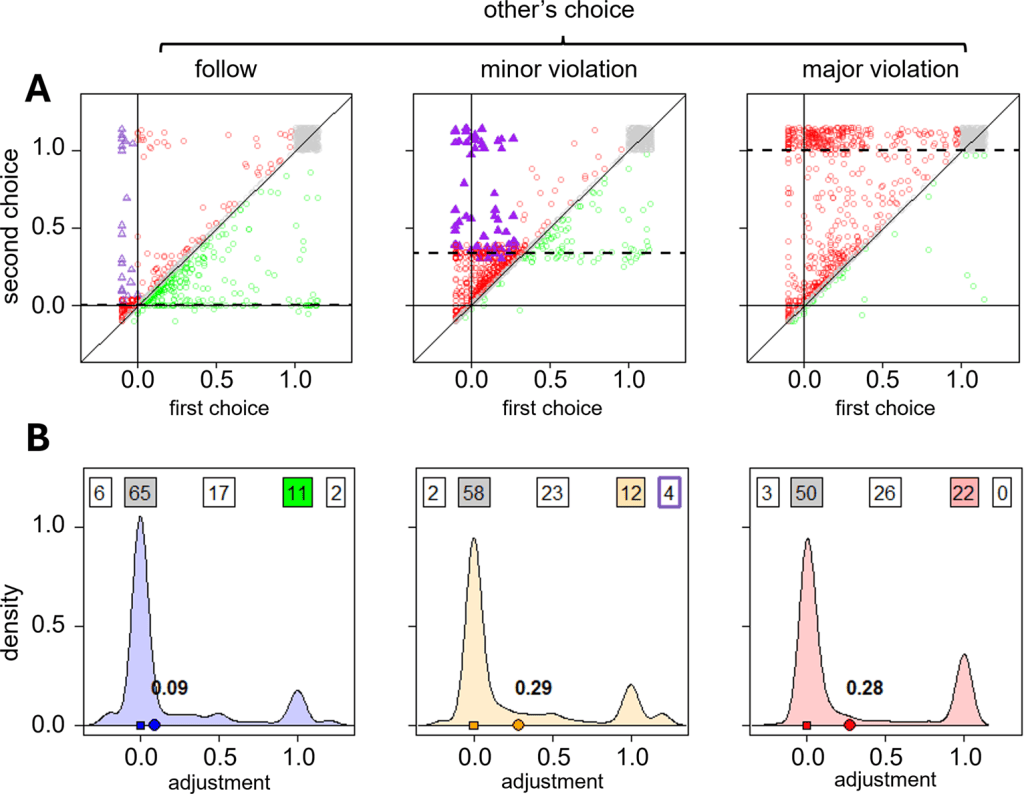
(A) Scatterplots show second choices as a function of first choices when the observed other participant either followed the rule, or committed minor or major violations. Dots show participants’ choices in individual trials. Colours indicate the types of updates (green: reduced rule-breaking; red: increased rule-breaking; grey: no change; purple: updates exceeding the observed behaviour (r1 < X and r2 > X). In the rule-following condition, open triangles denote participants whose first choice lay left of the cue and whose second choice overshot the observed rule-following example; in the minor violation condition, filled triangles denote ‘escalation’ beyond the observed rule violation. Thick horizontal dashed lines show average social information (X) in each treatment. Thin lines at x = 0 and y = 0 mark the cue; the diagonal indicates no change. First or second choices that are full rule-breaking (x = 1 and y = 1) are shown with positive-only jitter to reduce overplotting.
(B) Distributions of adjustments from first to second choices. Circles with labels indicate average adjustments, and squares indicate medians.
Our study highlights the powerful role of social influence in shaping rule-following behaviour. In our experiment, we observed that rule-violating examples exerted a stronger influence than rule-following examples, and this effect was amplified by social proximity.
Our data suggest that minor violations invite imitation and can sometimes trigger escalation.
We then use the experimentally collected parameters to inform the simulations. We find that even when limited to a minority of individuals, escalatory responses can substantially undermine collective rule compliance as violations spread through groups.
Together, our simulation model and behavioural experiment reveal how minor violations can lead to collective rule-breaking.
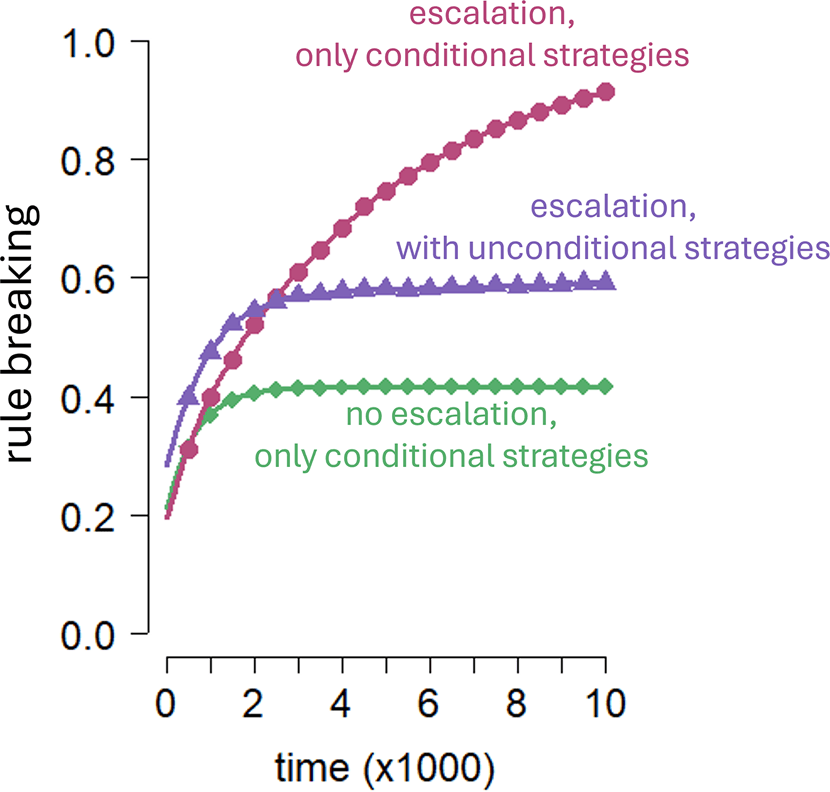
Agents updated their behaviour based on the mean adjustment observed in response to rule-following and rule-violating in the experiment (green diamonds).
Adding a small probability of escalation amplifies rule-breaking over time (pink dots).
Including a proportion of unconditional rule-followers and rule breakers, as observed in the experiment, tempers this escalation and stabilizes the group at an intermediate level of rule-breaking (blue triangles).
Lines show averages
Taken together, our study sheds light on the behavioural processes through which rule violations spread through social influence, showing how individuals’ escalatory responses to minor rule violations can scale up to collective rule-breaking.
These findings identify a behavioural mechanism through which minor rule violations may not only spread through groups, but also progressively amplify, increasing the severity of subsequent violations and ultimately giving rise to collective rule-breaking.

