“Embracing wicked problems thinking will advance conservation science and practice”
Highlights
- Provides a definition for understanding wicked problems in conservation science
- Demonstrate how wicked problems thinking can inform research through case studies
- Provide a framework with recommendations to support conservation scientists
Wicked problems thinking has been used to describe problems related to food security and health care, but it is often underused or misused to describe and investigate conservation problems.
In this paper, we define wicked conservation problems as conservation problems that involve the following:
(1) non-human, more than human, and human actors;
(2) conflicting values among actors;
(3) uncertainty that is non-reducible;
(4) an extended timeline with no set end;
(5) a need for satisficing decisions agreed among most actors;
(6) inability to isolate the nature of the problem;
(7) no test of success; and
(8) every wicked conservation problem can be considered a symptom of another problem.
We explore three case studies of conservation science problems, two of which have not been described previously in the literature as wicked problems. Using our definition of a wicked conservation problem, we provide evidence that each case study meets the criteria of a wicked conservation problem.
To better support conservation scientists in studying wicked conservation problems, we provide several recommendations to facilitate more effective research:
(1) where appropriate, accept a conservation problem as a wicked conservation problem;
(2) take collective action;
(3) set and manage expectations; and
(4) reassess the wicked conservation problem as it evolves.
We hope that this paper will be used by conservation scientists to conduct and facilitate more context-appropriate research on wicked conservation problems.
Rittel and Webber (1973) coined the term ‘wicked problem’ and provided a formal definition that included ten distinguishing features:
(1) no definitive formulation,
(2) no stopping rules,
(3) no true or false solutions,
(4) no ultimate tests of solutions,
(5) no opportunities for trial and error,
(6) no set number of potential solutions,
(7) essential uniqueness,
(8) connection to other wicked problems,
(9) discrepancies (often numerous), and
(10) consequences for refuted hypotheses.
Ultimately, wicked problems are those that have no simple solution—they are ‘untame’ problems that involve multiple actors with competing interests and values, multiple points of uncertainty, and no time limit on solutions.
In fact, wicked problems may never be solved—only managed more or less effectively over time. These ideas have been accepted and adopted in various disciplines, including political and environmental sciences, and are gaining greater recognition in research at large.
The Wicked Conservation Problems Spiral is a conceptual tool to describe conservation research through theories of wicked problems and through our definition of a wicked conservation problem.
Wicked conservation problems have extended timelines and tend to be cyclical in nature; attempts to address one issue often generate new challenges that require further investigation, mainly due to their lack of a set endpoint. For example, in conservation science, even when specific threats are addressed (such as protection measures for a species at risk), the initial solution may only be temporary or prove ineffective, or the initial threat (such as an invasive species) might remain.
In our Wicked Conservation Problems Spiral, each loop represents a specific question or problem that actors aim to address within a broader conservation context.
Our definition of wicked conservation problems also recognizes that actors are integral to the research questions and to inform more effective management. We represent these actors—human, non-human, and more-than-human—as braided strands that form the Wicked Conservation Problems Spiral itself. This structure seeks to acknowledge non-Western knowledge systems, particularly the reciprocal land-human relationships expressed in Indigenous knowledge systems and other works.
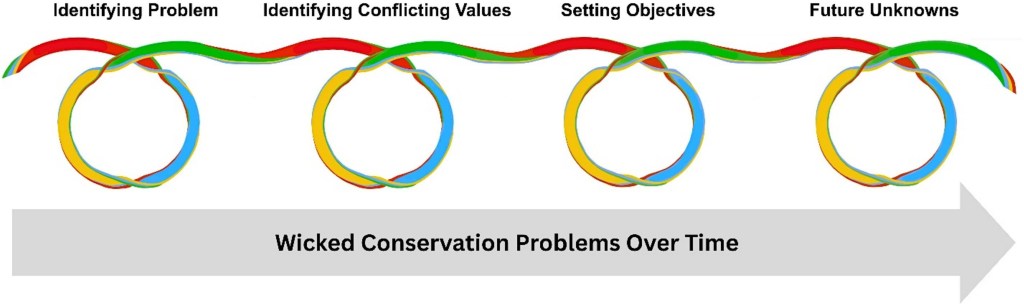
This spiral provides a visual depiction of the evolving nature of a wicked conservation problem over time. Each loop is composed of interwoven segments that have their own dominant periods. This represents the multifaceted nature of the problem. Each loop represents a new arising issue within the wicked conservation problem, with their own evolving goals and side effects, requiring constant reassessment.
To support knowledge generators (e.g., researchers, academics, community leaders) researching wicked conservation problems, we outline a Framework for Conducting Research on Wicked Conservation Problems.
We recommend that knowledge generators
(1) accept that a conservation problem is wicked (when appropriate),
(2) take collective action,
(3) set and manage expectations, and
(4) reassess the conservation problem as it evolves.
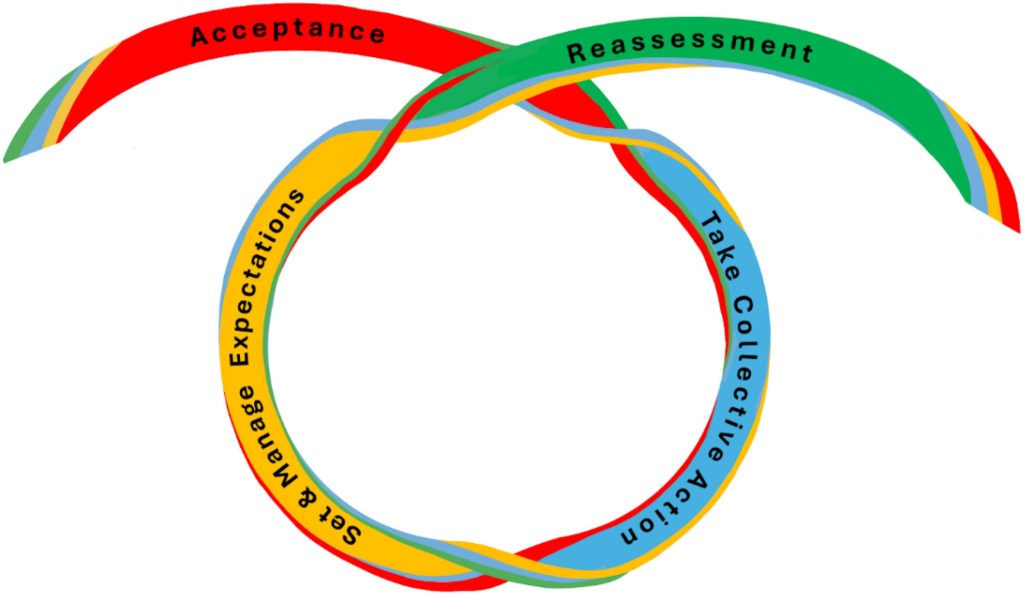
The framework has four recommendations: (1) accept that a conservation problem is wicked (when appropriate), (2) take collective action, (3) set and manage expectations, and (4) reassess the conservation problem as it evolves.

