
The social mind is tailored to the problem of predicting the mental states and actions of other people. However, social cognition researchers have only scratched the surface of the predictive social mind. We discuss here a new framework for explaining how people organize social knowledge and use it for social prediction. Specifically, we propose a multilayered framework of social cognition in which two hidden layers – the mental states and traits of others – support predictions about the observable layer – the actions of others. A parsimonious set of psychological dimensions structures each layer, and proximity within and across layers guides social prediction. This simple framework formalizes longstanding intuitions from social cognition, and in doing so offers a generative model for deriving new hypotheses about predictive social cognition.
Diana Tamir & Mark Thornton propose a multilayered framework consisting of two hidden layers – traits and states –and one observable layer – actions. This framework address two key challenges in social cognition: organizing social knowledge efficiently, and using it for social prediction.
Three dimensions – rationality, social impact, and valence – organize the layer of mental states, while three dimensions – power, sociality, and valence – organize the domain of traits. Cross-encoding analysis suggests that these layers may be partially overlapping.
Proximity within state space predicts perceived and actual transitional probabilities between emotions, and mediates the accuracy of one’s perceptions. Thus, the organizational dimensions of social content may scaffold social prediction.

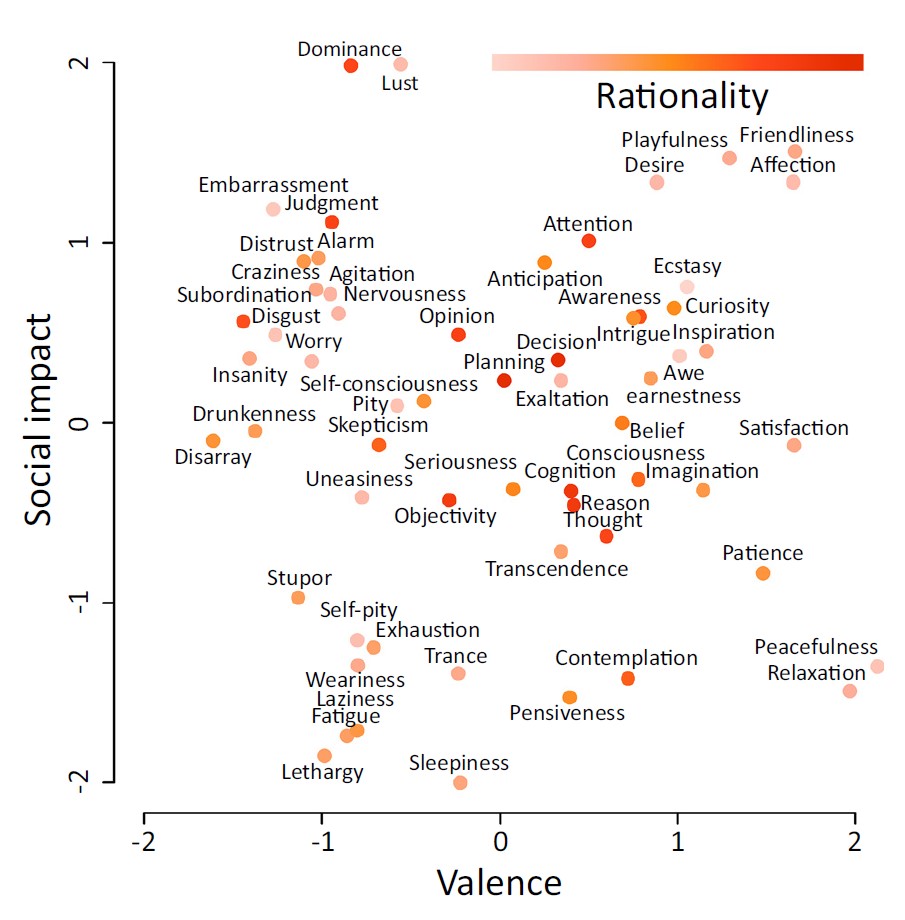
The neural representation of mental states is defined by three psychological dimensions: Social impact (y axis), valence (x axis), and rationality (orange gradient). The figure below plots 60 mental states that span each of the three dimensions.
Positions on each dimension were derived from principal component analysis of ratings of mental states on dimensions from existing psychological theories including valence and arousal, warmth and competence, agency and experience, emotion and reason, mind and body, social and nonsocial, and uniquely human and shared with animals.
Rationality loads highly in one direction on the dimensions emotion, experience, and warmth, and loads highly in the opposite direction on reason, agency, and competence; social impact loads positively on the social and high-arousal dimensions, and negatively on nonsocial and low-arousal; valence loads positively on positive and warmth, and negatively on negative.
 Surtil :
3 responses to “Modeling the Predictive Social Mind”
[…] ideas presented, also scale up to a higher level of teams and societies, and helping decision-making uncertainties for communities. Foundation of this acceptance of governing VUCA is the key observation that we – as a […]
LikeLike
[…] social context we live in, has some complex, but important characteristics, and our well-being depends on the feedback we get. In the article Kindness in short supply: […]
LikeLike
[…] te brengen blijven: ga even wandelen, of slaap er eens over. Dit is ook van toepassing ook voor sociale interacties, en hoe deze de oude structuren kunnen […]
LikeLike