
Natural decisions involve two seemingly separable processes: inferring the relevant task (task-belief) and performing the believed-relevant task.
The assumed separability has led to the traditional practice of studying task-switching and perceptual decision-making individually. In this study, “Dynamic task-belief is an integral part of decision-making”, Xue, Kramer and Cohen used a novel paradigm to manipulate and measure macaque monkeys’ task-belief and demonstrated inextricable neuronal links between flexible task-belief and perceptual decision-making. They showed that in animals, but not in artificial networks that performed as well or better than the animals, stronger task-belief is associated with better perception.
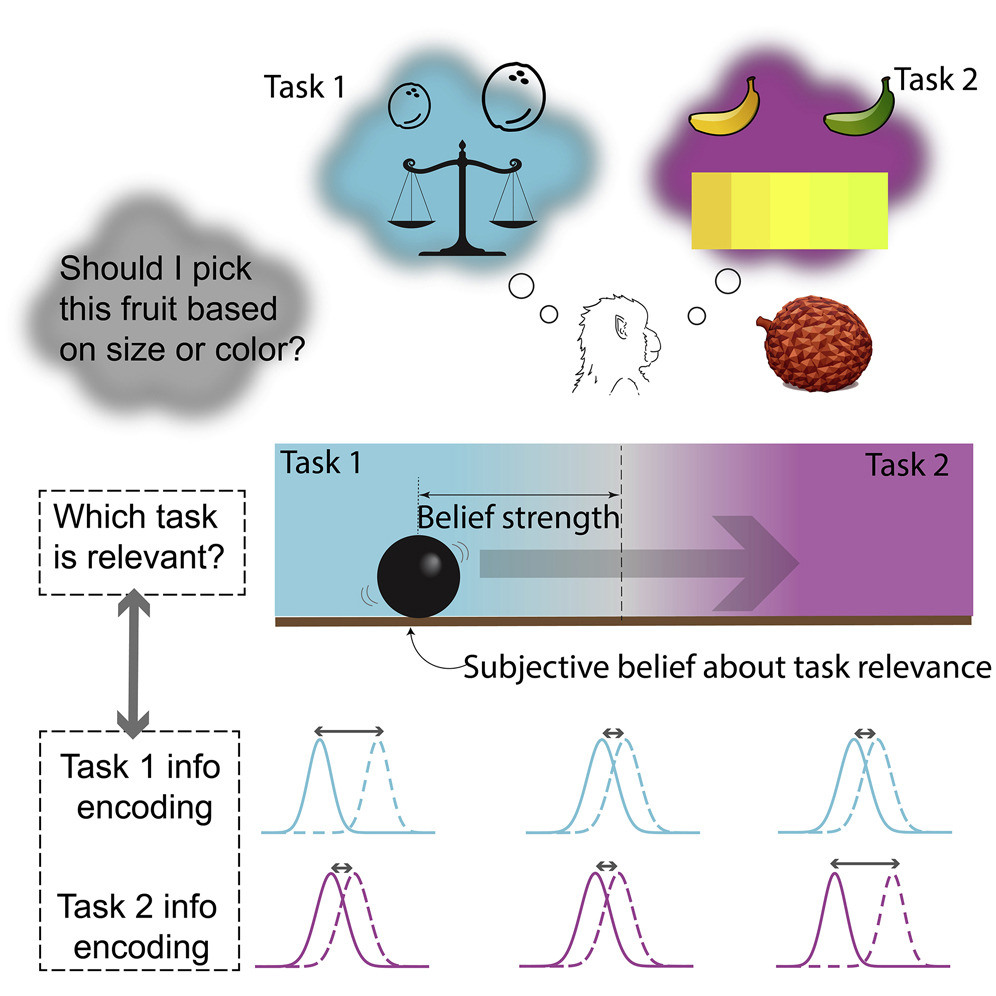
- We use neuronal activity to understand decision-making in uncertain task conditions
- Task switching and perceptual decisions are inextricably linked
- Stronger task-belief is associated with better perception of task-relevant features
- Fluctuations in visual cortex affect how task-beliefs are updated
Correspondingly, recordings from neuronal populations in cortical areas 7a and V1 revealed that stronger task-belief is associated with better discriminability of the believed-relevant, but not the believed-irrelevant, feature. Perception also impacts belief updating; noise fluctuations in V1 help explain how task-belief is updated.
The results demonstrate that complex tasks and multi-area recordings can reveal fundamentally new principles of how biology affects behavior in health and disease.
First, we demonstrated that fluctuating task-beliefs affect perceptual performance.
Using a combination of multi-neuron, multi-area physiology, complex but controlled behavior, and hypothesis-driven dimensionality reduction, we demonstrated that perception and task-belief are intimately intertwined such that weak task-beliefs are associated with poor perception of task-relevant information. This suggests that instead of a homogeneous mechanism such as arousal, task-belief strength is selectively associated with the processing of believed-relevant information.
Second, we demonstrated that fluctuations in perceptual decision-related neuronal activity affect belief updating.
This aspect brings new insights to the current knowledge about cognitive flexibility from studies using unambiguous stimuli, and therefore has very little perceptual involvement. Using perceptually challenging tasks is not only more realistic, but also offers powerful tools to investigate, manipulate, and quantitatively understand the specific neuronal process governing perception and belief updating. Our study demonstrates that incorporating these more natural behavioral features into well-controlled laboratory studies leads to important new insights.

