“Divergent Perception: Framing Creative Cognition Through the Lens of Sensory Flexibility”
“Savoir regarder est un moyen d’inventer.”
Salvador Dali.
Creativity is a cornerstone of human evolution and is typically defined as the multifaceted ability to produce novel and useful artifacts.
Although much research has focused on divergent thinking, growing evidence underscores the importance of perceptual processing in fostering creativity, particularly through perceptual flexibility.
The present work aims to offer a framework that relates creativity to perception, showing how sensory affordances, especially in ambiguous stimuli, can contribute to the generation of novel ideas. In doing so, we contextualize the phenomenon of pareidolia, which involves seeing familiar patterns in noisy or ambiguous stimuli, as a key perceptual mechanism of idea generation—one of the central stages of the creative process.
We introduce “divergent perception” to describe the process by which individuals actively engage with the perceptual affordances provided by ambiguous sensory information, and illustrate how this concept could account for the heightened creativity observed in psychedelic and psychotic states.
Moreover, we explore how divergent perception relates to cognitive mechanisms crucial in creative thinking, particularly focusing on the role of attention.
Finally, we discuss future paths for the exploration of divergent perception, including targeted manipulation of stimulus characteristics and the investigation of the intricate interplay between bottom-up and top-down cognitive processes.
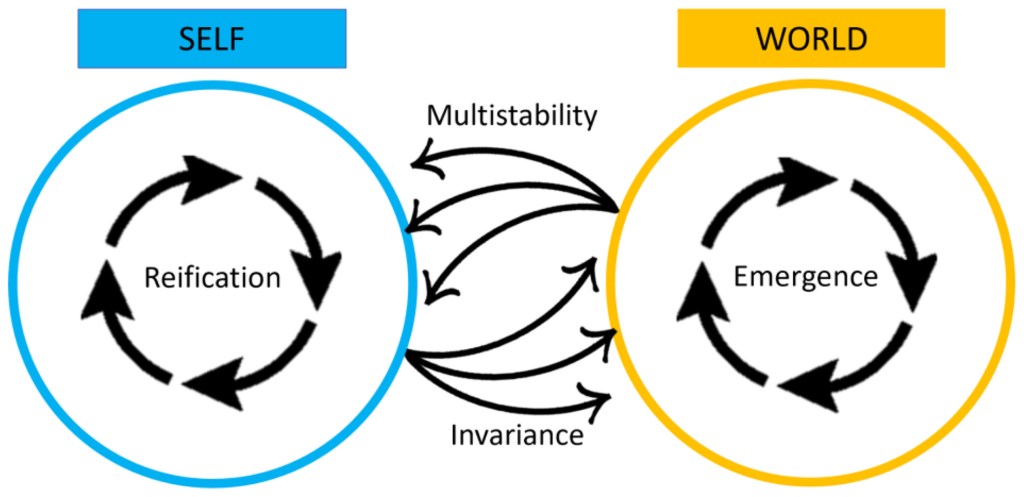
From the Gestalt perspective, ambiguity in physical stimuli acts as a fertile ground upon which imagination can project, catering to the human need for deriving meaning. This ambiguity is central to understanding creative perception. When presented with ambiguous stimuli, the brain is challenged to reconcile this uncertainty, often resulting in the synthesis of creative ideas by connecting disparate sensory information or elements of the perceptual experience. One way to measure the level of ambiguity in stimuli is by examining their multistable nature. It has been posited that multistable perceptions facilitate the emergence of meaning, which is known to build upon self-referential processes in cognitive systems. In support of this idea, a study utilizing the Rorschach inkblot task was conducted where participants attempted to discern cohesive images from ambiguous forms. Their ability to coherently perceive these forms showed a significant correlation with peer-rated creativity. Moreover, the ability to alternate between different versions of a multistable percept has been associated with divergent thinking. Interestingly, the origin of creativity was represented as an impression that a gap has to be filled, a sense of unfulfillment, which resembles the gap-filling mechanism characteristic of gestalt.
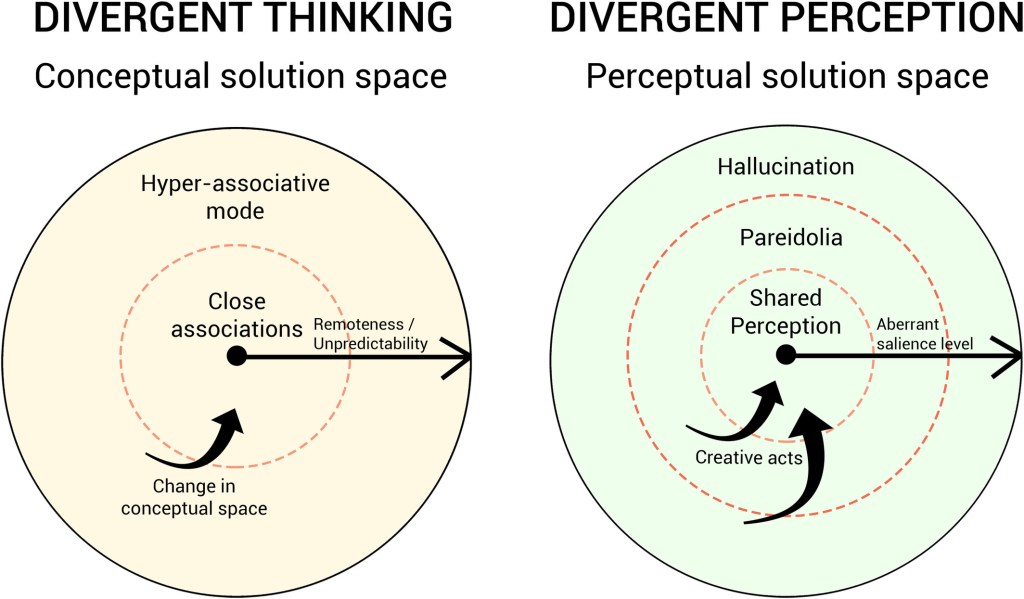
The “Perceptual Solution Space” represents the initial phase where sensory inputs are processed to generate multiple, flexible interpretations, setting the stage for subsequent cognitive processes involved in creative ideation.
The “Conceptual Solution Space” is where cognitive processes generate and refine ideas based on these initial perceptual interpretations.
The outward-moving arrow represents the divergent property. In the context of divergent thinking, this corresponds to increased remoteness of association, while for divergent perception, it relates to increased granularity of predictions and complexity in the sensory input (aberrant salience).
Conversely, the inward-moving arrows signify the restructuring of the solution space, either by transforming remote associations into closer ones or by incorporating phenomena like pareidolia and hallucinations into the collective perceptual domain through creative acts.
Divergent perception, much like divergent thinking, is fundamentally influenced by the dynamics of a variety of cognitive processes. Attention in particular can either broaden or narrow the perceptual field, and thereby influence the degree of novelty and unpredictability of the sensory input. A broadened attentional focus, associated with increased idea generation, allows for the processing of a wider range of sensory information. This, in turn, increases the potential for perceptual ambiguity. The relationship between attentional breadth and creativity appears to operate at a fundamental, perceptual level, where adjustments in attentional scope allow the cognitive system to align with specific task demands, actively facilitating perceptual reconfiguration and serving as a core component of divergent perception. More precisely, the ability to detect multiple pareidolic percepts (i.e., fluency) may be facilitated by flexible attention, which allows for focusing, disengaging, and shifting the attentional focus. Furthermore, the flexibility and originality of pareidolic percepts might benefit from enhanced capacities in remote association, which enables the formation of novel and diverse connections between ambiguous sensory inputs and stored memory concepts. Divergent perception refers to a process where complex sensory inputs are flexibly interpreted and recontextualized in novel ways through altered attentional states, leading to the formation of new perceptual connections that may not rely solely on internal concepts, thereby extending the scope of divergent thinking into the perceptual domain.
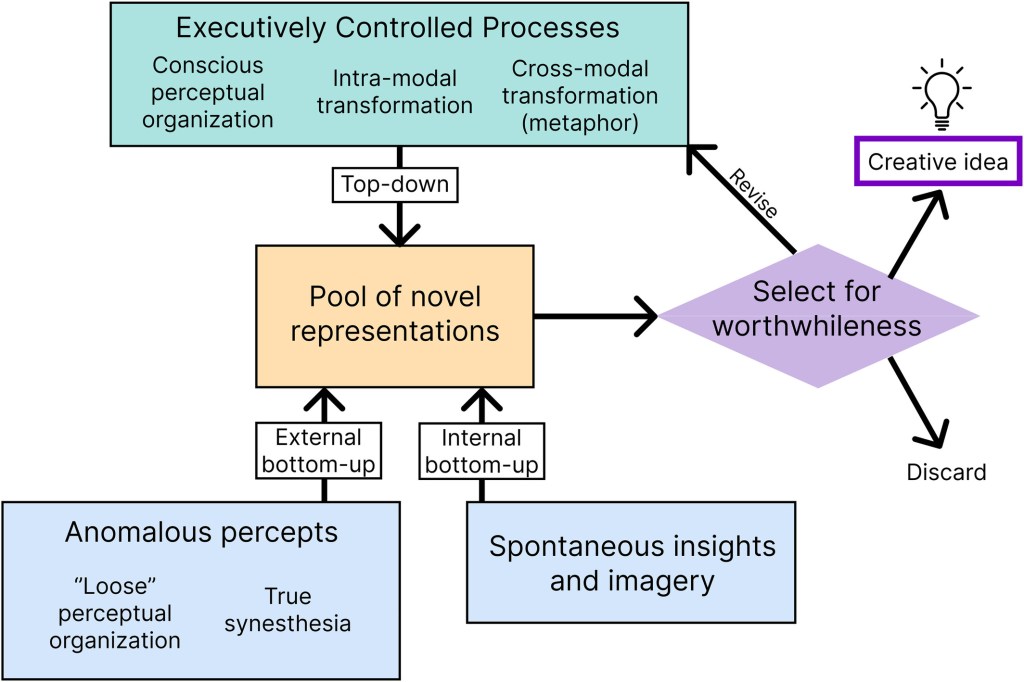
The figure depicts the interplay between cognitive processes and perceptual representations in creativity. “Anomalous Percepts,” being external bottom-up signaling, are the brain’s interpretations of ambiguous or unfamiliar external stimuli. “Spontaneous Insight & Imagery” represents internal bottom-up signaling, mediated by the default mode network (DMN), wherein ideas or images emerge without conscious effort. The transition to “Executively Controlled Processes” shows how these perceptions and insights are consciously organized, refined, or transformed. The “Pool of Novel Representations” can be seen as the brain’s playground for pareidolia—a space where ambiguous stimuli are interpreted and mixed together, leading to the generation of novel ideas. These representations are then assessed for their value, leading to their selection, revision, or discard, culminating in the formation of a “Creative idea.”
“divergent perception” is introduced as the perceptual analog to divergent thinking, which is predominantly linked with the exploration phase of the creative process. We proposed the “aberrant salience” mechanism to elucidate the common phenomenological experiences of altered perception found in both psychedelic states and psychotic episodes. Additionally, literature on brain networks related to psychedelics and creativity was synthesized to develop hypotheses regarding the neural networks underpinning divergent perception. Exploring the neural signatures linked to pareidolia and understanding how various stimulus attributes influence this phenomenon can also catalyze innovation in brain–computer interface (BCI) technology. Indeed, real-time manipulation of these stimuli could enable a new generation of BCIs, seamlessly integrating human cognition with technology to enhance creative ideation.

