
“Why friendship and loneliness affect our health”
Friendships play an especially important role in our lives, providing emotional and other sources of support as well as creating the communities on which our survival has depended.
Friendship is underpinned both by core areas within the brain and by β-endorphins.
Because β-endorphins have a number of direct beneficial effects on mental and physical health, loss of friendship and loneliness have significant adverse consequences.
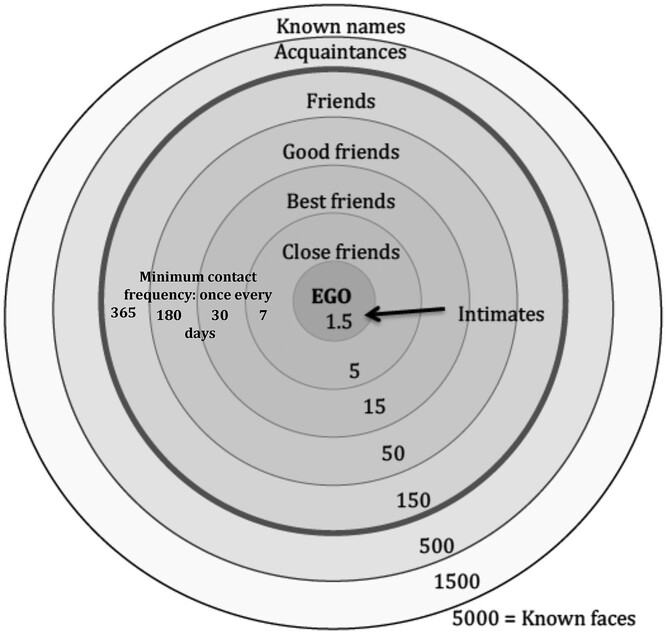
Schematic diagram of the layering present in human ego-centric social networks, illustrating the typical sizes (number of individuals) in each layer and the characteristic relationships involved.
The “Friends” layer of ∼150 demarcates the limit on the number of meaningful relationships (those that are reciprocated, have a history, and involve relationships characterized by obligation, altruism, reciprocity, and trust).
The layers within the 150 include both extended family and conventional friends.
Time spent interacting with individual members, and willingness to act altruistically toward them, decrease across successive layers. Beyond the 150-layer, relationships become more explicitly transactional, involve negligible social interaction, and are based on identity recognition rather than intimacy. Beyond the outermost layer at 5000, there are only strangers.
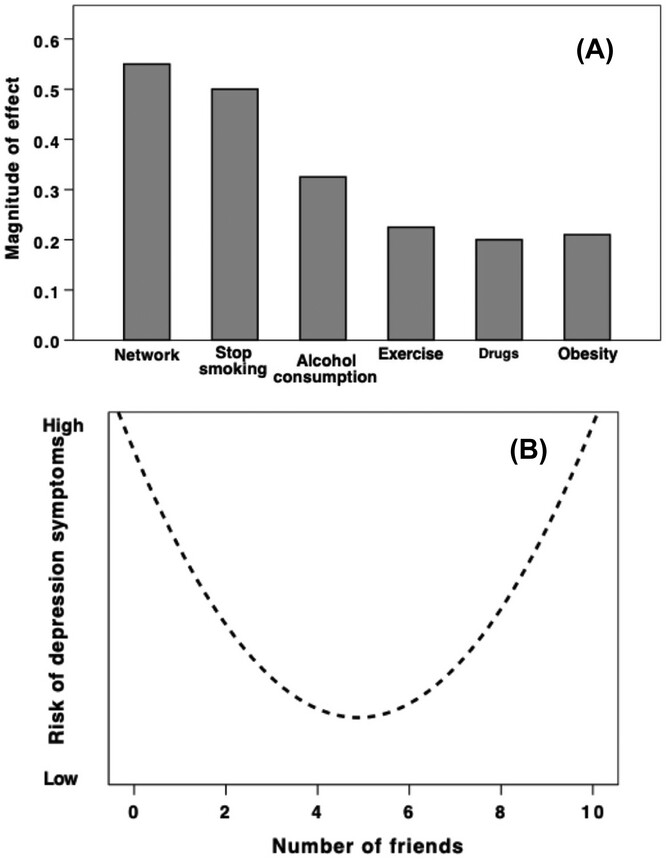
(B) Likelihood of developing symptoms of depression within 2 years as a function of the number of friends at the start, based on a prospective sample of 38,300 individuals (aged >50 years) from 13 European countries.
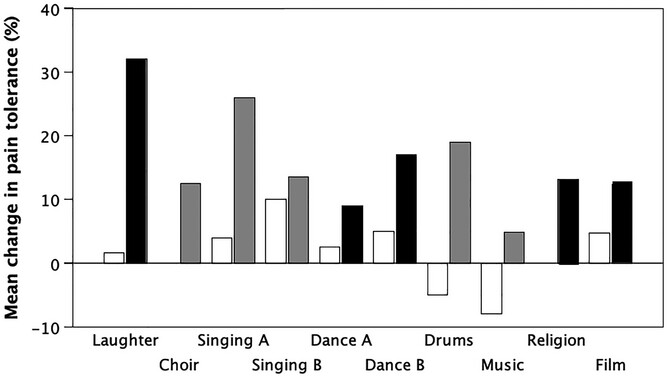
Black and gray bars: experimental activity; white bars: control condition. Black bars indicate studies where β-endorphin release was confirmed, either by PET-imaging or by naltrexone administration. Control conditions varied with activity (e.g., neutral video, nonsinging hobby class, gentle arm-movements while seated, listening to music rather than playing). Laughter (total of seven experiments: six in UK, one in Netherlands); Singing A and B (two separate experiments, one in UK and one in Netherlands); Dance A and B (two separate experiments, one in UK and one in Brazil); Music (listening to music with or without active head-nodding); and Film (tragedy video vs. factual documentary) were carried out in the lab; one of the laughter experiments and the Choir and Drums (drumming circle vs. passive listening) studies were carried out in natural settings (all in the UK). Pain tolerances were determined using the cold pressor task (frozen sleeve or ice bucket), cuff sphygmomanometer, or wall-sit task (Roman chair), all indexed by duration.

