
“Intelligent soft matter: towards embodied intelligence”
Intelligent soft matter lies at the intersection of materials science, physics, and cognitive science, promising to change how we design and interact with materials.
This transformative field aims to create materials with life-like capabilities, such as perception, learning, memory, and adaptive behavior. Unlike traditional materials, which typically perform static or predefined functions, intelligent soft matter can dynamically interact with its environment, integrating multiple sensory inputs, retaining past experiences, and making decisions to optimize its responses.
Inspired by biological systems, these materials leverage the inherent properties of soft matter such as flexibility, adaptability, and responsiveness to perform functions that mimic cognitive processes.
By synthesizing current research trends and projecting their evolution, we present a forward-looking perspective on how intelligent soft matter could be constructed, with the aim of inspiring innovations in areas such as biomedical devices, adaptive robotics, and beyond.
We highlight new pathways for integrating sensing, memory and actuation with low-power internal operations, and we discuss key challenges in realizing materials that exhibit truly ‘‘intelligent behavior’’. These approaches outline a path toward more robust, versatile, and scalable materials that can potentially act, compute, and ‘‘think’’ through their inherent intrinsic material properties—moving beyond traditional smart technologies that rely on external control.
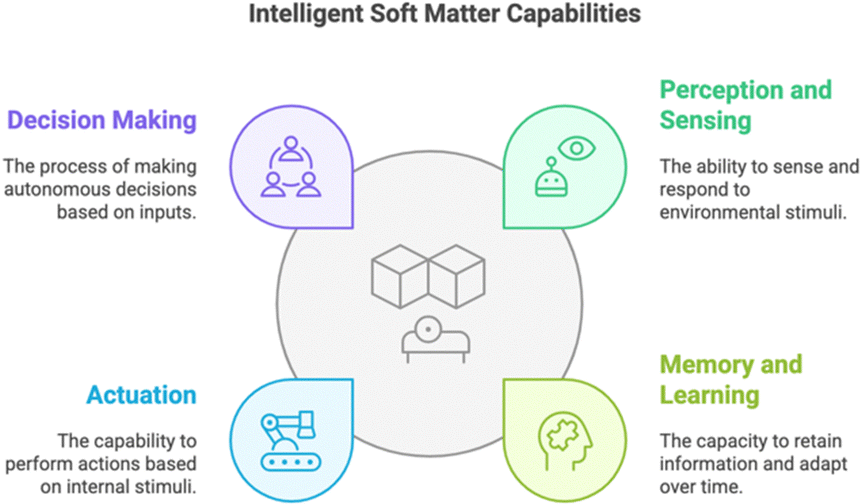
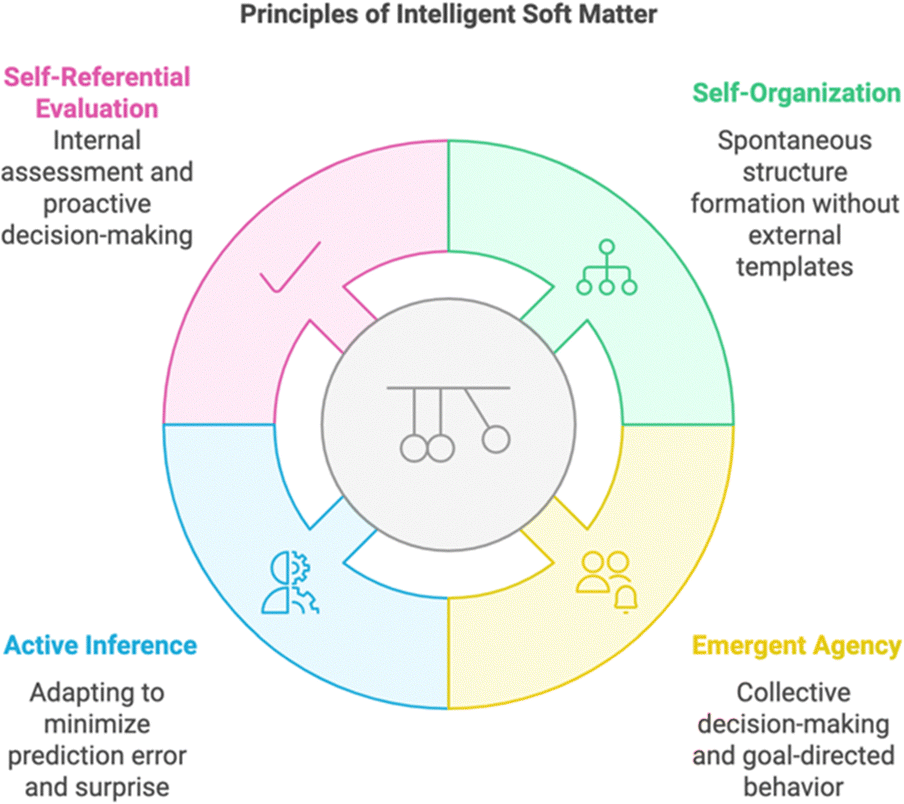
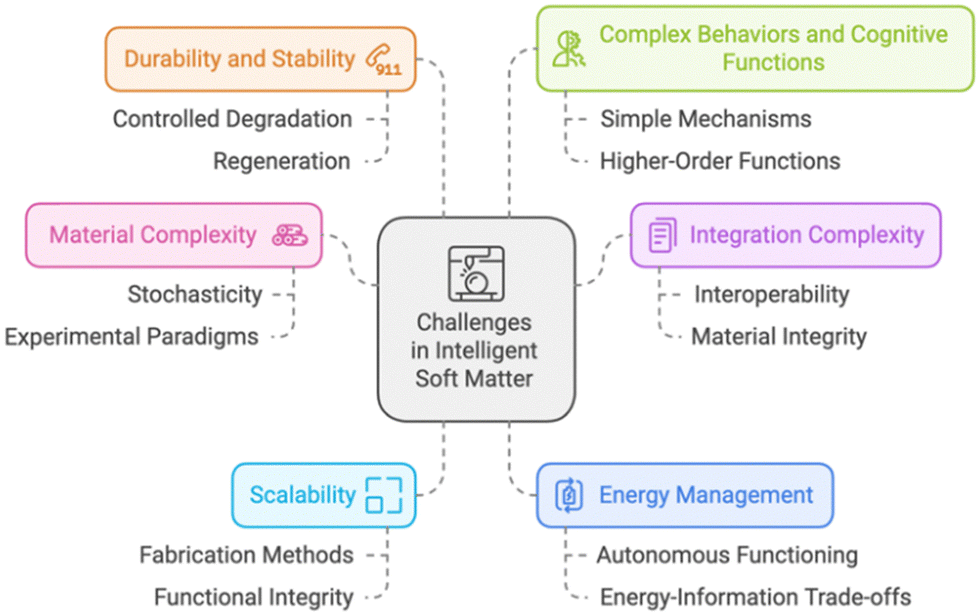
ISM is set to transform materials science, not only by integrating cognitive capabilities traditionally associated only with living systems, but also by introducing groundbreaking potential for autonomous, adaptive, and self-aware materials.
While current research predominantly focuses on macroscopic demonstrations of sensing, actuation, and memory, we invite the exploration of the unique opportunities that emerge at the nanoscale.We argue for a paradigm shift that embraces intrinsic stochasticity and fluctuations as integral design elements, propelling the development of intelligent softmatter capable of advanced functionalities by exploiting the huge numbers of interacting units available at the nanoscale.
Unlike traditional materials, ISM moves beyond passive responsiveness towards dynamic, evolving functionalities, either by mimicking the sophisticated behaviour of biological systems, or by embedding synthetic intelligence within the material itself.
The interplay of distributed processing, complex network topologies, and the inherentmaterial dynamics of intelligent soft matter establishes the foundation for novel computational paradigms and versatile sensing and actuation functionalities, with no analogues in traditional approaches. This form of distributed control, combined with non-linear system dynamics, unlocks the potential for self-learning and adaptation, enabling a variety of cognitive behaviours to emerge without the need for a central control or ‘‘brain’’.

