(This article discusses the bias in animal behaviour research, but – as known to most readers, I hope – humanes too are members of the animal kingdom 🙂
Biases in animal behaviour research are inevitable consequences of our societal and cultural standpoint.
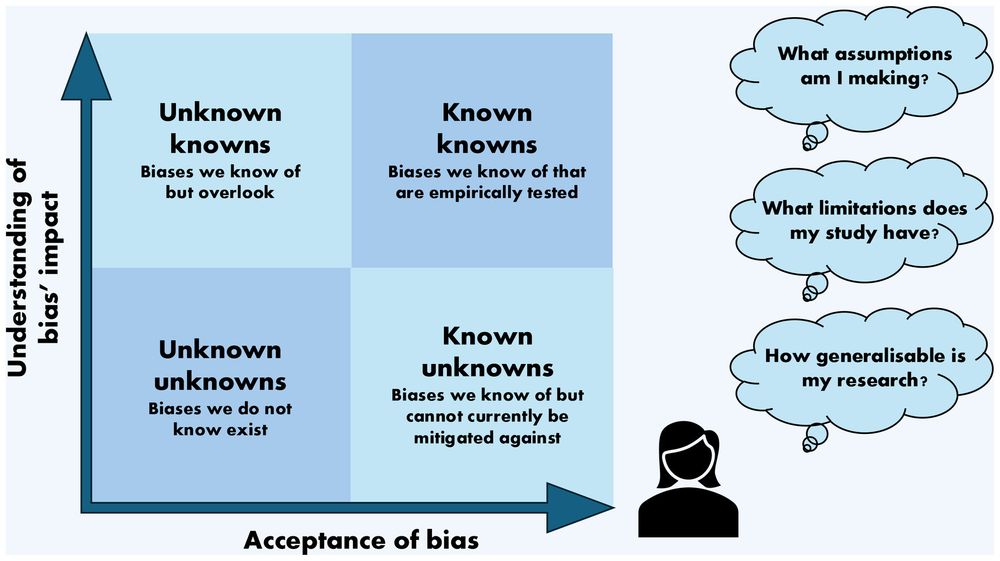
To remove our biases, the first stage is to identify them. We call on individual researchers to adopt a more active approach to addressing bias within their research. We propose that biases exist within a matrix defined by the general acceptance of a bias’s existence and the understanding of the impact this bias has on research outputs.
Borrowing from a conceptual framework previously applied to the study of biodiversity, our matrix consists of four categories: “known knowns” are biases we are aware exist and are empirically tested; “known unknowns” are biases we know of but have limits to being mitigated against; “unknown knowns” are biases which we know exist but are overlooked; and “unknown unknowns” are biases we are unaware exist.
Contextualising biases in this way, we believe, will lead to greater investment by individual researchers to locate and mitigate biases in their own research. To facilitate this process, we provide a set of self-reflective questions designed to help researchers critically evaluate the assumptions, limitations, and generalisability of their research.
By acknowledging and addressing biases within this framework, we move toward a more robust and trustworthy scientific process.
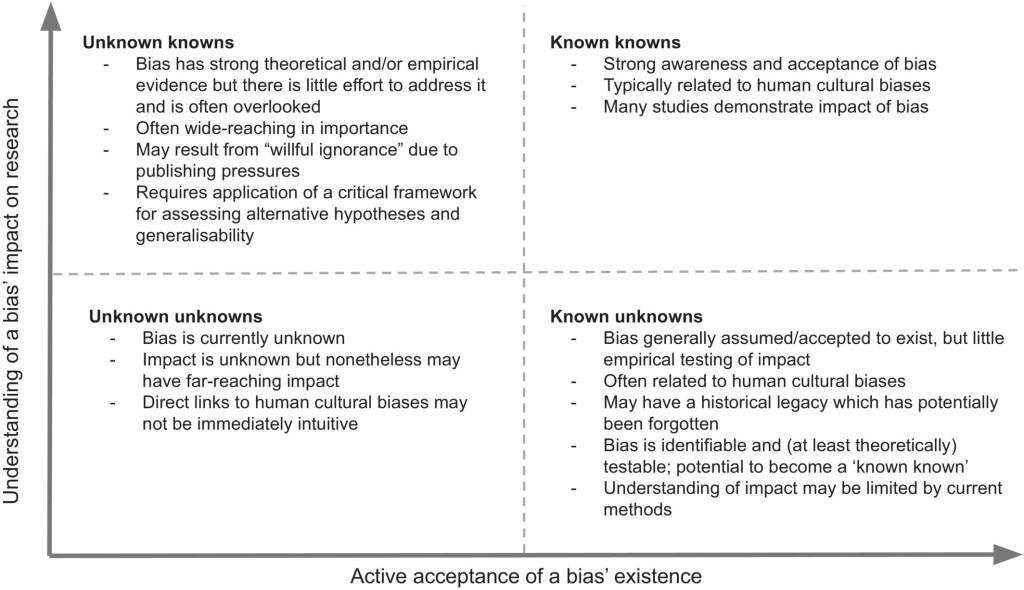
The framework is based on a matrix where (x) represents the level of acceptance that a bias exists and (y) represents the current understanding of the impact a bias is having on scientific research, and each combination describes the features of a bias located along each axis. The four categories can be interpreted as coordinates (x, y).
Biases are not static in the matrix framework proposed here. All biases are capable of becoming ‘known knowns’ with varying degrees of ease. Biases can move between categories, and it is the responsibility of all of us to ensure bias in our work moves towards becoming removed entirely, even if it is only able to currently be mitigated or acknowledged.
Importantly, we must be cautious of biases becoming stagnant with no effort to remove them from the academic process.
| Ideas for example | Testing for example | Explaining for example | |
| What assumptions am I making? | What is my justification for exploring this trait in the context I am studying it? | Am I exploring a trait in a context that is appropriate for the study organism/system? | Can my results be explained by an alternative hypothesis? |
| Is my personal standpoint influencing my expectations? | Have I made assumptions that limit my observations? | Is my interpretation of my results subject to confirmation bias? | |
| Could my methods be inadvertently exploring a different trait to what I think I am exploring? | |||
| Have I chosen appropriate methods/subjects to test my hypothesis? | |||
| What limitations does my study have? | Are any of the assumptions I have made limiting the scope or validity of my research question? | Is my methodology designed to reduce or account for bias? | Are there limitations in my methods, data or results that could be misinterpreted or be misleading? |
| Could I be missing alternative possibilities due to systematic biases (for example, publication bias) | Could my data be influenced by systematic biases? | Can I improve the accessibility of my research? | |
| Is my data subject to an assumption or limitation that I cannot rectify retrospectively? | |||
| How generalisable is my research? | Does my hypothesis reflect the generalisability of my idea? | To what extent do my methods allow me to generalise beyond the trait or organism being tested? | Have I made clear whether/how the trait is likely to vary in a different context/species? |
| Is the generalisability of my research impacted by taxonomic or geographical bias? | Is my methodology repeatable for other systems or species? | ||
| Does my sampling approach allow me to generalise to the level I require? |
Acknowledging the limitations of our own objectivity, and recognising that all existing knowledge within animal behaviour research may be influenced by known and/or unknown biases, should lead us to act with deliberate caution when designing and conducting our studies, and interpreting our findings. Furthermore, we should be transparent about the limitations of our research when reporting findings, being careful not to overstate results or the generalisability of the research.
Our framework (Figure) and self-reflective questions (Table) we hope will enable researchers to be more mindful of potential biases in their own research. Although this paper focuses on biases in animal behaviour research, many biases, such as sampling limitations, observer bias, and publication bias, are also common in other fields of research. Evaluating the assumptions, limitations, and generalisability of our work can be applied more broadly to other fields and all researchers. Regardless of discipline, researchers should consider how biases might impact their own research. Adopting an active approach to locating and mitigating bias will lead to a research culture of continuous improvement, creating a transparent and trustworthy scientific process.

