
“Origins and Evolution of Imagination, From Australopithecus to Modern-Day Deep Learning”
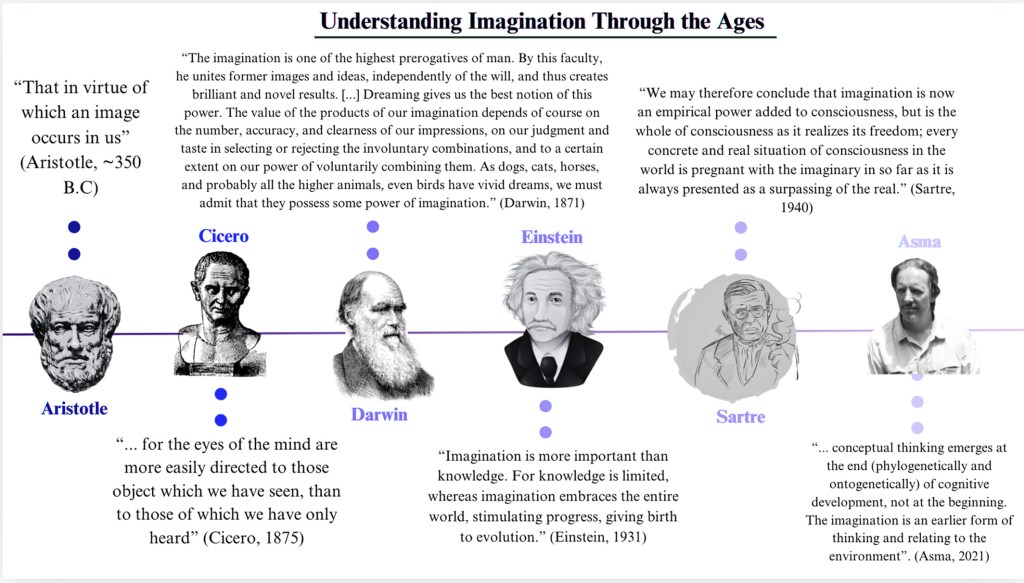
Where does imagination come from?
How did it originate, and which organisms are capable of imagination?
What deeper connections does imagination share with consciousness, survival, and the very essence of life?
Across both scientific literature and public discourse, imagination is invoked to describe a wide range of phenomena, including artistic creativity, problem solving, symbolic thought, and mental imagery, much like the concept of consciousness, whose interpretation varies across theoretical perspectives.
This conceptual breadth motivates the need for a more precise theoretical specification of imagination. In this Perspective, we update and extend prior work that formally specifies imagination as imaginative generativity (IG), a transdisciplinary theoretical construct describing the generative process through which organisms produce novel multisensory imaginings. Through IG, organisms can anticipate potential changes and challenges in their environments and guide internally guided actions. This generative capacity supports adaptive behavior that may extend beyond immediate individual survival to influence species-level development.
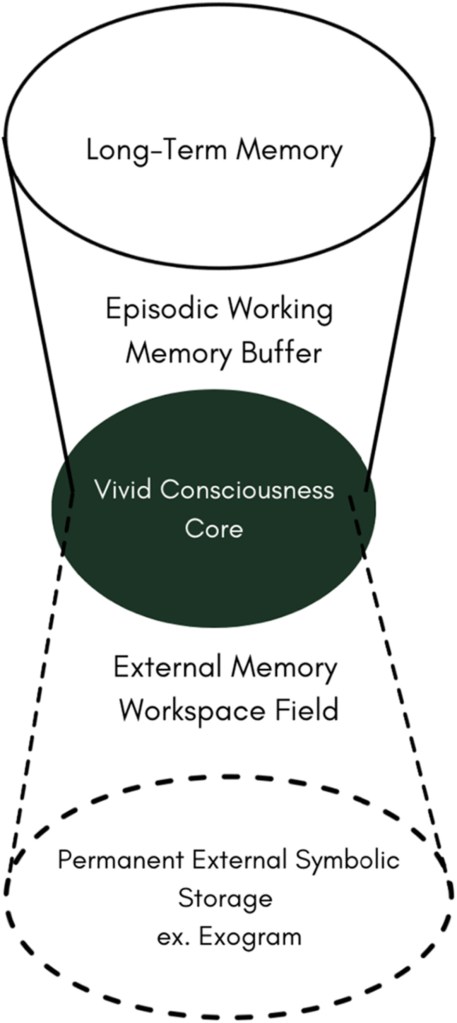
The formal extension developed in this paper involves identifying the functional characteristics that distinguish imaginative/IG processes from related representational mechanisms such as vivid representing and mental imagery. Relative to our previous IG formulation, the present paper makes three specific contributions: it clarifies the distinction between vivid representing (VR) and imaginative generativity (IG), situates that distinction within an evolutionary and archaeological account of representational change, and uses contemporary AI systems as comparative cases for identifying restricted functional analogues of IG in the absence of reflective, self-awareness.
The synthesis we offer uses the language of epistemology as an organizing infrastructure for the development of transdisciplinary theory.
While imagination is intuitive, its study demands careful dismantling and re-examination of the underlying assumptions and grounding.
Precedents for this methodology exist within psychology and consciousness studies; however, we additionally offer an integrative review to garner supporting evidence across neuroscience, biology, and cognitive science to refine contemporary understanding of imaginative processes and their relationship to cognition and consciousness.
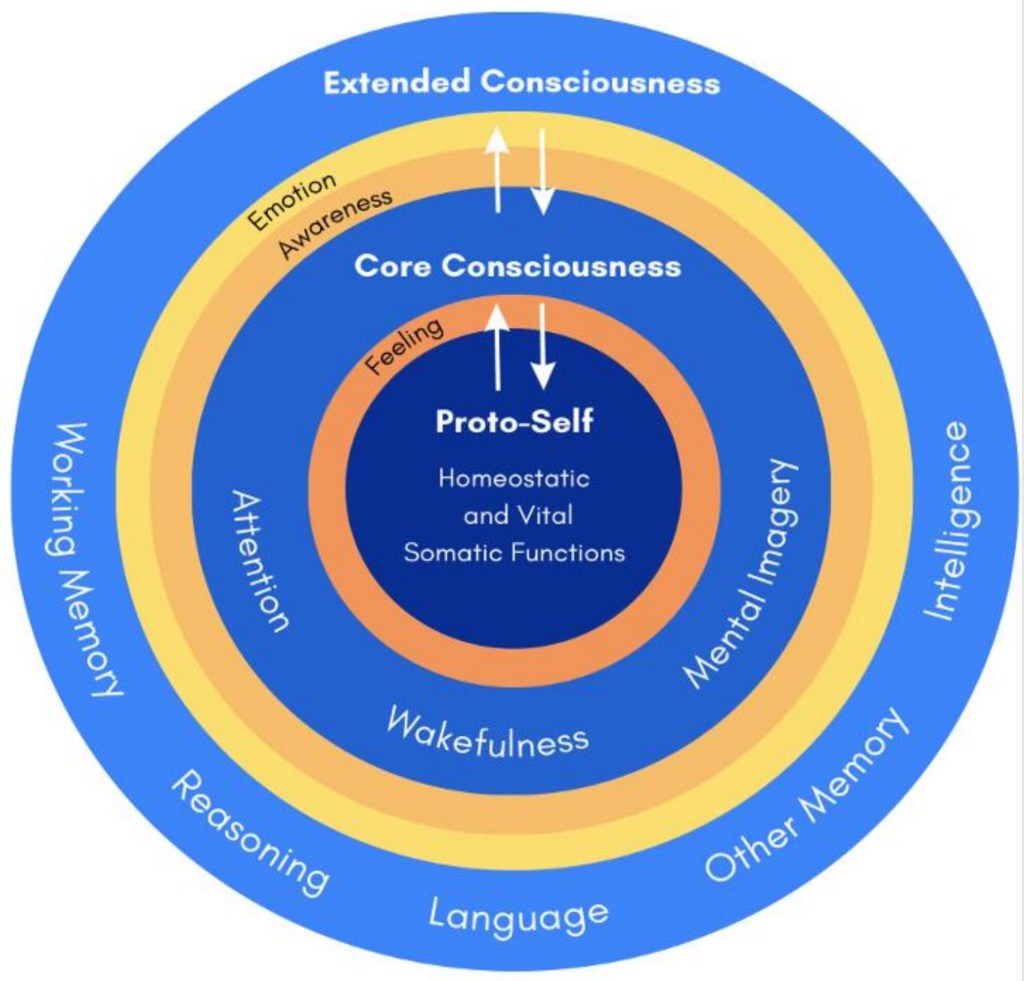
This perspective makes three main contributions. First, it distinguishes imaginative IG from VR, treating VR as a representational basis and IG as the novel generative transformation of representations. Second, it integrates archaeological and evolutionary evidence into a gradual account of how these capacities expanded across hominin history. Third, it uses contemporary AI as a comparative case to isolate which representational operations may be functionally IG-like while remaining non-conscious. On this basis, imagination is best understood as a central generative capacity that develops together with, rather than independently from, consciousness. Evidence from neuroscience, archaeology, and evolutionary theory suggests that imaginative processes have expanded alongside the increasing complexity of cognitive systems. Within this framework, imagination appears closely intertwined with the emergence and elaboration of consciousness. Rather than one strictly preceding the other, imaginative capacities and conscious awareness likely developed through mutually reinforcing evolutionary dynamics.
Understanding imagination as a generative and adaptive process also provides a useful lens for examining representational mechanisms in artificial systems. Although current AI lacks self-consciousness, its generative architectures offer valuable comparative models for exploring how imaginative processes may arise from complex information-processing systems, including the contingent limitations in levels of imagination which might drive its generativity. Taken together, this perspective positions imagination not as a secondary feature of cognition, but as a central generative capacity shaping the evolution of minds, cultures, and intelligent systems.

