
“Structure Inference in Complex Environments Improves From Childhood to Adulthood” also available on website of Aaron M. Bornstein.
Early in development, children can infer latent structure in the world from sparse and ambiguous evidence.
Through a process known as structure learning, they extract statistical regularities, construct causal models from those regularities, and use those models to arbitrate between exploiting known options and exploring novel alternatives.
In turn, each decision and its outcomes refine the model that produced them. Despite the clear reciprocal relationship between structure learning and decision-making in the real world, developmental research has largely examined these processes separately.
To address this gap, we compared how children, adolescents, and adults behaved in a patch-foraging task designed to reveal how structure learning shapes exploratory decisions in a richly structured, dynamic environment.
We found that younger participants left patches sooner than adults, enabling them to explore the environment more broadly within the fixed time window of the study.
Computational modeling demonstrated that this difference in exploration arose from differences in participants’ causal models of the environments. Younger participants grouped all patches into a single category despite large differences in richness, whereas older participants separated them into distinct categories. Despite differences in representation, participants of all ages used their uncertainty about the environment to guide their decisions. Together, our findings suggest that structure learning undergoes protracted development, but uncertainty-sensitive decision-making emerges earlier and can support adaptive behavior even when representations remain imprecise.
Summary
- Children and adolescents formed less granular representations of environmental structure than adults.
- Despite these imprecise representations, younger participants showed adult-like sensitivity to uncertainty, planning further ahead when more confident in their internal models of the environment.
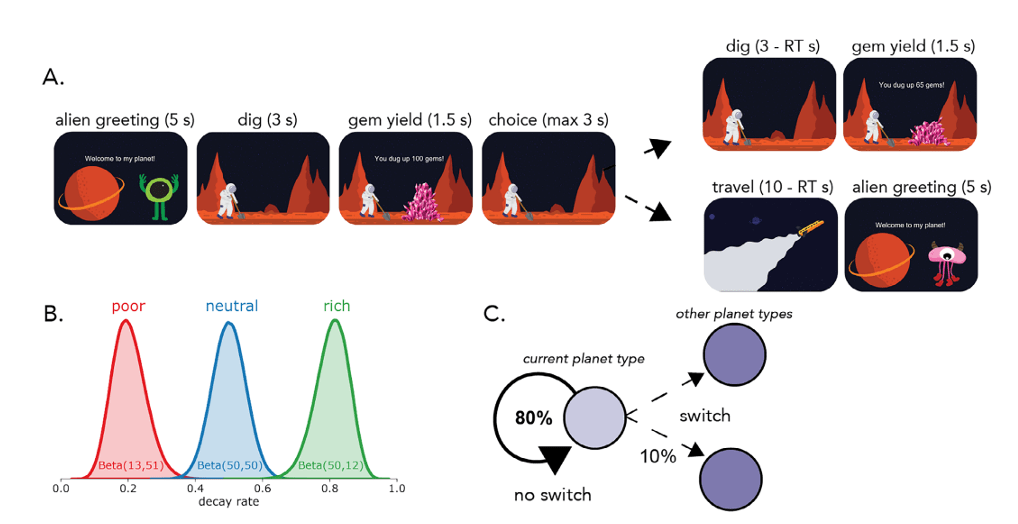
(B) Environment structure. Planets belonged to one of three types—poor, neutral, or rich–differing in how quickly they depleted as mined. Each type was characterized by a distinct distribution over decay rates.
(C) Environment dynamics. Planet richness was correlated in time. A new planet had an 80% probability of being the same type as the previous planet (“no switch”) and a 20% probability of transitioning (“switch”) to a different type.
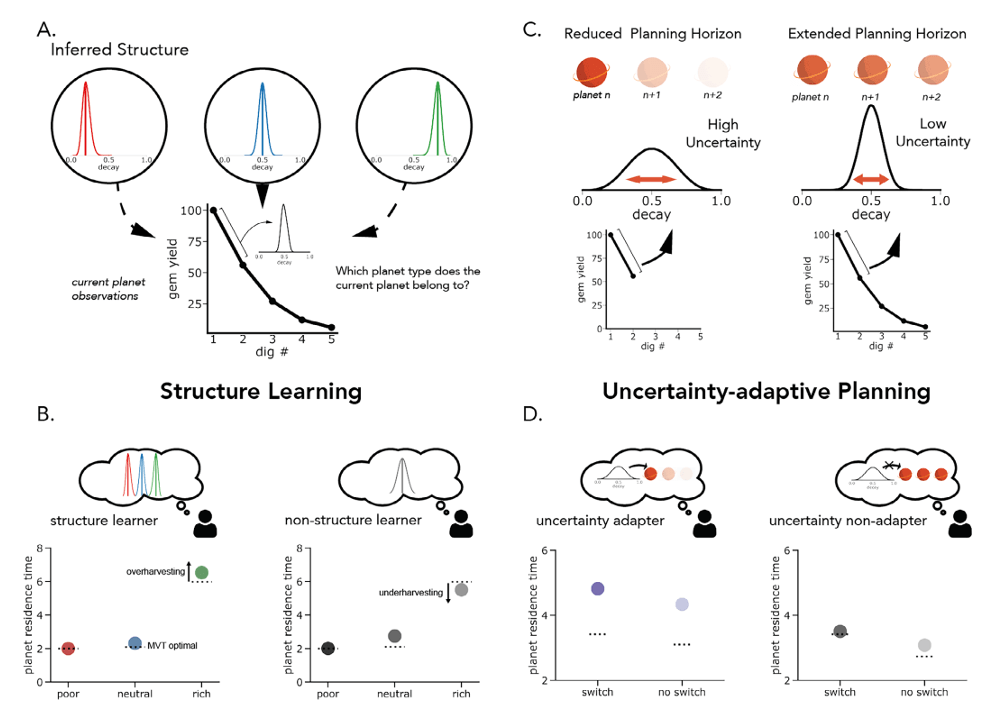
(B) Structure learning predictions. The forager’s inference of planet types is governed by the parameter, α. The model predicts distinct patterns of over- and underharvesting depending on the forager’s representation of the environment and the number of planet types they consider. The non- structure learner’s behavior is simulated with α = 0 and the structure learner’s behavior is simulated with α = 0.2. The markers show model-simulated planet residence times (PRTs), while dotted lines indicate the Marginal Value Theorem (MVT)-optimal PRTs for reference.
(C) Uncertainty adaptive planning computation. Foragers adjust their planning horizon based on their uncertainty about the current planet’s type. Less uncertainty encourages planning further into the future, while more uncertainty discourages planning. We modulate the planning horizon through adjusting the extent future rewards are discounted.
(D) Uncertainty adaptive planning predictions. Foragers whose planning incorporates their uncertainty should overharvest more when the planet type switches, because these switches are rare and uncued and so should, on balance, increase local uncertainty. In contrast, foragers who do not incorporate uncertainty into their planning (or who do not detect the change) should overharvest to a similar extent regardless of whether the planet type has changed.
Children can discover latent structure that adults cannot, often in cases where the structure is unusual. This advantage has been attributed to children’s broader exploration.
Although children in our task did explore more broadly, leaving patches sooner, this did not provide them with more veridical representations of the environment. One possibility is that broad exploration is not well-suited to structure discovery in every environment. Under standard definitions, exploratory actions are those that sacrifice immediate reward to gain information. In patch foraging tasks, remaining longer under uncertainty fits this definition. Doing so allows learners to gather additional observations that refine estimates of local depletion rates, even as it entails deviating from the reward-maximizing behavior prescribed by the Marginal Value Theorem.
Importantly, different forms of exploration may support learning about differ- ent aspects of the environment. Leaving patches sooner provides the opportunity to explore a greater number of patches, improving the forager’s estimate of the global reward rate. Staying longer, meanwhile, refines knowledge of local patch dynamics.
Both are forms of exploration but ones operating at different scales. Leaving sooner is a form of broad exploration while leaving later, though often interpreted as over-exploitation, may in fact be a form of deep exploration. Developmental differences in the balance between these exploratory strategies could provide one potential explanation for why foragers of different ages may acquire different forms of structural knowledge.
Through computational modeling, we inferred how participants represented the environment.
Notably, children’s broader exploration did not confer a structure-learning advantage in this task. Instead, adults’ tendency toward deep exploration supported structure inference.
These results point toward a more nuanced view of developmental differences in not only structure learning but also exploration.

