“Beyond attention: performance pressure shifts information-processing complexity”
Why does performance pressure sometimes cause choking but sometimes elicit exceptional performance?
We propose that pressure shifts the complexity of information-processing rules that guide action.
Performance improves when shifts move processing toward task-matched complexity and deteriorates when they promote maladaptive simplification, overcomplexification, or the use of rules that exceed available processing resources.
Performance pressure (see Glossary) is a feature of many important situations in life. Across contexts, people must perform skilled actions when outcomes are consequential and evaluation is salient. Sports provide vivid illustrations of this phenomenon with strikingly diverse outcomes: In one moment, a football penalty kick sails wide or a tennis player double-faults at match point. In another, a gymnast completes a perfect routine or an athlete delivers a personal best precisely when the stakes are highest. This dual possibility of failure and success under pressure is a challenge for theory and matters when preparing people for high-stakes situations.
Existing theories explain how attentional misallocation can impair performance and recognize that pressure can prompt performers to invest additional cognitive effort that, in some circumstances, maintains or even improves performance.
Yet effort alone cannot explain performance outcomes, because its consequences depend on how processing changes. Competing accounts emphasize opposite attentional shifts—either away from task-relevant information or toward normally automatized processes.
Yet both accounts have received empirical support, leaving unresolved how pressure changes information processing and why these changes sometimes produce choking and sometimes clutch performance. We propose that reframing these effects in terms of shifts in information-processing complexity can reconcile seemingly opposing findings and provide new insights into this long-standing debate.
Recent action-oriented decision research shows that rule use is tuned to task constraints, cognitive costs, and uncertainty.
We propose that pressure affects performance by shifting the information-processing complexity relative to task requirements. Pressure impairs performance when it shifts processing away from task-matched complexity and improves performance when it shifts processing toward it. Pressure, therefore, does not simply alter what information receives attention; it changes how selected information is integrated to guide action.
The notion of task-matched complexity builds on the bias–variance trade-off, a principle widely used in decision-making research to explain why simple rules can sometimes outperform more complex strategies under uncertainty, and that has been recently extended to action control.
Bias reflects systematic error: a rule produces the same kind of deviation because relevant information is omitted or underweighted.
Variance reflects instability: performance is sensitive to noise or unreliable implementation.
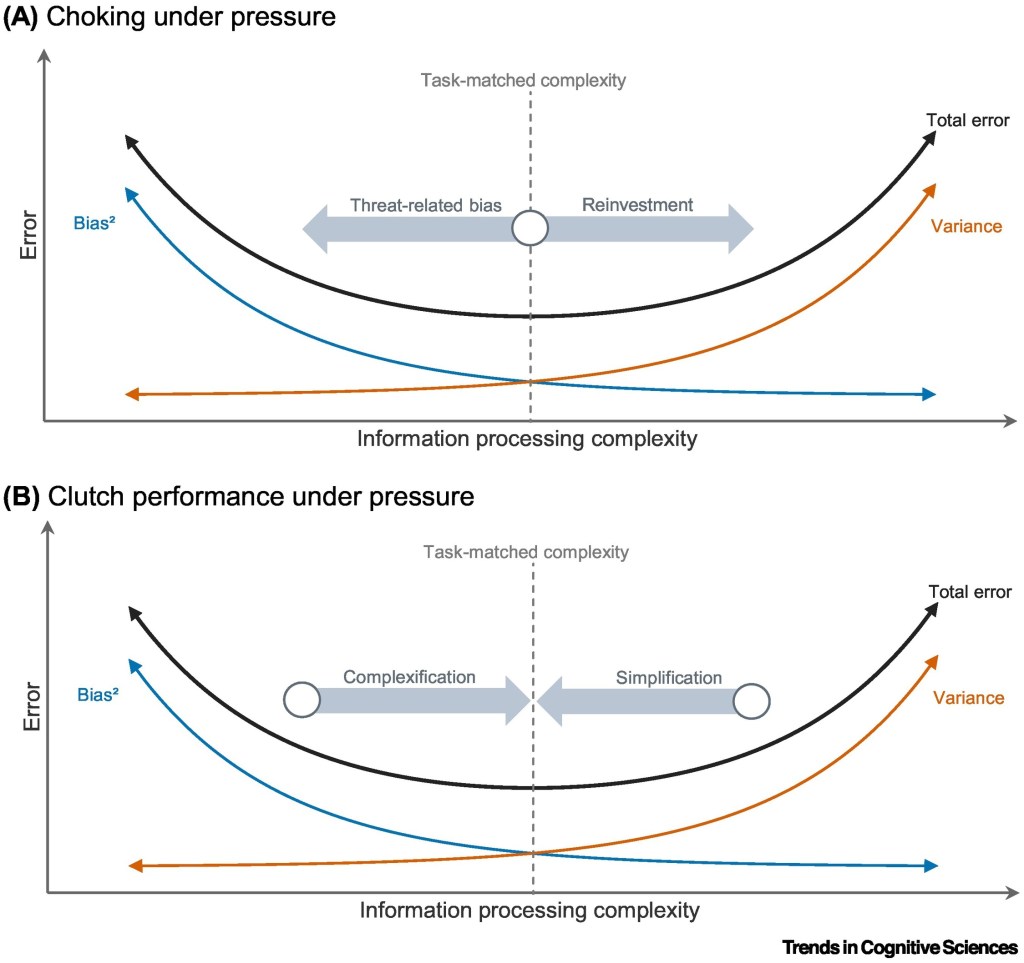
Skilled performance can be described in terms of information processing, with the complexity of the processing determining the trade-off between systematic error and sensitivity to noise. Within this bias–variance framework, total error (black line) combines squared bias (blue line), variance (orange line), and irreducible error and is lowest at task-matched complexity (dashed line). Bias is squared to remove the error direction and match variance. Pressure shifts information-processing complexity relative to task-matched complexity.
Choking (A) occurs when pressure shifts information processing away from task-matched complexity, toward oversimplification (leftward shift; e.g., threat-related biases) or overcomplexification (rightward shift; e.g., reinvestment.
Clutch performance (B) occurs when pressure shifts processing toward task-matched complexity by increasing overly simple processing (rightward shift; e.g., compensatory effort) or by reducing overly complex processing (leftward shift; e.g., strategic simplification).
In general, overly simple rules that use too little information may reduce variance but at the cost of greater bias. For example, a penalty taker in football who always aims at a preselected corner uses a simple, consistent rule but systematically ignores useful goalkeeper information, producing low variance but potentially high bias.
Conversely, an overly complex rule that considers too much information (e.g., the goalkeeper’s position, movement, and prior tendencies) can reduce bias, but, because these cues are noisy, they increase variance. Best performance is therefore supported by task-matched rather than minimal or maximal complexity, which represents the ‘sweet spot’ where bias and variance are at their lowest.
Because variance also depends on how reliably a performer can implement a given rule—for instance, as a function of processing capacity or skill level—task-matched complexity is jointly shaped by task and performer.
Understanding pressure as a shift in information-processing complexity changes the question from whether pressure disrupts attention to which rules performers use, how pressure changes those rules, and whether this improves their fit to the task.
This perspective also reframes preparation for high-pressure situations. Interventions should not universally prescribe simplification or complexification but should identify and train rules that fit task demands and can be implemented reliably when performance matters most.

